
Trolley
You have no items in your shopping cart

 Budgets
 Dumbers
 Discs
Discs
 Benches
 Racks and Rigs
 Weights Holders
 Isotonic machines
 Calisthenics
 Cardio
 Kettlebells
 Flooring
 Gym Set
 Accessories
 Combat
 ARTI MARZIALI
 CONTAINER GYM
 Tug-Of-War
 Used Gym Equipment
 PILATES MACCHINARI
 GINNASTICA ARTISTICA
 CAMPI DA PADEL
 Prodotti in Pronta Consegna
 Informazioni
 IRONMAN
 Gift Card
- Donatif
- General information
- 0 I like it
- 74 Views
- 0 comments
- gym flooring, safety flooring, gym safety, shock-absorbing materials
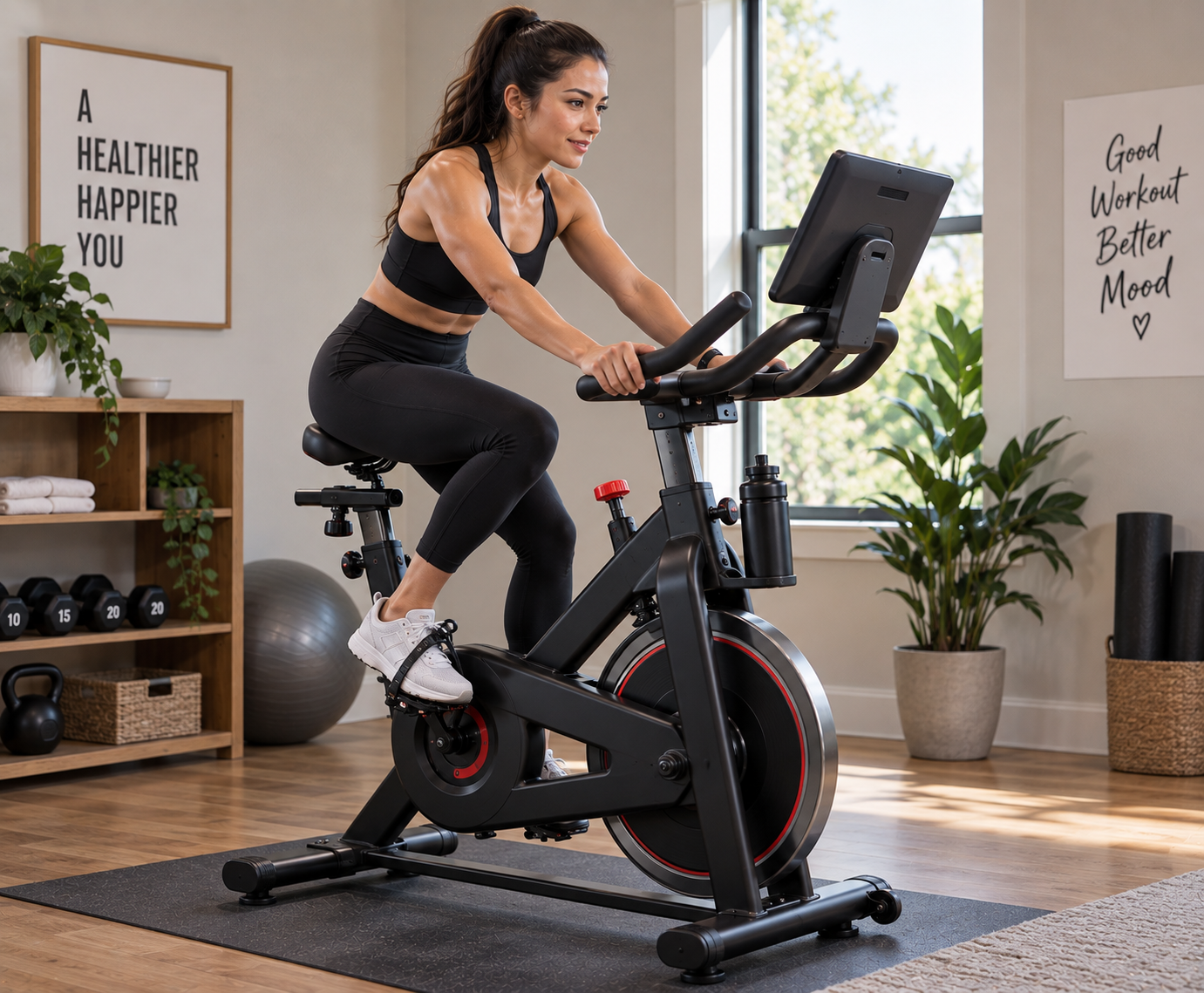
Professional vs. Home Exercise Bike: Differences, Benefits, and Selection Criteria
Choosing a professional exercise bike or a home model means evaluating the context of use, frequency of employment, and the characteristics required by the environment where it will be installed. Although both types allow for cardiovascular workouts, they are designed for very different needs.
An exercise bike intended for a gym, hotel, or fitness center must sustain continuous use by numerous users, guaranteeing reliability, ergonomic adjustments, and ease of maintenance. A home model, on the other hand, is normally designed for private use with lower frequency.
This guide compares the two categories through verifiable technical criteria, highlighting the main differences, the most appropriate usage scenarios, and the elements to evaluate before purchase.
- Quick answer
- What are the main differences
- How usage changes
- Which criteria to use in the choice
- Errors to avoid
- Safety and maintenance
- Comparison table
- How to evaluate the investment
What is the difference between a professional and a home exercise bike?
The main difference concerns the intended use. A professional exercise bike is designed to withstand intensive and continuous use in shared environments, while a home machine is generally used by a limited number of people with lower frequency.
Before making a choice, it is advisable to compare build quality, availability of spare parts, technical assistance, adjustments, maintenance, and documentation provided by the manufacturer.
Evaluating the total cost of ownership allows you to identify the solution best suited to the needs of the facility while avoiding comparisons based exclusively on the initial price.
What is the first criterion to consider?
The context of use represents the main element because it determines the characteristics required of the machine.
Why is durability important?
Equipment intended for intensive use should maintain constant performance even during many hours of daily use.
What are the main differences?
The differences concern design, robustness, ergonomics, and operational management. A professional machine is developed to cope with a high number of use cycles and allow frequent adjustments by different users.
Home versions may prioritize needs related to personal employment and less intensive use.
Before purchasing, it is also advisable to compare the availability of technical assistance and spare parts, elements that directly affect operational continuity.
How does the structure change?
Professional models are generally designed to cope with more demanding and continuous usage conditions.
Why do adjustments matter?
Wide adjustments make it possible to quickly adapt the machine to users with different physical characteristics.
How does usage change between a home and professional environment?
A commercial gym can host numerous users throughout the day, requiring equipment designed for continuous employment.
In a home environment, the machine is normally used by one or a few users and with a generally lower frequency.
This difference influences the choice of components, scheduled maintenance, and the support methods provided by the manufacturer.
Why does continuous cardio matter?
Repeated use throughout the day requires machines designed to guarantee operational continuity and reliability.
What role does warm-up play?
In many professional facilities, the exercise bike is used both for cardio workouts and as a preparation phase for other activities.
Which criteria to use in the choice?
A complete evaluation should include build quality, weight capacity, resistance system, ergonomic adjustments, technical assistance, and availability of spare parts.
It is advisable to request technical sheets, manuals, and documentation related to maintenance to compare models using verifiable data.
To design a complete cardio area, you can also evaluate other professional cardio machines to offer different training methods to users.
Why check weight capacity?
The capacity declared by the manufacturer represents an important technical parameter to verify the suitability of the machine with respect to the intended users.
How much do assistance and spare parts matter?
Good organization of technical support helps reduce downtime and facilitates long-term management.
Which errors are best avoided?
One of the most frequent errors consists in choosing a home machine for continuous use in commercial environments without evaluating the design differences between the two categories.
It is also advisable to avoid comparisons based exclusively on the initial price while neglecting maintenance, assistance, and the availability of spare parts.
Underestimating the needs of users and the facility can also lead to a choice inconsistent with the intended use.
Why is price not enough?
The total cost also includes maintenance, availability of spare parts, operational continuity, and equipment management over time.
Why respect the intended use?
Each machine is designed for specific operational contexts that should be considered during the choice.
How do safety and maintenance impact?
Scheduled maintenance makes it possible to maintain high performance and reduce the risk of breakdowns during use.
Following the instructions contained in the manufacturer's manual represents the main reference for planning periodic checks and interventions.
The availability of spare parts constitutes an additional element to consider when the machine is intended for professional employment.
What checks to schedule?
Periodic checks of adjustments, components subject to wear, and the general state of the machine according to what is provided by the manufacturer.
Why check the availability of spare parts?
Good availability facilitates maintenance interventions and reduces downtime.
Comparison between professional and home exercise bikes
| Characteristic | Professional | Home |
|---|---|---|
| Intended use | Gyms, hotels, fitness centers | Homes |
| Usage | Continuous and shared | Personal |
| Adjustments | Designed for different users | Suitable for private use |
| Assistance | Fundamental element of evaluation | To be verified according to the manufacturer |
| Spare parts | Important for operational continuity | To be evaluated based on the model |
| Maintenance | Programmable according to the facility's plan | Generally linked to domestic use |
How to compare two models?
A checklist based on technical characteristics, documentation, adjustments, assistance, and maintenance allows for an objective comparison.
What documents to request?
Technical sheets, user manuals, warranty conditions, and information on maintenance represent a useful basis for evaluation.
How to evaluate the long-term investment?
The choice of the professional exercise bike should be guided by the operational context and not exclusively by the initial cost. Evaluating durability, assistance, maintenance, availability of spare parts, and technical characteristics allows for a more conscious choice.
Comparing professional and home models means analyzing different needs rather than identifying a universally better solution. In fact, each category responds to specific usage scenarios.
Requesting official technical documentation and verifying the manufacturer's instructions represents the most reliable method to make an evaluation consistent with the facility's objectives.
Can a home exercise bike be used in a gym?
Before using it for commercial purposes, it is necessary to verify that the manufacturer provides for its use in the desired operational context and consult the relative technical documentation.
What is the most important criterion in the choice?
The correspondence between the machine's intended use, expected intensity of use, and the operational characteristics of the facility represents the starting point for an informed choice.
Comments (0)