
Trolley
You have no items in your shopping cart

 Budgets
 Dumbers
 Discs
Discs
 Benches
 Racks and Rigs
 Weights Holders
 Isotonic machines
 Calisthenics
 Cardio
 Kettlebells
 Flooring
 Gym Set
 Accessories
 Combat
 ARTI MARZIALI
 CONTAINER GYM
 Tug-Of-War
 Used Gym Equipment
 PILATES MACCHINARI
 GINNASTICA ARTISTICA
 CAMPI DA PADEL
 Prodotti in Pronta Consegna
 Informazioni
 IRONMAN
 Gift Card
- Donatif
- General information
- 0 I like it
- 33 Views
- 0 comments
- gym flooring, safety flooring, gym safety, shock-absorbing materials
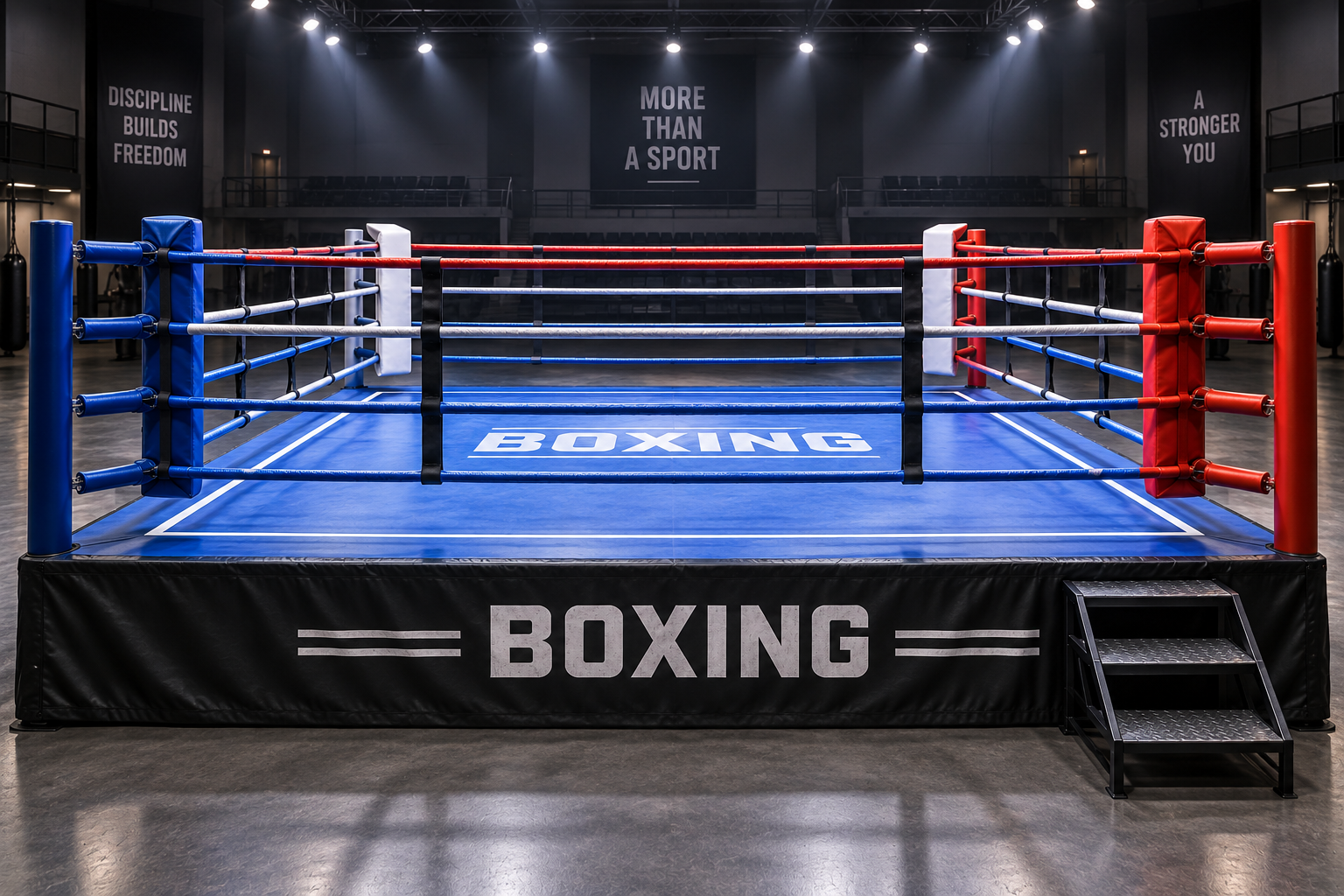
Boxing ring dimensions: how to choose the right size
The dimensions of a boxing ring represent one of the main criteria to evaluate before purchase. The size of the structure affects the layout of the gym, the space required for installation, the management of training sessions, and compatibility with the available area. A correct choice must start from the analysis of the operational context and the technical specifications provided by the manufacturer, avoiding relying exclusively on the internal dimensions of the ring.
A gym dedicated exclusively to boxing may require different configurations compared to a multisport facility or a center where the ring is used together with other equipment. For this reason, it is essential to consider not only the surface area occupied by the ring, but also the surrounding space necessary for movement, maintenance, and the work of instructors.
Before making a choice, it is advisable to check the room layout, access points, characteristics of the flooring, and the manufacturer's technical documentation. Analyzing these elements allows you to select a configuration consistent with the gym's objectives and the intended use.
- Quick answer
- What dimensions really matter?
- Practical selection criteria
- Compatibility with the gym
- Comparison table
- Errors to avoid
- Manuals and technical documentation
- FAQ
- Evaluating the investment
How to choose boxing ring dimensions?
The dimensions of the boxing ring must be evaluated by considering the available space, intended use, number of users, gym layout, and instructions provided by the manufacturer. The choice concerns not only the measurement of the combat surface, but also the area required for installation, access, and maintenance.
Early planning allows the ring to be integrated into the gym layout without limiting the functionality of other areas.
Before purchasing, it is appropriate to compare the technical specifications of available models with the characteristics of the room.
Define objectives
It is important to establish whether the ring will be used primarily for technical training, sparring, athletic preparation, or sporting events.
Evaluate the number of users
Frequency of use, number of classes, and the simultaneous presence of athletes affect the choice of the most appropriate configuration.
What dimensions should be considered?
The measurement of the combat surface represents only one of the elements to analyze. It is also necessary to consider the overall footprint of the structure, the space needed around the ring, and the presence of the platform height in the case of raised models.
Each manufacturer can offer different configurations, which is why it is always advisable to check the measurements reported in the official documentation.
To complete an area dedicated to combat sports, you can consult the range of combat sports equipment.
Structure dimensions
The external measurement of the ring includes all construction elements and represents the main data to compare with the available space.
Overall footprint
It is also necessary to include access points, circulation paths, maintenance, and surrounding operational areas in the evaluation.
What criteria help in the choice?
Selection should be based on available space, intended use, installation methods, and gym layout.
It is also useful to check the possibility of modifying the room layout in the future and compatibility with other existing equipment.
All evaluations should be carried out by comparing the room's characteristics with the manufacturer's technical documentation.
Gym layout
A room dedicated exclusively to boxing has different needs compared to a multipurpose environment.
Installation methods
Dimensions must be compatible with access points, internal paths, and the characteristics of the structure intended to host the ring.
How to verify compatibility with the gym?
Before purchasing, it is advisable to accurately measure the room and compare them with the overall footprint of the ring.
It is also necessary to check for the presence of columns, walls, openings, and other elements that could limit installation.
The operational space must allow instructors to work and the structure to be maintained without obstacles.
Access paths
Doors and corridors must allow the transport and assembly of the ring components.
Surrounding area
The free space around the structure facilitates workouts, cleaning, and periodic checks.
Comparison table
Before making a choice, it is useful to compare the main aspects.
| Criterion | Why it is important | What to check |
|---|---|---|
| External dimensions | Compatibility with the room | Overall footprint |
| Operational area | Ease of use | Surrounding free space |
| Installation | Correct assembly | Access points and internal paths |
| Configuration | Compatibility with the activity | Intended use |
| Documentation | Technical support | Manufacturer manuals and specifications |
Compare specifications
Analyzing technical datasheets allows different models to be compared using objective criteria.
Compare layout
The arrangement of other equipment influences the choice of the most suitable size.
What errors to avoid?
One of the most common mistakes is choosing the ring considering only the combat surface without evaluating the overall footprint.
It is equally important not to neglect the space needed for maintenance, walkways, and daily use.
Modifying the configuration provided by the manufacturer can compromise the correct functioning of the structure.
Evaluate only internal measurements
The overall footprint represents the most useful parameter to verify compatibility with the room.
Ignore the gym layout
Incomplete planning can limit the efficiency of the entire area dedicated to boxing.
Manuals and technical documentation
Before purchasing, it is advisable to consult the manufacturer's manual to check dimensions, installation methods, maintenance, and structure configuration.
It is also useful to keep documentation relating to components, spare parts, and the log of periodic checks.
When applicable, the manufacturer's instructions and current regulations regarding sports equipment must be respected.
Installation manual
The manual contains all the information necessary to verify compatibility, assembly, and space requirements.
Maintenance log
Documenting checks and interventions facilitates the management of the ring during its usage cycle.
FAQ
Does only the size of the combat square matter?
No. It is also necessary to consider the overall footprint of the structure and the surrounding operational space.
Does the platform modify the necessary dimensions?
Yes. In raised models, accessibility, structure height, and the organization of space around the ring must also be evaluated.
Why check the layout before purchase?
To ensure that the ring can be installed and used correctly without interfering with other gym activities.
Why correctly choose the dimensions of the boxing ring
Carefully evaluating the dimensions of the boxing ring allows you to design a more functional gym, simplify installation and maintenance, and organize spaces efficiently. Analyzing layout, intended use, structure configuration, and the manufacturer's technical documentation allows you to make a choice consistent with the operational objectives of the sports facility and future usage needs.
Comments (0)