
Trolley
You have no items in your shopping cart

 Budgets
 Dumbers
 Discs
Discs
 Benches
 Racks and Rigs
 Weights Holders
 Isotonic machines
 Calisthenics
 Cardio
 Kettlebells
 Flooring
 Gym Set
 Accessories
 Combat
 ARTI MARZIALI
 CONTAINER GYM
 Tug-Of-War
 Used Gym Equipment
 PILATES MACCHINARI
 GINNASTICA ARTISTICA
 CAMPI DA PADEL
 Prodotti in Pronta Consegna
 Informazioni
 IRONMAN
 Gift Card
- Donatif
- General information
- 0 I like it
- 528 Views
- 0 comments
- gym flooring, safety flooring, gym safety, shock-absorbing materials
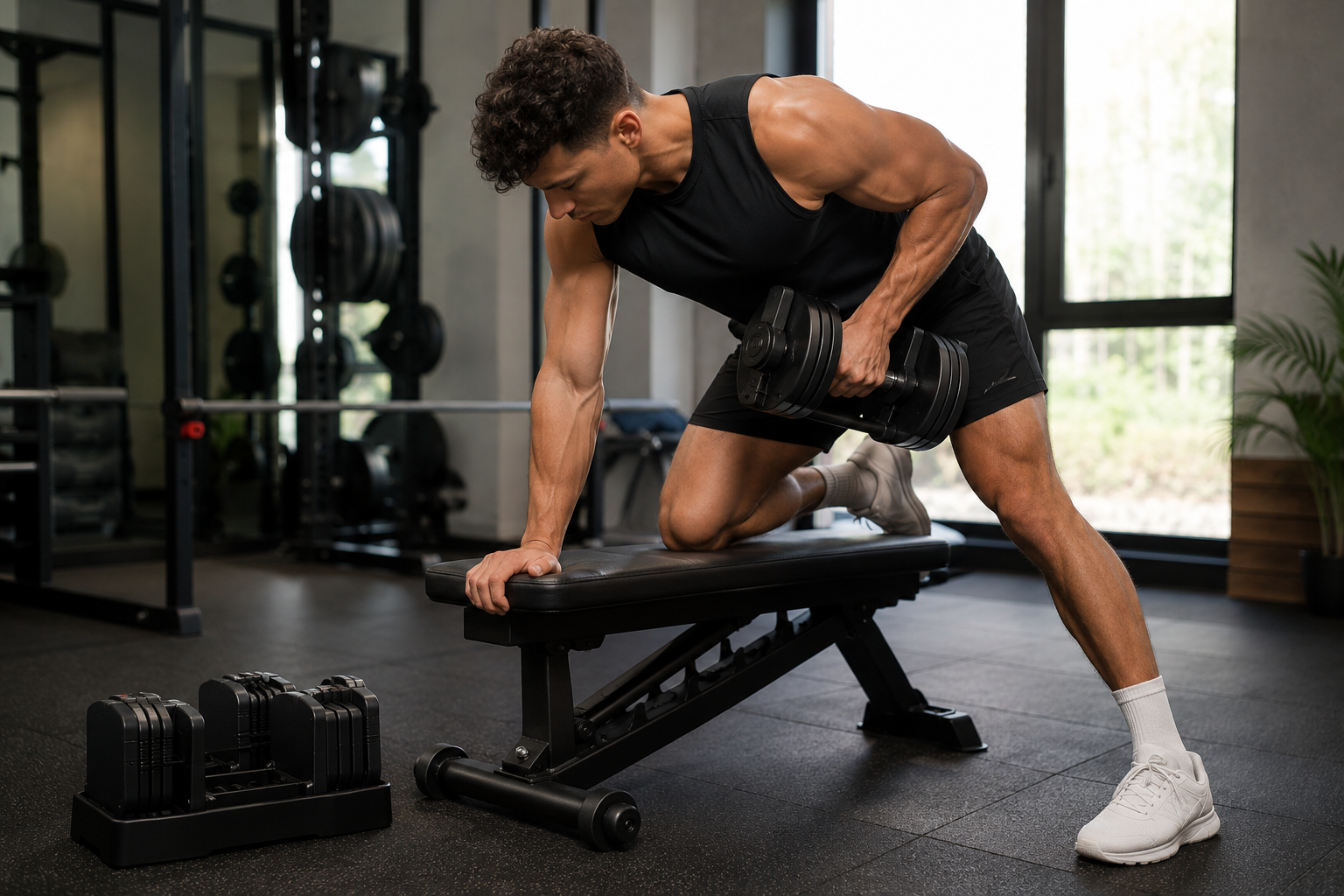
Adjustable dumbbell exercises: 5 variations to improve strength, muscle symmetry, and control
Many weight training programs focus primarily on major barbell exercises, often considered the benchmark for developing strength and muscle mass. However, this approach can leave some areas less trained, especially when it comes to balance between the two sides of the body, movement control, and the ability to stabilize the load.
Dumbbell exercises offer a freedom of movement that is difficult to replicate with a barbell. Each arm must work independently, forcing the stabilizing musculature to intervene more and allowing for the identification of any differences in strength or coordination between the right and left sides.
Using adjustable dumbbells within a structured program allows you to combine versatility, load progression, and space optimization. This characteristic makes them particularly interesting tools both for the athlete who wants to improve their performance and for those who wish to build a more balanced physique.
- Why use dumbbells instead of a barbell
- The role of unilateral training
- 5 adjustable dumbbell exercises to include in your program
- Dumbbells vs barbell: differences in training
- How to program load progression
- Creating an effective dumbbell workout plan
- Choosing the right equipment to train better
Why use dumbbells instead of a barbell
Dumbbells allow for more natural movement management compared to a barbell because they leave more freedom for the joints. During many exercises, the path of movement can better adapt to the individual structure of the athlete, improving comfort and the ability to express strength.
With a barbell, both limbs are connected by the same bar, which can allow the dominant side to compensate for any weaknesses. Dumbbells, on the other hand, require each arm to control its own load independently, highlighting any imbalances.
This characteristic makes working with dumbbells particularly useful for those who wish to improve muscle symmetry and develop greater awareness of their body during execution.
Greater freedom in trajectories
One of the main advantages of dumbbells is the ability to slightly modify the angle of movement based on your physical characteristics. This flexibility can be especially useful in exercises for the chest, shoulders, and upper body.
The ability to find a more natural trajectory allows you to focus more on muscle contraction and technical control.
Greater activation of stabilizing muscles
When the load is not connected by a single bar, the body must control position and balance more. The stabilizing muscles therefore work to keep the movement precise and safe.
This aspect improves the quality of execution and contributes to building a more complete athletic foundation.
The role of unilateral training
Unilateral training consists of performing movements using mainly one side of the body at a time. This methodology allows you to correct strength differences, improve coordination, and increase the demand for control during the exercise.
Athletes often develop small imbalances due to anatomical characteristics, daily habits, or years of training with predominantly bilateral movements. Working with dumbbells helps make these differences more evident and manageable.
Including unilateral exercises in a balanced routine therefore represents an effective strategy to improve the overall quality of performance.
Reducing muscle imbalances
When one side of the body is stronger than the other, dumbbell exercises prevent the dominant side from fully compensating for the work. Each limb must in fact complete its own movement with the assigned load.
This allows for building greater uniformity in muscle development and better control capacity.
Developing control and stability
Working with independent loads requires greater attention to technique. The brain must coordinate position, balance, and force production more precisely.
This additional demand makes dumbbells useful tools even for experienced athletes who want to improve the quality of their training.
5 adjustable dumbbell exercises to include in your program
The versatility of dumbbells allows you to train practically every muscle group with a limited number of tools. An adjustable system also allows you to quickly change the load and adapt the work to different levels of experience.
Below are five particularly effective variations to take advantage of the benefits of working with dumbbells compared to exercises exclusively with a barbell.
1. Dumbbell bench press
Dumbbell presses allow you to work on the chest while involving more control of the negative phase and shoulder stabilization. Compared to the barbell, each arm must manage its own weight independently.
This exercise can be used to increase technical awareness and improve the ability to contract the target muscle.
2. One-arm dumbbell row
The unilateral row represents one of the most effective exercises for developing the back while correcting any differences between the two sides. The support of a bench also allows you to focus on muscle contraction.
The ability to work each side separately makes this movement particularly useful in programs oriented toward muscle balance.
3. Dumbbell lunges
Lunges require strength, balance, and coordination. Using dumbbells increases the demand for stabilization without restricting the movement as can happen with some barbell variations.
They are a complete exercise for developing legs and general athletic ability.
4. Dumbbell shoulder press
Overhead presses with dumbbells allow the shoulders to follow a freer trajectory than with a barbell. This can improve movement perception and joint control.
The exercise also allows you to identify strength differences between the two upper limbs.
5. Alternating dumbbell curl
The alternating curl allows you to focus on the contraction of the individual arm, preventing a stronger side from taking control of the movement.
It is a simple but effective variation for developing control and technical quality.
Dumbbells vs barbell: differences in training
The dumbbells vs barbell comparison is not about which tool is universally better, but which solution is more suitable for the athlete's specific goal. Both tools have advantages and can be used within a complete program.
The barbell generally allows you to handle higher loads and represents an effective solution for developing maximal strength. Dumbbells, on the other hand, offer greater freedom and a higher demand for stabilization.
When to prefer the barbell
Barbell exercises are often indicated when the main goal is to increase strength on fundamental movements. The connection between the two limbs allows for the use of heavy loads.
When to prefer dumbbells
Dumbbells become particularly advantageous when the goal is to improve control, balance, and uniform muscle development.
How to program load progression
Proper progression is essential to achieve results with any equipment. Adjustable dumbbells offer an important advantage because they allow you to gradually increase the weight without taking up large amounts of space.
Progression must still be accompanied by correct technique and intelligent management of training volume.
Increasing the load gradually
Increasing the weight only when the movement remains controlled allows you to build more solid results and reduce the risk of compensations.
Priority to movement quality
The search for a heavier load must not compromise technique and control. The best results come when strength and precision grow together.
Creating an effective dumbbell workout plan
A well-structured dumbbell workout plan must consider goals, the athlete's level, and the distribution of work throughout the week. Dumbbells allow you to build complete programs even in small spaces.
The variety of available exercises allows you to train all muscle groups while maintaining high technical quality.
Structuring a complete session
An effective session can combine pushing, pulling, leg movements, and specific work to create a balanced stimulus.
Adapting the program to goals
Every athlete needs a personalized program. Adjustable dumbbells allow you to easily modify intensity and volume.
Choosing the right equipment to train better
The quality of the equipment directly influences the continuity of the training journey. A reliable system allows you to focus on progression without technical limitations.
Choosing versatile and resistant tools means creating a solid foundation for improvement over time.
Why choose adjustable solutions
Adjustable dumbbells allow you to have numerous loads available in a single system, optimizing space and investment.
A support for continuous improvement
Adequate equipment accompanies the athlete through the different phases of the journey, offering flexibility and the possibility of evolution. Using quality dumbbells means investing in greater control, muscle symmetry, and more complete results.
Comments (0)