
Trolley
You have no items in your shopping cart

 Budgets
 Dumbers
 Discs
Discs
 Benches
 Racks and Rigs
 Weights Holders
 Isotonic machines
 Calisthenics
 Cardio
 Kettlebells
 Flooring
 Gym Set
 Accessories
 Combat
 ARTI MARZIALI
 CONTAINER GYM
 Tug-Of-War
 Used Gym Equipment
 PILATES MACCHINARI
 GINNASTICA ARTISTICA
 CAMPI DA PADEL
 Prodotti in Pronta Consegna
 Informazioni
 IRONMAN
 Gift Card
- Donatif
- General information
- 0 I like it
- 478 Views
- 0 comments
- gym flooring, safety flooring, gym safety, shock-absorbing materials
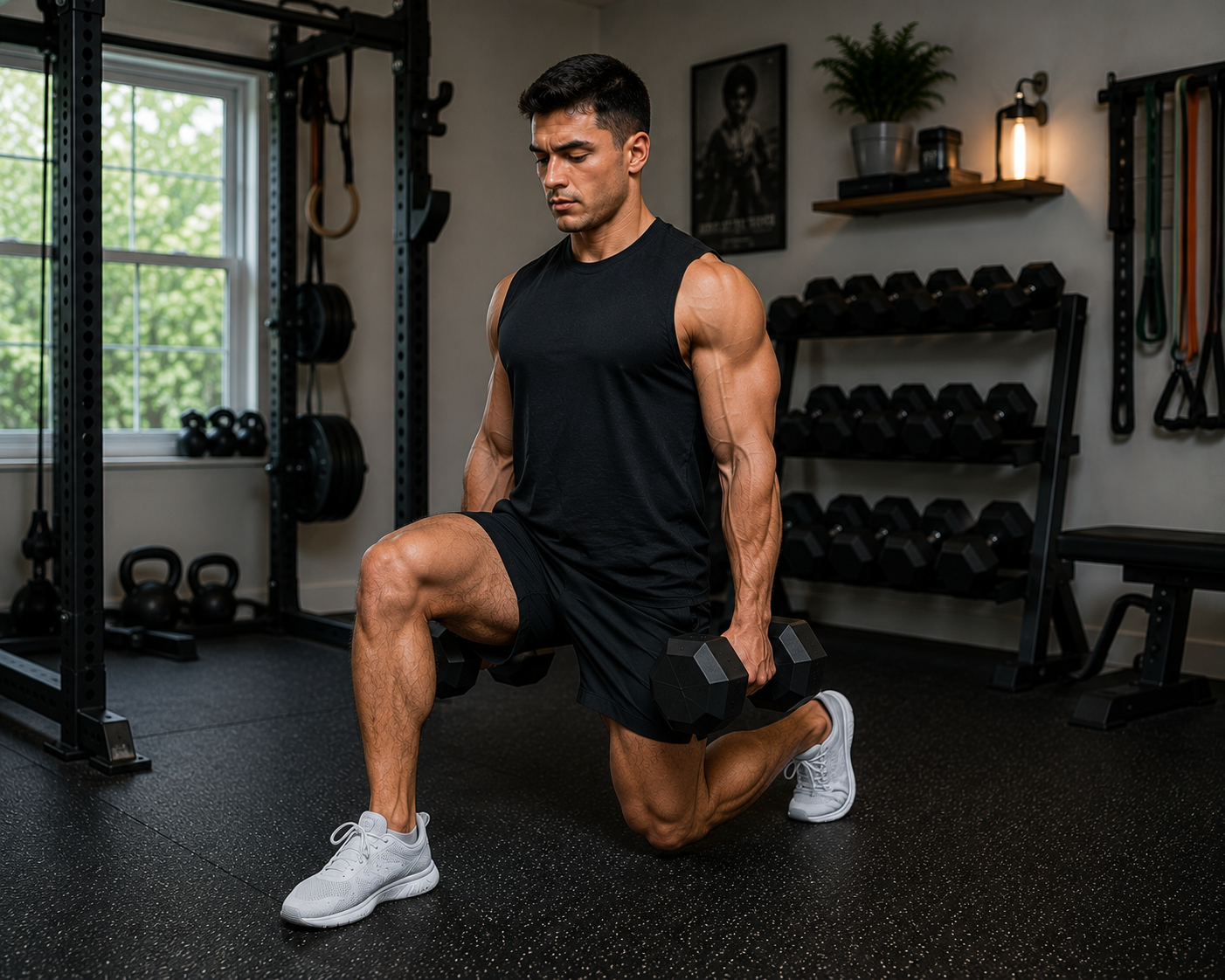
Leg exercises with dumbbells: build strength and mass even in small spaces
Training your legs effectively does not necessarily require bulky machines or a professional weight room. With an intelligent selection of exercises and versatile equipment, it is possible to build a complete program dedicated to the lower limbs even within a compact home gym. Dumbbell leg exercises represent a practical solution for those who want to build strength, increase muscle mass, and improve stability without taking up large amounts of space.
Dumbbells offer an important advantage over many traditional solutions: they allow you to work freely, engaging stabilizer muscles more and allowing for a great variety of movements. Through bilateral and unilateral exercises, it is possible to stimulate the quadriceps, hamstrings, glutes, and core muscles with protocols suitable for both beginners and more experienced athletes.
For those who train at home and have only a few square meters, designing an effective program means choosing high-yield movements. The goal is not simply to lift as much weight as possible, but to create a sufficient stimulus for muscle growth through control, load progression, and correct technical execution.
- Why train legs with dumbbells
- Anatomy of the leg muscles involved
- Best leg exercises with dumbbells
- Unilateral training and core stability
- Protocol for leg hypertrophy with dumbbells
- Training legs at home with minimal equipment
- Common mistakes in dumbbell leg exercises
- Building strong legs in a compact home gym
Why train legs with dumbbells
The legs represent one of the most important muscle groups in the human body and require adequate stimuli to develop strength and mass. Many people associate lower limb training exclusively with specific machines found in traditional gyms, but dumbbells can offer an extremely effective alternative.
Using dumbbells allows you to perform natural movements that involve multiple joints simultaneously. This approach improves not only muscle capacity but also balance, coordination, and body control.
For a home gym, dumbbells are a strategic choice because they allow you to train the entire body using a limited amount of equipment. With a pair of appropriate weights, it is possible to create complete sessions without resorting to bulky machines.
Advantages over traditional machines
Guided machines offer stability and isolation, but often limit the athlete's natural movement. Dumbbells, on the other hand, require greater activation of the stabilizer muscles, making the exercise more complete.
This aspect is particularly useful for those who want to improve the functional capacity of the body in addition to simply increasing muscle mass.
Versatility for small spaces
One of the main advantages of dumbbells is the ratio between footprint and training possibilities. A single adjustable pair can be used for numerous exercises, allowing you to create complex programs even in small environments.
This feature makes dumbbells an ideal solution for those who want to achieve high performance in just a few square meters.
Anatomy of the leg muscles involved
To build an effective workout, it is important to know the main muscles involved in leg movements. Each dumbbell exercise can emphasize certain areas depending on the technique used, body position, and the load chosen.
A complete program should include movements capable of stimulating the front of the thigh, the posterior chain, and the supporting musculature.
The variety of exercises allows for the development of proportionate and functional legs.
Quadriceps and pushing movements
The quadriceps are mainly involved in movements where the knee extends, such as squats and lunges. They are fundamental for strength, stability, and the ability to produce power in the lower part of the body.
Dumbbell exercises allow you to easily modulate intensity and work volume to stimulate this muscle group.
Hamstrings, glutes, and posterior chain
The hamstrings and glutes participate in hip extension movements and are fundamental for general strength. Exercises like dumbbell Romanian deadlifts allow you to focus on the control phase and muscle tension.
Correctly training the posterior chain improves balance and performance in more complex exercises.
Best leg exercises with dumbbells
Dumbbell exercises for the legs can be organized based on the main goal: strength increase, hypertrophy, or improvement of athletic capacity. The choice of movements must consider experience level, available space, and existing equipment.
An effective combination includes squatting exercises, unilateral pushing movements, and work dedicated to the posterior chain.
The quality of execution always remains more important than the weight used.
Dumbbell squats
The dumbbell squat is one of the fundamental exercises for training the legs without using machines. The movement mainly involves the quadriceps and glutes, but also requires core stability and control of position.
The ability to hold dumbbells in different positions allows you to modify the stimulus and adapt the exercise to your capabilities.
Dumbbell Romanian deadlifts
Dumbbell Romanian deadlifts represent a very effective exercise for hamstrings and glutes. The main focus is the hip movement, with a controlled eccentric phase that increases tension on the posterior chain.
Correct execution requires a stable back, control of the movement, and perception of muscle stretching.
Unilateral training and core stability
One of the main advantages of using dumbbells in leg training is the ability to work unilaterally. Single-leg exercises require more balance and core activation compared to movements performed with both legs simultaneously.
Unilateral training also allows you to identify any strength differences between limbs and work to improve any imbalances.
This approach is particularly interesting for those seeking complete athletic preparation even in home environments.
Why unilateral training improves control
When working with only one leg, the body must stabilize the pelvis, torso, and joints more. This increases the involvement of the deep muscles responsible for movement control.
The greater coordination requirement makes these exercises very useful for developing skills transferable to other sports as well.
Unilateral exercises with dumbbells
Lunges, split squats, and step-ups are examples of exercises that can be performed with dumbbells and adapted to different levels of difficulty.
These movements allow you to obtain a high muscle stimulus without the need to use extremely high loads.
Protocol for leg hypertrophy with dumbbells
Muscle hypertrophy requires a progressive stimulus based on volume, intensity, and consistency. Even with a compact home gym, it is possible to create an effective program using only dumbbells.
The main goal is to gradually increase difficulty while maintaining correct technique and adequate control of the movement.
Muscle growth does not depend on the quantity of machines available, but on the quality of the stimulus produced.
Volume and repetition management
To promote hypertrophy, it is useful to use sets with a number of repetitions sufficient to create muscle fatigue. The load must be chosen so as to maintain technical quality until the end of the set.
Progressively increasing volume or intensity allows you to continue improving.
Load progression with dumbbells
Progression represents a fundamental element for muscle development. Gradually increasing the weight of the dumbbells, the number of repetitions, or the difficulty of the exercise allows the body to adapt.
A flexible loading system allows you to follow this evolution without having to continuously replace equipment.
Training legs at home with minimal equipment
Home leg training with weights proves that you don't need to own a full gym to achieve significant results. An essential setup with dumbbells can offer many possibilities for working on the lower limbs.
The key is to select high-yield exercises and organize sessions correctly.
With intelligent programming, even a small space can become an effective environment for strength development.
Creating a compact home gym
A functional home gym must prioritize versatile equipment. Dumbbells allow you to train legs, the upper body, and the core while occupying minimal space.
This feature makes them particularly suitable for those who have only a few square meters.
Maximizing results in little space
Training in a restricted space requires greater attention to the selection of exercises. Compound movements like squats, lunges, and deadlifts allow you to obtain a great stimulus with few tools.
Efficiency therefore becomes a fundamental element of the program.
Common mistakes in dumbbell leg exercises
Even with simple equipment, it is possible to make mistakes that limit results. Technique, load choice, and progression management are fundamental aspects for training effectively.
Correcting these mistakes allows you to obtain greater benefits while reducing the risk of overexertion.
A conscious approach leads to more consistent results over time.
Using loads that are too heavy
Choosing an excessive weight can compromise control and posture. In leg exercises, it is fundamental to maintain a correct movement trajectory.
An adequate load allows you to stimulate muscles without sacrificing technique.
Neglecting unilateral technique
Single-leg exercises require balance and control. Performing them too quickly or without stability reduces their potential.
The quality of movement must always be the priority.
Building strong legs in a compact home gym
Training legs with dumbbells represents an effective solution for those who want to build strength and muscle mass without depending on bulky machines. Through exercises like squats, Romanian deadlifts, and unilateral movements, it is possible to create complete protocols even in very small environments.
The versatility of dumbbells allows you to adapt the program to the athlete's level, progressively increasing difficulty and load. Good programming allows you to obtain important results even with essential equipment.
Choosing modular and functional equipment like adjustable dumbbells systems allows you to build a home gym capable of supporting the athlete's growth over time, combining efficiency, practicality, and professional performance.
Comments (0)