
Trolley
You have no items in your shopping cart

 Budgets
 Dumbers
 Discs
 Benches
 Racks and Rigs
 Weights Holders
 Isotonic machines
 Calisthenics
 Cardio
 Kettlebells
 Flooring
 Gym Set
 Accessories
 Combat
 ARTI MARZIALI
 CONTAINER GYM
 Tug-Of-War
 Used Gym Equipment
 PILATES MACCHINARI
 GINNASTICA ARTISTICA
 CAMPI DA PADEL
 Prodotti in Pronta Consegna
 Informazioni
 IRONMAN
 Gift Card
- Donatif
- General information
- 0 I like it
- 4 Views
- 0 comments
- gym flooring, safety flooring, gym safety, shock-absorbing materials
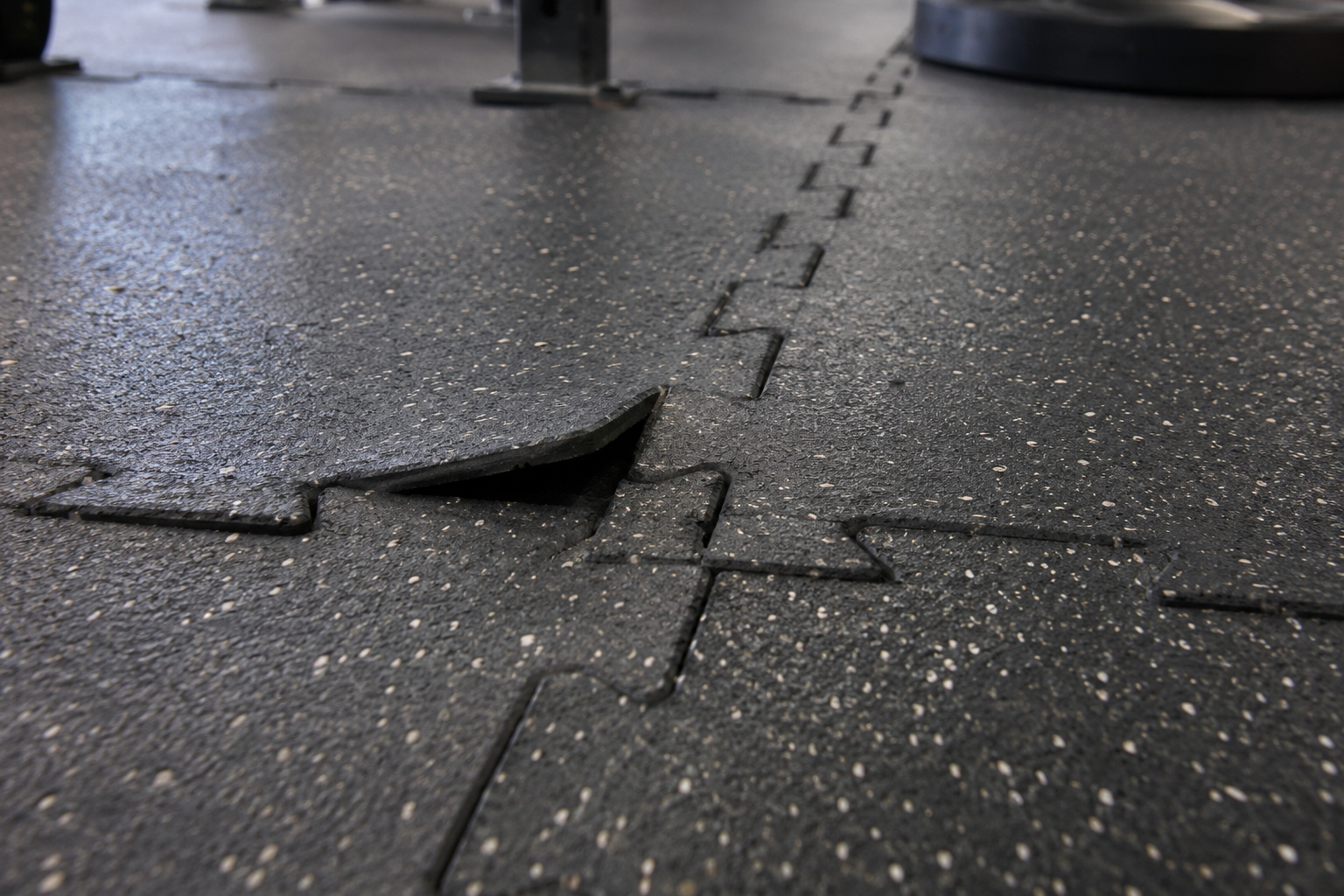
Joint opening after months: how to evaluate repairing or replacing modules
A joint that opens after months of use represents an issue that requires careful evaluation in the management of modular sports flooring. In a professional gym, weight room, or fitness center, the appearance of a separation between two modules can depend on installation conditions, material characteristics, operational stresses, or changes that occurred during exercise. The presence of the defect alone does not make it possible to determine whether local intervention is sufficient or if a more extensive part of the surface needs to be replaced.
For a facility manager, understanding how to address a joint that opens after months means distinguishing the observable symptom from its possible cause. An apparently limited separation can be linked to a circumscribed condition or indicate a problem affecting multiple modules. Before choosing an intervention, it is therefore necessary to collect verifiable information, compare conditions of use, and consult the technical documentation of the installed system.
The decision between repair and replacement must also consider the operational continuity of the gym, the frequency of traffic, the presence of concentrated loads, and the responsibilities of the parties involved. This guide proposes a method to document the problem, compare alternatives, and identify when to request a specialist evaluation, avoiding improvised interventions or replacements not justified by technical evidence.
- The problem: why a joint can open after months
- What data to collect before deciding
- Criterion 1: junction types and transition points
- Criterion 2: traffic, wheels, and loads on the flooring
- Checks upon delivery and during use
- When to evaluate repairing or replacing modules
- Operational example with two intervention scenarios
- Checklist, critical signals, and questions for the supplier
- How to protect your flooring investment
The problem: why a joint can open after months
Modular flooring consists of elements that are placed side by side or connected according to different systems. The behavior of joints depends on material characteristics, element geometry, the installation system, and environmental and operational conditions. When a separation appears after a period of use, the first mistake to avoid is immediately attributing the problem to a product defect or improper installation.
An opening may be observed near an access point, along a passageway, or close to an area subject to frequent movement. The position provides useful information, but does not automatically prove the origin of the phenomenon. It is necessary to check whether the affected joint has different characteristics compared to the others and whether the problem also manifests in areas with comparable conditions of use.
The evaluation must distinguish the presence of a visible discontinuity from its operational consequences. A separation can affect surface regularity, cleaning operations, and equipment movement. Any impact on safety requires a contextual verification and, when necessary, the intervention of qualified personnel.
Distinguishing an aesthetic variation from a functional criticality
Not all observable irregularities have the same meaning. A color difference or a more evident joint line does not necessarily equate to a functional separation of the modules. Conversely, an opening accompanied by movement, lifting, or interference during transit requires specific investigation.
The facility manager should describe what is actually observable, avoiding premature diagnoses. A photograph accompanied by a measurement and position indication allows the problem to be communicated to the supplier much more precisely than a generic description such as defective flooring.
Why the timing of appearance matters
A joint that presents an opening immediately after installation must be evaluated by considering initial conditions and installation methods. When instead the separation appears after months, it becomes important to reconstruct the actual use of the surface over the elapsed period.
Late appearance does not prove that the installation was correct nor that the material suffered anomalous deterioration. However, it allows for more targeted questions regarding operating conditions, space modifications, and any variations in applied stresses.
What data to collect before deciding
The first phase of evaluation consists of building a technical file of the problem. Main information includes layout plans, material data sheets, photographs of the affected area, dimensional surveys, and installation-related documentation. These elements allow comparing the current situation with what was planned by the project and the manufacturer's instructions.
Photographs should be associated with a recognizable position on the room layout plan. Taking a close-up photo of the joint is not sufficient: an overall shot helps understand the relationship with accesses, machinery, pathways, and transition points. Detail images, on the other hand, can document the progression of the separation and any differences between adjacent modules.
It is also advisable to record when the phenomenon was first observed and whether previous reports are available. Chronological reconstruction helps distinguish an isolated event from a recurring problem, without turning simple temporal coincidences into proof of causality.
Organizing photographs and dimensional surveys
A useful survey must be repeatable. For each affected point, it is advisable to identify the position on the plan, document the geometry of the separation, and record the observed conditions. If measurements are taken, the instrument used must be indicated and the results preserved.
Comparing photographs taken at different times can help understand if the phenomenon is evolving. However, differences in perspective and lighting can alter visual perception. For this reason, images should be integrated, whenever possible, with surveys performed using consistent criteria.
Retrieving technical data sheets and installation documents
The documentation should identify the product actually installed, the expected joint system, and the conditions declared by the manufacturer. Information related to the substrate, installation methods, and usage limitations can prove decisive in the evaluation.
If certain documents are not available, this lack must be recorded. It is incorrect to replace the instructions of the installed model with generic indications referring to apparently similar products, because materials and connection systems may feature different characteristics.
Criterion 1: junction types and transition points
Modular flooring joints do not all function in the same way. Some systems feature abutting elements, while others use interlocking geometries or specific connections. Junction characteristics influence installation methods, intervention possibilities, and usage conditions declared by the manufacturer.
Before evaluating a repair, it is necessary to identify the system actually present. An intervention compatible with one product might not be appropriate for another. The use of adhesives, fasteners, or treatments not foreseen can modify system behavior and introduce further critical issues.
Particular attention must be paid to transition points, where the flooring meets different surfaces, thresholds, edges, or fixed elements. These zones may be subject to different usage conditions compared to the central parts of the room and require dedicated analysis.
Evaluating the module connection system
The first check consists of identifying the connection type and related technical indications. It is necessary to understand whether the system provides specific abutting conditions, any accessories, and documented installation procedures.
The presence of an interlock does not automatically guarantee that the module can be removed and reinstalled without limitations. This possibility must be verified through the manufacturer's instructions and the actual conditions of the flooring.
Checking edges, thresholds, and surface changes
Transition points deserve attention because they can coincide with variations in transit modes or load distribution. A joint near the entrance of a weight room may be subjected to different conditions compared to one located in a less frequented part of the hall.
The evaluation should include edge geometry, the presence of transition elements, and the compatibility of installed solutions. Any modifications must be defined based on technical documentation and necessary verifications.
Criterion 2: traffic, wheels, and loads on the flooring
Stresses on gym flooring depend on the activities actually carried out. An area frequently crossed by users presents different conditions compared to an area destined for stationary machinery. Movement of wheeled equipment and application of concentrated loads can also represent important variables.
The presence of a load does not prove that it is responsible for the joint opening. To formulate a reliable evaluation, operational conditions must be compared with those foreseen for the installed system, also considering load distribution and substrate characteristics.
The facility manager can contribute by collecting information on zone usage, but should not independently deduce the load-bearing capacity of the flooring. Performance must be verified through relevant technical data and, when necessary, via specialist evaluation.
Analyzing high-traffic areas
Room accesses, connections between training areas, and pathways used to move equipment can present high transit frequencies. Their position should be compared with that of the joints affected by the problem.
It is useful to check whether separations concentrate along recurring paths or also appear in zones with different usage. This comparison can guide further investigations, but does not replace technical verification of causes.
Evaluating wheels, machinery, and concentrated loads
Equipment moved on wheels can apply different stresses compared to simple pedestrian foot traffic. Their impact depends on mass, wheel characteristics, movement methods, and surface conditions.
For machinery permanently positioned, the distribution of support points must also be considered. Compatibility must be verified with equipment and flooring documentation, without assuming that greater thickness automatically guarantees suitability for any load.
Checks upon delivery and during use
Documentation gathered at delivery constitutes an important reference for evaluating a problem appearing later. Initial photographs, any reports, layout plans, and logs allow reconstruction of conditions observed before starting ordinary activities.
If initial records are not available, the evaluation must explicitly state this limitation. It cannot be stated with certainty that a joint was perfectly aligned at installation simply because the problem was noticed several months later.
During operation, it is useful to schedule periodic checks consistent with manufacturer instructions and usage conditions. Frequency and methods must be defined according to the installed system, avoiding arbitrary intervals presented as universally valid.
What information to retrieve from delivery
The initial file may include product documentation, material references, layout plans, and logs of checks performed. It is important to distinguish what was actually checked from what was simply foreseen in documents.
When differences emerge between the installed configuration and available documentation, clarifications must be requested from competent parties. The facility manager should avoid retroactively modifying records or attributing responsibilities without sufficient evidence.
Monitoring behavior during operation
A reporting system allows operators to log new openings, displacements, or irregularities. Information should be associated with dates, positions, and observable conditions to make comparison over time possible.
Monitoring must not become a reason to keep a potentially unsuitable zone in use. When discontinuity can interfere with transit or activities, appropriate precautionary measures must be promptly evaluated and necessary checks requested.
When to evaluate repairing or replacing modules
The choice between repairing or replacing modules must be formulated after identifying the problem and verifying usage conditions. Local repair can be considered when criticality is circumscribed, the cause has been adequately evaluated, and the manufacturer provides a procedure compatible with the installed system.
Replacing one or more modules may become an alternative to examine when elements present conditions that do not allow appropriate restoration or when technical documentation excludes certain intervention methods. In this case too, compatibility of new elements with existing ones must be verified.
If separation depends on substrate condition or a more extensive problem, intervening exclusively on modules might not resolve the cause. Before proceeding, it is therefore necessary to establish whether the proposed intervention addresses only the symptom or also the factor that caused it.
Conditions to evaluate a localized intervention
A circumscribed intervention requires at least product identification, evaluation of affected module conditions, and availability of applicable technical instructions. Adjacent elements and any consequences of removing or modifying the area must also be considered.
The fact that a module can be physically moved does not mean any restoration operation is correct. The procedure must be defined according to relevant instructions and, when requested, by competent personnel.
When to investigate a broader replacement
An extensive replacement can be evaluated when the phenomenon affects multiple points, reappears after documented interventions, or criticality emerges involving a significant part of the system. None of these elements, in isolation, proves that the entire surface must be replaced.
Before authorizing purchase, the actual extent of the problem must be defined, technical alternatives verified, and reasons for intervention documented. Generalized replacement without diagnosis can generate high costs without eliminating conditions that produced separation.
Operational example with two intervention scenarios
Consider a professional gym where openings between flooring modules are observed after several months of use. The facility manager has a layout plan, photographs of the area, and part of the technical documentation. They must decide whether to request a localized intervention or investigate replacing multiple elements.
The first step consists of recording the position of affected joints and comparing it with equipment and pathway distribution. Subsequently, data sheets of the installed system and manufacturer instructions on installation methods and permitted interventions are requested.
The example considers two distinct scenarios, without presuming one is automatically preferable. The objective is to show how to organize decision-making and what conditions must be verified before authorizing work or purchases.
Scenario A: opening limited to one zone
In the first scenario, separation concerns a limited number of joints, while other areas present no observable anomalies. The facility manager documents the phenomenon, checks report history, and requests an evaluation of possible causes.
If analysis confirms the problem is circumscribed and an appropriate restoration procedure exists, a local intervention can be evaluated. The choice must still include subsequent verification, with acceptance criteria defined by technically competent parties.
Scenario B: separations present in multiple points
In the second scenario, openings affect different zones, including transit areas and points near equipment. Problem distribution requires broader analysis of installation conditions, substrate, and operational stresses.
In this situation, automatically replacing all affected modules is not sufficient. It is necessary to establish if a common cause exists, verify real criticality extent, and compare alternative interventions. Economic decision must follow technical evaluation, not precede it.
Checklist, critical signals, and questions for the supplier
An operational checklist helps keep decision-making consistent and documentable. Before requesting a quote, it is advisable to verify product identification, layout plans, photographs, surveys, and usage condition information are available. Any gaps must be explicitly indicated.
The checklist should also distinguish checks the manager can perform directly from those requiring the manufacturer, designer, or qualified technician. Gathering information and logging anomalies falls under ordinary management, while establishing technical cause of separation may require further competence and assessments.
Signals justifying further investigation include phenomenon evolution, module displacement, transit interference, and problem recurrence after previous interventions. These elements do not constitute a diagnosis, but help define verification priorities.
Questions to ask the supplier
It is useful to ask what installation conditions are foreseen for the installed system, what checks are recommended in the presence of openings, and which interventions are compatible with materials. It should also be clarified whether technically compatible replacement modules are available with existing ones.
Answers should refer to identified product and documented conditions of the gym. Generic indications are not sufficient to establish correctness of intervention on specific flooring.
Defining when to involve a specialized technician
Technical escalation becomes necessary when available information does not allow identifying appropriate solution, when phenomenon affects multiple zones, or when possible interference with surface safety and functionality emerges.
The facility manager should transmit an orderly file to the professional, avoiding descriptions based solely on impressions. Layout plans, localized photographs, technical data sheets, and report history make analysis more effective and facilitate defining subsequent verifications.
How to protect your flooring investment
Managing an open joint does not concern only immediate intervention cost. A technically motivated decision also allows evaluating area downtime, material availability, specialist verifications, and need for subsequent checks. For a professional gym, these elements impact activity scheduling and overall maintenance sustainability.
Before purchasing new elements, compatibility with existing system should be verified. The category of gym anti-shock flooring includes solutions to evaluate based on declared technical characteristics and actual usage conditions. Availability of products belonging to the same family does not prove they are interchangeable with already installed modules.
Economic comparison should distinguish at least three components: material cost, technical and operational activity cost, and impact on room usage. A solution with lower initial price might prove less convenient if it requires repeated interventions or does not address cause of separation. Likewise, extensive replacement is not automatically more reliable than a correctly designed localized intervention.
Considering life-cycle cost
Economic evaluation must include control and maintenance activities foreseen for the system. Effective duration and flooring behavior depend on product characteristics, installation, and usage conditions, hence attributing guaranteed performance without specific documentation is incorrect.
Keeping intervention history allows identifying recurrences and improving future decisions. If a problem appears multiple times in the same zone, collected information can guide deeper verifications instead of automatically repeating the exact same operation.
Formalizing decision before purchase
A documented decision should indicate observed problem, collected information, considered alternatives, performed verifications, and any remaining limits. It must also clarify who expressed technical evaluation and what conditions must be respected during intervention.
For facility manager, this method allows comparing quotes based on concrete requirements and distinguishing effectively compatible solutions from insufficiently documented proposals. The objective is not always choosing least expensive or most extensive intervention, but identifying a response proportionate to problem and supported by available evidence.
Before authorizing repair or replacement, it is also useful to define final verification methods and documentation to preserve. An intervention should be considered completed only after appropriate checks and logging of observed conditions, according to applicable responsibilities and technical indications. This approach allows managing flooring criticalities with greater continuity, keeping plant costs, decisions, and operating conditions under control.
Comments (0)