
Trolley
You have no items in your shopping cart

 Budgets
 Dumbers
 Discs
 Benches
 Racks and Rigs
 Weights Holders
 Isotonic machines
 Calisthenics
 Cardio
 Kettlebells
 Flooring
 Gym Set
 Accessories
 Combat
 ARTI MARZIALI
 CONTAINER GYM
 Tug-Of-War
 Used Gym Equipment
 PILATES MACCHINARI
 GINNASTICA ARTISTICA
 CAMPI DA PADEL
 Prodotti in Pronta Consegna
 Informazioni
 IRONMAN
 Gift Card
- Donatif
- General information
- 0 I like it
- 129 Views
- 0 comments
- gym flooring, safety flooring, gym safety, shock-absorbing materials
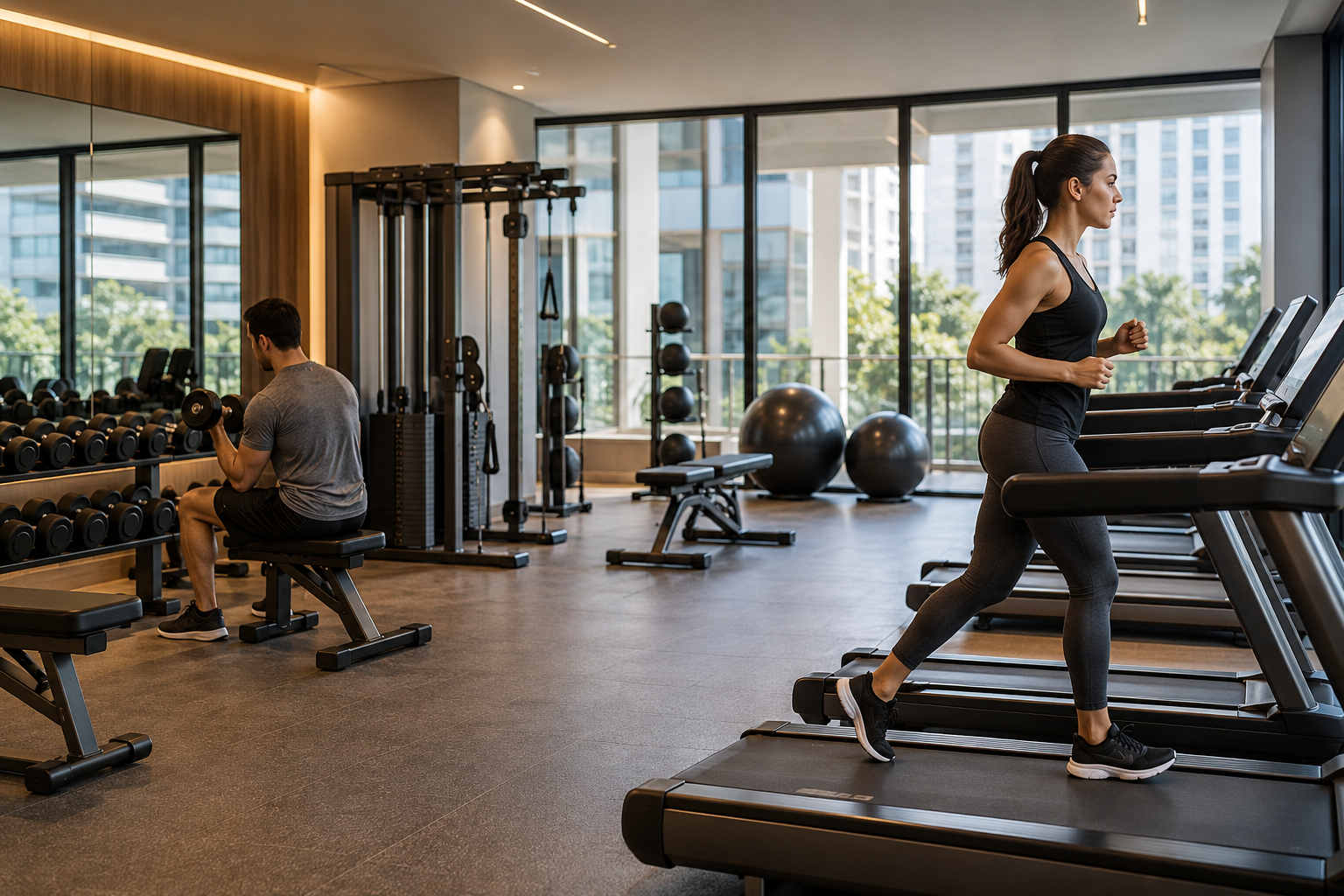
Gym Project Examples for Hotels and Condominiums: Two Scenarios
A common room in a residential building and a fitness room in a hotel can have similar dimensions and require different designs. In a condominium, the same users return over time and share organizational decisions. In a hotel, guests change frequently and the service must integrate with reception, cleaning, and maintenance. The comparison helps to understand why the equipment cannot be chosen solely based on surface area.
These gym project examples for hotels and condominiums describe two hypothetical scenarios. They are not reports of completed interventions and do not present economic results or measured performances. They serve to highlight necessary decisions and data, distinguishing what depends on the planned activities from what requires a technical evaluation of the building or an organizational choice of the facility.
In the first scenario, a small hotel wants to introduce a service for guests with limited time. In the second, a condominium wants to make a general training space available to residents. Both start from an essential equipment list yet to be defined. The path shows what questions they share and how answers change when considering access, location, use, and post-opening management.
- Define the audience before configuration
- Evaluate the location of the room in the building
- Choose few functions with a clear rationale
- Design pathways and storage together with stations
- Prepare the organization of reports
- Compare costs and services with homogeneous perimeters
- Use the comparison to define your project
Define the audience before configuration
The project must describe who will use the space and in what manner.
This information guides the selection of functions and the preparation of instructions. In the comparison between the two scenarios, the main difference is not the aesthetic level of the layout, but the relationship between users, available staff, and service organization during the day.
The hotel gym is imagined as a service accessible to guests according to methods yet to be defined. The manager gathers information on clientele and requests received, without immediately turning them into a certain usage forecast. The brief must explain which activities are considered essential and which can be evaluated in a subsequent development.
The hotel scenario with changing guests
In the hotel scenario, a guest may enter for the first time and not know room adjustments or procedures. The project must therefore make stations and information legible, consistently with the expected support. A versatile machine must also be evaluated for the comprehensibility of its use, avoiding assuming continuous familiarity with the environment.
The condominium scenario with recurring users
In the condominium scenario, residents can be consulted on activities and time slots. The recurrence of users helps gather needs, but does not eliminate differences in experience and equipment management capabilities. The configuration must remain consistent with a shared environment, without relying on the skill of only the initially most interested group.
Evaluate the location of the room in the building
In both scenarios, the room must be evaluated before the final selection of machines.
Dimensions, accesses, systems, and relationship with neighboring environments constitute preliminary data. Photographs help commercial comparison, while technical aspects pertinent to the building require competent professionals and cannot be solved solely by the availability of a room.
The compatibility of the fitness room must be referred to the planned activities. Noise and vibrations require attention when the room is located near sensitive environments, and flooring does not automatically guarantee the absence of disturbance. The project must make necessary checks visible and link them to choices that depend on their outcomes.
The relationship with hotel rooms and services
In the hypothetical hotel, the manager also examines the guest and staff pathways. A convenient location for access may entail different requirements for cleaning and assistance. Future deliveries must be organizable without considering the fitness room as a space isolated from the facility's functioning and department activities.
Coexistence with residential spaces
In the hypothetical condominium, the administrator gathers information on neighboring environments and access conditions to the common room. Evaluations must be consistent with decisions pertinent to the project and applicable references. Usage rules can contribute to organization, but do not replace the technical insights necessary to understand the building's conditions.
Choose few functions with a clear rationale
In both scenarios, initial equipment favors general activities, still without indicating models.
The criterion is to link each station to a requested function and verify its insertion. A small room does not necessarily have to reproduce all the possibilities of a fitness center: it must make what it offers understandable and the chosen configuration manageable.
The compact cardio equipment can be explored through data of individual models. Reduced dimensions are not enough to demonstrate suitability for hotels or condominiums. Intended use, access, and installation conditions must be compared with activities, users, and room characteristics provided in each scenario.
Cardio as a category to verify
In the hotel, the cardio comparison also considers the legibility of the station for occasional users. In the condominium, the simultaneity of accesses in the most requested slots may assume greater relevance. Differences guide selection and organization, without making a specific type automatically preferable in every facility.
General strength in a shared space
For general strength, a multi-function solution must be evaluated through adjustments, pertinent exercises, and operational spaces. Free accessories instead also require a recognizable arrangement. In both cases, versatility must be read together with actual management, avoiding attributing value solely to the number of movements declared in the commercial description.
Design pathways and storage together with stations
The design must show how users access the machines and reach the accessories.
Operational footprint includes adjustments and movement, not just the product perimeter. Configurations must be compared under expected usage conditions, avoiding evaluating functionality through a floor plan in which all stations are stationary.
The organization of fitness spaces also includes storage and tidying up. If accessories do not have a clear placement, they can end up in passageways or near stations that must remain accessible. The problem must be addressed in the project, without attributing every future difficulty solely to the attention of users or staff in charge of the room.
The legible layout for the occasional guest
In the hotel scenario, the layout should allow rapid recognition of available functions and relevant information. The guest does not have to reconstruct an organization known only to regular patrons. Assigned staff can help identify positions compatible with cleaning and tidying, linking the setup to the actual activities of the department.
Tidying up in the residents' space
In the condominium, shared rules and legible storage help maintain the configuration over time. The position of accessories must correspond to actual use and allow understanding what is missing or has been moved. An arrangement that requires continuous informal corrections signals the need to review the organization before adding more equipment.
Prepare the organization of reports
An anomaly must reach the correct contact person with usable information.
In both scenarios, machine code, symptom, and date can constitute the basis of the report. Staff or the contact person gathers what is observed, while technical evaluation and interventions follow appropriate competencies and instructions pertinent to the equipment present.
The management of shared equipment must distinguish coordination from repair. Being available to receive a report does not mean performing technical interventions or automatically authorizing the return to use. Procedures must make these steps clear, especially when the person who observed the problem will not be present at the time of assistance.
The transition between guest and hotel departments
In the hotel, the guest might turn to reception with a generic description. The connection between identifiers and inventory helps staff transmit the request without ambiguity. Information on the station's status must be consistent across departments, avoiding communicating different availability dates or dates based on outdated updates.
The operational reference of the condominium
In the condominium, the contact person must be able to collect reports and contact designated subjects according to established organization. Machine instructions must remain accessible through appropriate modalities. If a situation requires the suspension of use, management follows pertinent procedures, avoiding improvised tests by residents to check if the symptom reappears.
Compare costs and services with homogeneous perimeters
The budget must distinguish room preparation, equipment, and pertinent delivery or installation services.
A total can exclude necessary activities and thus result difficult to compare with another proposal. In both scenarios, variable conditions must be recognizable, without considering a line item that still requires an inspection or definition as zero.
Recurring expenses also require attention through cleaning, checks, and maintenance according to configuration. Estimates must report assumptions and available sources. A design example can help build categories, but does not produce amounts automatically applicable to another building or a different service organization.
Hotel investment between departments and suppliers
In the hotel, some tasks may involve already existing departments and still require evaluation of additional work. The manager must understand which activities are purchased from the supplier and which remain internal. Staff availability should not be implicitly assumed, especially when the new gym introduces procedures not foreseen in previous management.
The economic framework to be discussed in the condominium
In the condominium, the economic framework must be legible for those participating in the decision. Separating initial expenses and recurring activities helps discuss the project with greater clarity. Any excluded services must be assigned to a subject and a phase, preventing them from emerging only during installation as needs that nobody had organized.
Use the comparison to define your project
The two scenarios show a common method and different answers.
User analysis, room verification, and offer comparison are used in both, but service organization changes. Those using these examples should therefore identify analogies and differences, avoiding transferring equipment just because the available surface area appears similar.
Investment can be evaluated when functions, pertinent technical conditions, and management are described with sufficient clarity. The preliminary document must make already defined decisions and still open questions visible. This allows designers and suppliers to formulate answers more adherent to the context and the client to compare them on a homogeneous basis.
Recognize which parts of the example are transferable
Transferable parts mainly concern the order of questions: who uses the space, what activities are planned, and how the setup will be managed. Answers must be gathered for one's own building. Configuration remains tied to specific products and checks, without attributing the value of an approved project or documented intervention to a hypothetical scenario.
Prepare a documented request for proposal
The request can include the room sheet, essential functions, expected access methods, and desired services. Economic comparison is thus linked to a recognizable perimeter. Before ordering, points conditioning the intervention must be resolved or explicitly managed, so that the delivered gym corresponds to the service that the hotel or condominium intends to organize.
Comments (0)