
Trolley
You have no items in your shopping cart

 Budgets
 Dumbers
 Discs
 Benches
 Racks and Rigs
 Weights Holders
 Isotonic machines
 Calisthenics
 Cardio
 Kettlebells
 Flooring
 Gym Set
 Accessories
 Combat
 ARTI MARZIALI
 CONTAINER GYM
 Tug-Of-War
 Used Gym Equipment
 PILATES MACCHINARI
 GINNASTICA ARTISTICA
 CAMPI DA PADEL
 Prodotti in Pronta Consegna
 Informazioni
 IRONMAN
 Gift Card
- Donatif
- General information
- 0 I like it
- 69 Views
- 0 comments
- gym flooring, safety flooring, gym safety, shock-absorbing materials
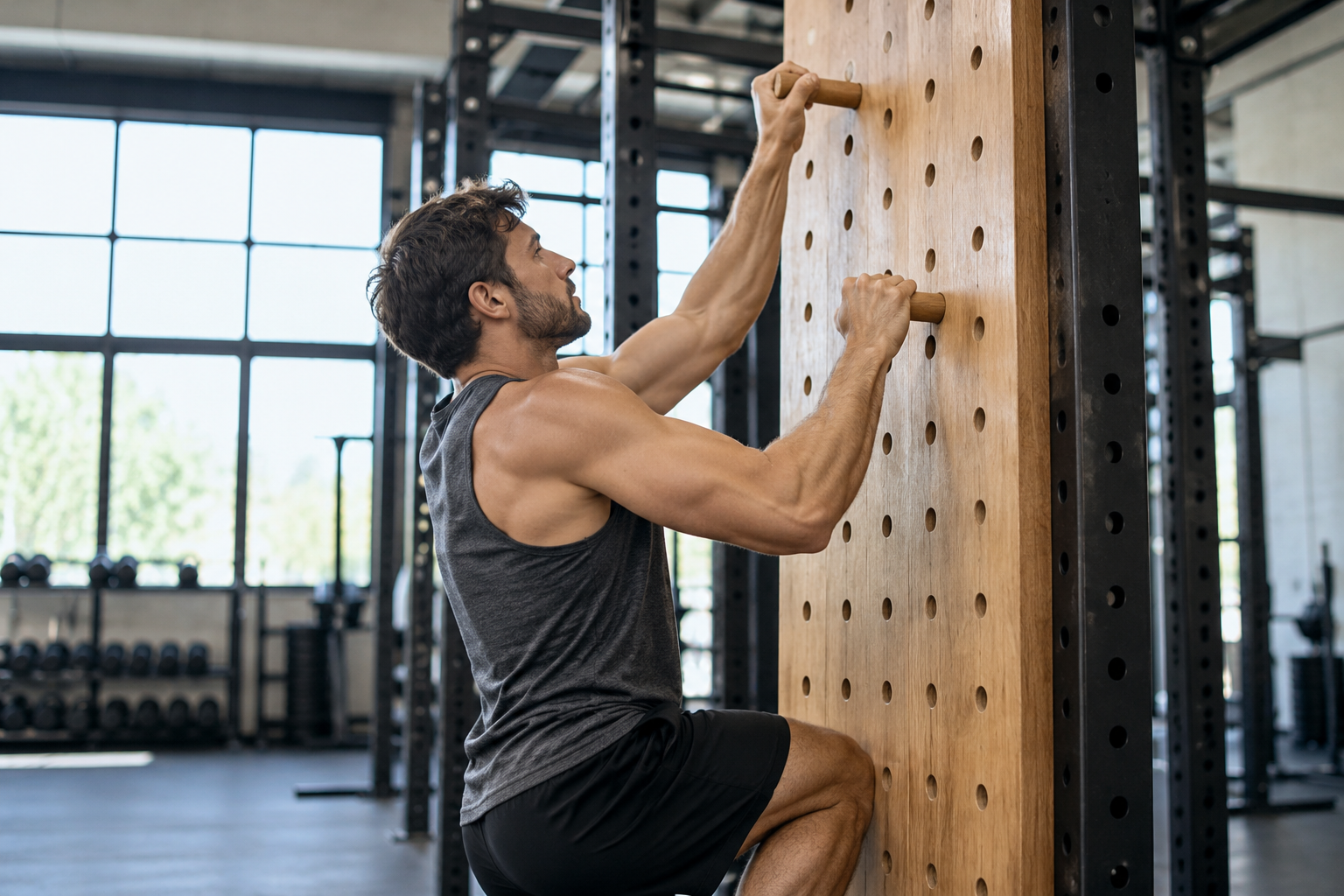
Pegboard exercises for strength development: techniques and progressions for professional gyms
The pegboard is a piece of equipment used in functional training, calisthenics, and athletic preparation to build pulling strength, grip ability, and body control. It consists of a panel with holes into which specific pegs are inserted, used as anchor points to support and move the body weight. The difficulty of the exercises depends on the hole layout, the distance between the anchor points, the angle of the panel, and the athlete's capabilities.
Pegboard exercises for strength development require coordinated work of the hands, forearms, arms, shoulders, and core musculature. Unlike traditional pull-ups, the user must also extract and reinsert the pegs during movement, alternating between phases of support and repositioning. This characteristic makes the pegboard particularly interesting for athletes who already possess a good strength base and wish to tackle more complex progressions.
For a gym manager or purchasing manager, introducing a pegboard requires an assessment that includes structure quality, mounting systems, operating space, and instructor skills. It is not enough to install the panel and immediately propose complete exercises: one must define adequate progressions, check technique, and organize usage in safe conditions. This guide delves into the main training criteria and the characteristics necessary to integrate the pegboard into a professional facility.
- How the pegboard works and what skills it trains
- Muscles involved and strength requirements
- Preparatory exercises for beginners
- Vertical progressions on the pegboard
- Horizontal movements and advanced variants
- How to program exercises to build strength
- Technique, safety, and errors to avoid
- Choosing and installing a professional pegboard
- Evaluating the investment and gym integration
How the pegboard works and what skills it trains
The pegboard uses a system of mobile anchors consisting of pegs inserted into the panel holes. During more demanding exercises, the athlete supports their own weight with one or two anchors and progressively modifies hand position. The movement requires sufficient strength to maintain suspension, coordination to move the pegs, and precision in reaching the next holes.
The panel configuration determines a major part of the difficulty. A vertical pegboard generally requires upward and downward movements, while a horizontal arrangement allows for lateral traverses. The distance between the holes influences the range of motion and the strength required during weight transfer.
The pegboard does not automatically replace traditional strength exercises. Pull-ups, rows, and specific forearm work remain useful tools for developing the necessary capabilities. However, the equipment introduces a coordinative component and unique anchor management that can enrich the preparation of already trained athletes.
The principle of mobile anchors
In pegboard movements, the pegs are used as temporary supports. The athlete must maintain a stable grip while changing the position of one of the anchors, avoiding uncontrolled body movements.
Transferring the load from one arm to the other represents one of the main difficulties. The ability to temporarily support a high portion of body weight requires specific preparation and should not be approached without adequate progressions.
Strength, coordination, and body control
The pegboard can contribute to the development of grip strength, pulling, and core stabilization. The need to coordinate hands and body also introduces a motor control component.
The trained capabilities depend on the chosen variant. A static suspension emphasizes maintaining the grip, while a complete ascent also requires repeated pulling and repositioning actions.
Muscles involved and strength requirements
Pegboard exercises involve several muscle groups that work together to support and move the body. The finger flexors and other forearm muscles contribute to maintaining the grip on the pegs. The arm musculature participates in elbow flexion, while the back muscles intervene in pulling movements and in controlling shoulder position.
The latissimus dorsi, biceps brachii, brachialis, and other muscles of the shoulder girdle contribute in varying degrees according to the position and phase of the exercise. Abdominal musculature and core stabilizers help limit unwanted oscillations and rotations. The work is therefore not limited to the hands, even if the grip often represents one of the limiting factors.
Before tackling complete exercises, it is appropriate to verify that the athlete possesses an adequate base of strength in pull-ups and the ability to hold their own weight in suspension. There is no universal number of repetitions that guarantees the necessary preparation: the required level depends on the pegboard configuration, technique, and individual characteristics.
Grip strength and forearm work
Grip strength is fundamental because contact with the pegs must remain stable during movement. An insufficient grip can compromise control even when the back muscles have adequate strength.
Preparatory exercises such as bar suspensions, loaded carries, and controlled holds can contribute to developing grip capacity. The progression must also consider the fatigue of the fingers and forearms.
Pulling strength and scapular stabilization
The ability to perform controlled pull-ups constitutes an important foundation. During the pegboard, in fact, the athlete must often maintain a position with flexed elbows while moving a peg.
Scapular control contributes to managing the forces on the shoulder. Pulling exercises performed with stable technique can be used to prepare users for the specific demands of the equipment.
Preparatory exercises for beginners
For a user who has never used the pegboard, the first phase should focus on familiarization with the pegs and understanding how to anchor them. It is not necessary to start with a full ascent. It is preferable to introduce exercises in which a portion of the body weight remains supported by the feet or an appropriate assistance system.
Initial progressions must allow for checking the ability to keep the pegs correctly inserted and to control body position. The presence of a qualified instructor is particularly important because the user might underestimate the difficulty of weight transfer between the anchors.
Preparatory exercises can be integrated with bar work, rows, and grip training. This combination allows for developing the necessary capabilities without focusing the entire training volume on a still-unfamiliar movement.
Familiarization with the pegs
A first activity consists of practicing inserting and extracting the pegs while keeping the feet stably planted on the floor or on a surface provided for assistance. The goal is to learn to recognize correct insertion before transferring significant load.
Precision must precede speed. A partially or incorrectly inserted peg should not be used as a support to hold the body.
Assisted suspensions and transfers
When the equipment configuration allows, the athlete can perform short assisted holds, limiting the weight supported by the arms. Subsequently, they can experiment with small transfers between nearby anchors.
The level of assistance must allow for controlled movement. Before increasing difficulty, the instructor should verify that the user maintains stability and knows how to stop the exercise safely.
Vertical progressions on the pegboard
The vertical ascent represents one of the most recognizable applications of the pegboard. The athlete starts from a set position, supports the body through the pegs, and progressively moves the anchors toward higher holes. Each advance requires a load transfer and new stabilization before the next movement.
Difficulty increases when holes are far apart, the body oscillates, or the ability to maintain pulling strength decreases. For this reason, it is useful to break down the progression into intermediate goals. Completing a few technically correct moves can be more productive than repeatedly attempting a full ascent without control.
The descent requires as much attention as the ascent. The accumulated fatigue can reduce precision in peg placement. The program must include a safe exit method consistent with the height and structure configuration.
First upward movements
The progression can begin with a single transfer to a higher hole, using an assistance system when necessary. The athlete must stabilize the body before extracting the peg to be repositioned.
The movement should be performed without excessive momentum. If the user cannot control the transfer, it is appropriate to reduce the difficulty rather than compensating with swinging.
Full ascent and descent management
A full ascent requires the ability to repeat different transfers while maintaining reliable technique. The distance traveled must be compatible with available strength and the expected level of fatigue.
The descent can be particularly demanding because it happens after the ascent phase. It is necessary to define in advance how to end the exercise, avoiding improvised jumps or movements that expose the user to a fall.
Horizontal movements and advanced variants
The pegboard can also be used for horizontal traverses when the structure is designed for this function. In these variants, the athlete progressively moves the pegs laterally, controlling body rotation and load distribution between the upper limbs.
Traverses require different management compared to vertical ascents. Lateral movement can increase the need for core stabilization and change the direction of forces applied to the anchors. Difficulty also depends on the distance between the holes and any possibility of using assistance.
Advanced variants should only be introduced when the athlete has consolidated technique. Increasing distance, duration, and movement complexity simultaneously makes it difficult to identify which factor is causing fatigue or loss of control.
Controlled lateral traverses
A traverse can be built through a few consecutive moves, keeping the body as stable as possible. The athlete must focus on the precision of insertion and gradual weight transfer.
When the movement becomes repeatable, it is possible to increase the number of steps. The progression should maintain technical quality and provide adequate recovery.
Variants with higher coordinative demands
Expert athletes can tackle paths that combine different directions, provided the structure is designed and installed for such uses. These variants increase the complexity of body control.
It is not necessary to introduce spectacular movements to obtain an effective stimulus. The difficulty should be chosen in relation to training goals, avoiding configurations that unnecessarily increase risk.
How to program exercises to build strength
Programming pegboard exercises to build strength must consider the athlete's level, path difficulty, and the overall volume of pulling already present in the training regimen. The pegboard can generate high demand on the hands, elbows, and shoulders, especially when numerous close attempts are performed.
For a strength goal, it is generally useful to prioritize quality sets, in which every transfer is executed with control. The number of steps, the duration of suspension, and the degree of assistance can be used to regulate the stimulus. It is not necessary to systematically seek failure, because the loss of grip or coordination can compromise safety.
The frequency of sessions must be compatible with individual recovery. An athlete who already does pull-ups, climbing, or intense forearm exercises might need a more cautious distribution of work. The progression should be monitored through simple and repeatable parameters.
Managing volume, intensity, and recovery
Volume can be expressed through the number of completed transfers, total work time, or the number of technically valid attempts. These parameters allow for comparing subsequent sessions.
Intensity depends on the difficulty of the variant and the portion of body weight supported. Increasing the number of steps without considering movement quality can produce excessive fatigue.
Building a progression over time
An effective progression can initially provide for assisted transfers, followed by short autonomous sequences, and subsequently by longer paths. The transition between levels should depend on the ability to maintain a stable technique.
It is useful to record the number of steps, assistance used, and perceived difficulty. This information allows instructors to adapt the program without indiscriminately increasing the workload.
Technique, safety, and errors to avoid
Safety is a priority when using the pegboard, as many exercises involve suspending the body at a variable height from the floor. The quality of the mounting, the integrity of the pegs, and the presence of an adequately protected fall zone must be verified before training. The characteristics of the protections must be consistent with risk assessment and manufacturer instructions.
During execution, the athlete must check peg insertion and maintain a reliable grip. A transfer executed too quickly can lead to loading an anchor that is not yet stabilized. Fatigue can also reduce movement precision and increase the risk of losing support.
Safety in pegboard training also depends on the choice of variant. An exercise that is technically too difficult does not become appropriate simply because the athlete is motivated to complete it. Supervision must include the possibility of interrupting the set before control is compromised.
Common technical errors
Among the most common errors are incomplete peg insertions, excessive swinging, and attempts to reach holes that are too far apart. Using an already fatigued grip can also reduce the ability to control the body.
Correction should start by reducing difficulty. Shorter paths, adequate assistance, and sufficient recovery times allow focusing on precision.
Checks before every use
Before the session, it is necessary to verify the integrity of the panel, holes, and pegs, as well as the presence of any signs of damage. A deformed or deteriorated component must not be used.
It is also important to check that the area underneath is clear and that the provided protections are correctly positioned. Verification methods must follow manufacturer instructions and internal gym procedures.
Choosing and installing a professional pegboard
The choice of a pegboard intended for a professional gym must start from an analysis of the users and planned activities. A panel used occasionally for assisted exercises might have different organizational needs than a structure intended for expert athletes performing full ascents and traverses.
Technical characteristics to verify include panel material, hole geometry, peg quality, stated load capacity, and installation methods. It is important to ascertain that the structure is designed for the stresses generated by the planned exercises. The mere apparent strength of the panel does not allow evaluating the suitability of the entire system.
Installation must be performed according to manufacturer guidelines and with verification of the suitability of the surface or load-bearing structure. Loads can generate significant stress on attachment points. In case of doubt about the capacity of the wall or support, a qualified technical assessment is necessary before use.
Materials, dimensions, and hole configuration
The choice of materials must consider strength, durability, and environmental conditions. Pegs must be compatible with the holes and designed for the intended use, without improvised adaptations.
The distance between holes determines the difficulty of transfers. A versatile configuration can allow for different progressions, but each path must respect the usage methods permitted by the manufacturer.
Mounting, operating space, and floor protection
Mounting is a critical element because it must safely transfer stresses to the load-bearing structure. It is not appropriate to choose anchors or other components based only on generic information.
The surrounding space must allow for planned movements and keep the area underneath free. To protect the exercise zone, it may be necessary to provide anti-shock gym flooring or other protection systems appropriate to the specific risk. The presence of a shock-absorbing surface does not eliminate the danger of falling and does not replace correct installation design.
Evaluating the investment and gym integration
For a gym manager, adding a pegboard should respond to precise needs. The equipment can enrich an area dedicated to calisthenics, athletic preparation, or functional training, but it does not necessarily represent a priority for all facilities. Its value depends on the member profile, instructor skills, and the possibility of proposing appropriate progressions.
Economic assessment must include equipment price, installation, any protections, maintenance, and space required. A relatively compact panel can require a wider operating area than the physical dimensions alone suggest. It is therefore important to consider the entire station, not just the pegboard footprint.
Pegboard exercises for strength development can help differentiate a gym's offering when included in structured programs. However, the return on investment should not be evaluated exclusively through the originality of the equipment. It is more useful to consider the number of potentially interested users and the expected frequency of use.
Integrating the pegboard into the functional area
The pegboard can be placed near other equipment dedicated to pulling and body control, provided safety distances are respected and no interference is created between stations. The layout should facilitate supervision by instructors.
Integrated programming can combine preparatory bar exercises, grip work, and specific progressions on the pegboard. In this way, the equipment becomes part of a training path rather than a station used only for occasional attempts.
Decision criteria for the purchasing manager
Before purchasing, it is appropriate to verify professional intended use, stated capacity, installation instructions, availability of spare parts, and maintenance procedures. Compatibility with the load-bearing structure must be ascertained before confirming the choice.
It is useful to also involve instructors in the evaluation, because they will be responsible for selecting exercises and supervision. Technically valid equipment can remain underutilized if staff does not possess the necessary skills to propose effective progressions.
The decision should therefore consider technical characteristics, safety, and the quality of the training experience together. A correctly installed, maintained, and used pegboard can expand the possibilities for developing pulling strength and grip, offering the gym a specialized tool consistent with professional programming.
Comments (0)