
Trolley
You have no items in your shopping cart

 Budgets
 Dumbers
 Discs
 Benches
 Racks and Rigs
 Weights Holders
 Isotonic machines
 Calisthenics
 Cardio
 Kettlebells
 Flooring
 Gym Set
 Accessories
 Combat
 ARTI MARZIALI
 CONTAINER GYM
 Tug-Of-War
 Used Gym Equipment
 PILATES MACCHINARI
 GINNASTICA ARTISTICA
 CAMPI DA PADEL
 Prodotti in Pronta Consegna
 Informazioni
 IRONMAN
 Gift Card
- Donatif
- General information
- 0 I like it
- 79 Views
- 0 comments
- gym flooring, safety flooring, gym safety, shock-absorbing materials
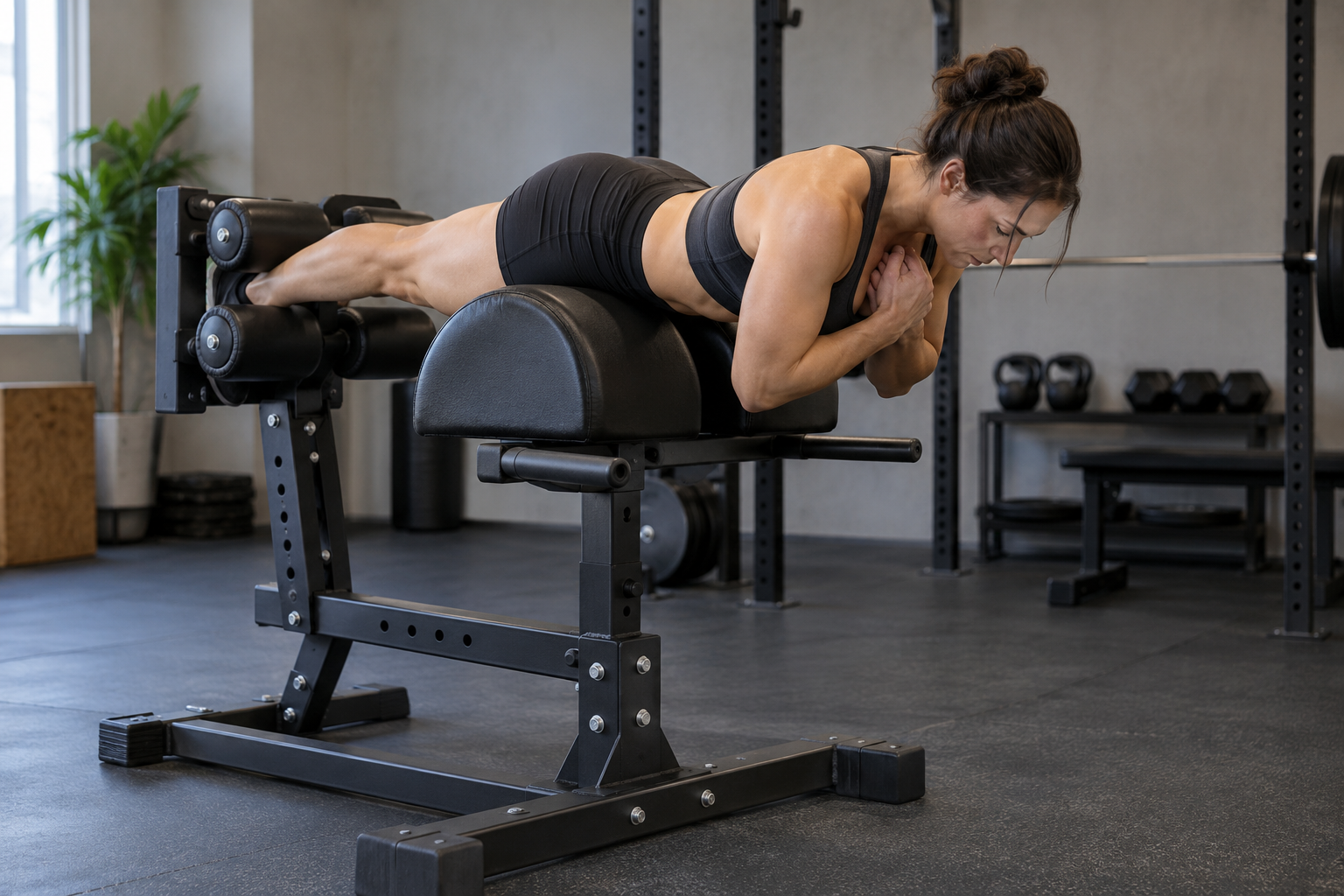
What is a GHD Machine for Training: Uses and Benefits for the Gym
The GHD machine is a piece of equipment used in strength training, athletic preparation, and physical conditioning programs. Its name derives from the English expression Glute Ham Developer, which refers to the engagement of the glutes and posterior thigh muscles. The structure allows for bodyweight exercises in which the torso or legs move relative to stabilized support points, creating particularly interesting conditions for working the posterior muscle chain.
Understanding what a GHD training machine is means knowing not only its function, but also the differences compared to traditional benches, the exercises that can be performed, and the requirements needed to use it correctly. For a gym manager, the GHD can represent complementary equipment to stations dedicated to squats, deadlifts, and functional training, provided it is integrated into a program consistent with user capabilities.
Choosing a professional GHD machine requires attention to structural stability, the geometry of the supports, adjustment possibilities, and padding quality. These elements affect the equipment's adaptability to people with different physical characteristics and the ability to perform controlled movements. This guide explores how the GHD works, its main applications, and practical criteria for evaluating its inclusion in a professional fitness room.
- What a GHD machine is and how it works
- Which muscles are involved in GHD exercises
- Main exercises that can be performed on the GHD machine
- Adjustments and correct user positioning
- Execution technique and safety during training
- Differences between GHD and other posterior chain equipment
- How to choose a GHD for a professional gym
- Exercise programming and maintenance
- Evaluating the investment in a GHD machine
What a GHD machine is and how it works
The GHD machine is a structure generally composed of a stable frame, a padded support for the pelvis or upper thighs, and a system of supports designed to lock the feet. The configuration allows the user to perform movements in which body weight constitutes a major part of the resistance. Depending on the exercise, the movement may predominantly involve the hip joint, the knee joint, or trunk flexion.
The distinguishing feature of the GHD is the ability to work with the body supported in a horizontal or near-horizontal position while keeping the feet stabilized. This configuration allows for movements different from those proposed by common abdominal benches or guided isotonic machines. Intensity depends on body position, joint range of motion, and user capabilities.
Not all GHD machines have the same characteristics. Some models offer wide adjustments of the distance between the support and foot supports, while others prioritize compactness and construction simplicity. For professional use, it is important to verify that the geometry allows correct positioning for people of different heights.
Main structural components
The frame forms the base of the equipment and must maintain stability during exercise execution. Padded supports sustain the body and distribute pressure in contact areas, while foot supports stabilize the lower limbs.
The quality of connections, padding, and adjustment mechanisms affects overall functionality. A machine intended for intensive use must be designed to withstand repeated stress and allow periodic component checks.
Biomechanical principle of GHD exercises
During exercises on the GHD, body weight generates force moments that vary according to position relative to support points. The musculature must produce tension to control movement and maintain required alignment.
Perceived resistance does not necessarily remain constant throughout the entire range of motion. For this reason, it is important to use appropriate technical progressions and not consider every bodyweight exercise automatically suitable for beginners.
Which muscles are involved in GHD exercises
Muscle engagement depends on the exercise performed. The GHD is frequently associated with glute and hamstring training, but it can also be used for exercises involving spinal extensors and abdominal muscles. The same equipment therefore allows for different stimuli by modifying the starting position and movement mode.
In hip extension exercises, the gluteus maximus and hamstrings contribute to producing the force needed to return the body to the intended position. Spinal extensors may intervene to keep the torso stable. In exercises involving active knee flexion, the role of the hamstrings in their function as flexors increases.
In abdominal movements performed on the GHD, however, the abdominal wall muscles and hip flexors intervene, with a contribution that changes according to the technique used. It is therefore necessary to avoid overly generic descriptions that attribute all GHD exercises to the same muscle groups.
Glutes and posterior thigh muscles
The gluteus maximus participates primarily in hip extension, while the hamstrings contribute to both hip extension and knee flexion, with differences among individual muscles. Exercises on the GHD can exploit these functions through controlled movements.
The glute ham raise represents a particularly interesting example because it requires a significant contribution from the posterior thigh musculature. Difficulty can be high even without using external loads.
Spinal extensors and abdominal musculature
Spinal extensors contribute to controlling trunk position during numerous exercises. Depending on the technique, they can primarily perform a stabilizing function or participate in movement.
In abdominal exercises, the rectus abdominis and other trunk muscles intervene in managing flexion and stability. The range of motion must be adapted to the user's capabilities, avoiding uncontrolled ranges.
Main exercises that can be performed on the GHD machine
The versatility of the GHD stems from the possibility of performing exercises with different objectives using a single structure. Among the best-known movements are glute ham raises, hip extensions, trunk extensions, and sit-up variants. Each exercise requires a specific setup and should not be proposed without evaluating the user's capabilities.
The level of difficulty can vary considerably. Some movements require significant posterior thigh muscle strength, while others can be adapted through reduced ranges of motion or external assistance. The instructor must distinguish between exercises intended for learning and more demanding variants.
For a professional gym, the GHD can be integrated into athletic preparation, strength training, and conditioning programs. Exercise selection should respond to program goals without using the equipment solely to introduce unusual movements.
Glute ham raise for the posterior chain
In the glute ham raise, the user keeps their feet stabilized and controls body movement through the action of the posterior musculature. Support position and range of motion significantly influence difficulty.
For less experienced users, assisted variants or partial movements may be necessary. The initial goal should be to develop control and the ability to manage body weight before increasing difficulty.
Hip extensions and abdominal variants
Hip extensions can be used to train posterior musculature through controlled trunk movement relative to the lower limbs. It is important to avoid confusing hip extension with unnecessary lumbar hyperextension.
Abdominal variants on the GHD require special attention to pelvic position and range management. Some executions can be very demanding and are not automatically appropriate for beginner users.
Adjustments and correct user positioning
Correct positioning represents one of the most important aspects when using the GHD machine. The distance between foot supports and the main support must be adapted to the user's build and the intended exercise. Inadequate adjustment can alter biomechanical leverage and make movement harder to control.
Pelvic position relative to the padding influences hip freedom of movement. In extension exercises, it is necessary to verify that the support does not obstruct the planned range. In movements requiring greater knee flexor contribution, the machine's geometry must allow stable support.
Adjustments must be made before starting the set. During execution, pins and locking systems must remain correctly engaged. In a gym frequented by numerous users, ease of adjustment represents an important operational advantage.
Adjusting the distance between supports and pads
The distance must allow the user to maintain a stable position without excessively compressing contact areas. There is no universal adjustment valid for all exercises and builds.
The instructor should verify positioning through a controlled test, observing stability, joint freedom, and the ability to complete the planned movement.
Foot stabilization and comfort
Feet must be stabilized by the manufacturer's provided supports. Insufficient support can compromise movement control, while excessive pressure can make execution uncomfortable.
It is important to check the integrity of the padding and proper functioning of adjustment systems. Damaged components must be checked before allowing further use.
Execution technique and safety during training
GHD exercises can produce high muscular demands even when no additional weights are used. Body position and lever length determine significant force moments. For this reason, it is important to introduce movements gradually, especially with users lacking specific experience.
Correct execution requires descent phase control, pelvic stability, and joint range management. Rapid, uncontrolled movements can increase difficulty without necessarily offering a more appropriate stimulus. Technique must be adapted to the goal and individual capabilities.
Safety in GHD exercises also depends on supervision quality. Instructors must verify that the user understands the movement and knows how to stop the set when losing control. The presence of pain or abnormal discomfort requires suspending the exercise and appropriate evaluation.
Progressions for beginner users
For beginners, it is useful to start with simpler posterior chain exercises, subsequently introducing GHD variants. Progression can include assisted movements, reduced ranges, and a limited number of repetitions.
Transitioning to more demanding exercises should occur when the user demonstrates adequate control. Reaching muscular failure is not necessary to obtain a useful training stimulus.
Common technical errors
Frequent errors include inadequate machine adjustment, using excessive range of motion, and loss of control during the eccentric phase. Marked spinal compensations may also indicate that the chosen variant is too demanding.
The instructor should correct movement by reducing difficulty when necessary. Repeatable technique allows better progress monitoring and maintains consistent training conditions.
Differences between GHD and other posterior chain equipment
The GHD is sometimes confused with the hyperextension bench or trunk extension machines. Although this equipment may involve similar muscle groups, differences exist in geometry, support points, and allowed movements. Selection must therefore consider the exercises intended to be proposed.
A 45-degree extension bench, for example, allows hip extension movements to be performed with a different configuration than the GHD. The GHD machine also offers the ability to perform glute ham raises and certain abdominal variants, increasing station versatility.
Isotonic machines dedicated to posterior thigh muscles, like certain leg curl types, use guided resistance systems. This equipment allows different load adjustments compared to GHD bodyweight exercises. The two solutions can therefore be complementary within the same strength room.
GHD and hyperextension bench
The hyperextension bench is generally designed to support the pelvis and stabilize lower limbs during trunk movements. The GHD features a configuration that also allows exercises with significant knee flexion involvement.
Selection depends on facility goals. An athletic preparation-oriented gym might find the greater variety of GHD exercises useful, while other contexts might prioritize simpler equipment.
### GHD and leg curl machines
Leg curl machines train knee flexion through adjustable resistance. This can facilitate load adaptation for users with differing strength levels.
The glute ham raise on the GHD instead uses a bodyweight configuration that can be demanding even for trained athletes. The two pieces of equipment are not necessarily substitutable and can be integrated into programming.
How to choose a GHD for a professional gym
Choosing a professional GHD machine should start by analyzing users and planned activities. A facility dedicated to functional training may use the GHD for different exercises compared to a traditional strength room. It is therefore important to define what movements will be proposed and how frequently.
Frame stability represents a fundamental requirement. During exercises, the body can generate considerable stress on the structure, especially when long levers are used. The machine must maintain a stable position and respect manufacturer-declared usage limits.
Adjustments must allow the station to be adapted to users with different anthropometric characteristics. Padding quality, locking system accessibility, and cleaning ease also contribute to equipment functionality in a professional context.
Frame stability and build quality
A robust frame must maintain its geometry during use and offer stable floor support. Base dimensions, connection quality, and declared load capacity should be verified.
Construction characteristics must be evaluated through verifiable technical information. Machine weight alone is not enough to establish quality, as stability also depends on overall design.
Adjustments, padding, and adaptability
A GHD intended for numerous users should allow quick and safe adjustments. Locking systems must be accessible and stably maintain the selected position.
Padding must offer adequate support and withstand repeated use. Easily washable upholstery and replaceable components can help simplify daily management.
Exercise programming and maintenance
Integrating the GHD into a professional gym requires programming consistent with user capabilities. Exercises can be used as complementary to strength training, in athletic preparation, or within specific circuits. Volume and intensity selection must consider experience level and work already performed for the same muscle groups.
More demanding exercises, like certain glute ham raise variants, can place high demands on posterior thigh musculature. It is therefore advisable to introduce them progressively and monitor user response. Intense muscle soreness after early sessions may indicate a need to reduce initial volume.
GHD maintenance includes structure checks, adjustment system verification, and surface cleaning. In a professional room, these operations should be integrated into periodic equipment inspection procedures.
Integrating the GHD into strength programs
The GHD can be used for complementary exercises dedicated to the posterior chain. Sets and reps should be defined relative to athlete goals and recovery capacity.
For inexperienced users, prioritizing technical control over work volume is preferable. As strength and coordination improve, more demanding variants can be introduced.
Periodic checks and conservation
Inspections should include padding integrity, connection tightness, and proper adjustment system function. Any abnormal play or structural damage requires evaluation before use.
Cleaning must be performed with products compatible with materials. It is also important to keep the surrounding area clear, preventing other equipment from interfering with movements performed on the machine.
Evaluating the investment in a GHD machine
For a gym manager, understanding what a GHD training machine is helps evaluate whether this equipment responds to a real facility need. The GHD can expand posterior chain training possibilities and offer useful variants for athletic preparation, but its value depends on usage frequency and staff ability to propose appropriate exercises.
Before purchasing, existing equipment should be analyzed. If the room already features extension benches, leg curl machines, and functional training equipment, the GHD should be evaluated based on the additional functions it can offer. Introducing a new machine is unnecessary when user goals are already met through adequate tools.
Economic evaluation should include initial price, footprint, expected lifespan, and maintenance needs. For a professional gym, considering space availability and the ability to place equipment in an easily supervised area is also important.
Integrating the GHD into the strength area
The GHD can be placed near stations dedicated to athletic preparation and posterior chain training. Functional layout facilitates exercise integration into programs and reduces unnecessary user movement.
When evaluating setup, considering gym equipment and accessories that complete the strength area is also useful. Selection should maintain consistency between training goals, available space, and user level.
Criteria for an informed purchasing decision
An effective decision should be based on stability, adjustments, padding quality, intended use, and available support. Requesting updated technical information and verifying machine suitability for intended use is recommended.
The purchasing manager should also consider staff training. A correctly used GHD can offer interesting training opportunities, while a lack of specific skills can limit operational utility.
Investing in a GHD machine therefore means evaluating the contribution this equipment can offer gym programming. When choice is supported by concrete needs, adequate space, and competent supervision, the GHD can become a functional station to develop strength and posterior chain control, contributing to the variety and quality of service offered to members.
Comments (0)