
Trolley
You have no items in your shopping cart

 Budgets
 Dumbers
 Discs
 Benches
 Racks and Rigs
 Weights Holders
 Isotonic machines
 Calisthenics
 Cardio
 Kettlebells
 Flooring
 Gym Set
 Accessories
 Combat
 ARTI MARZIALI
 CONTAINER GYM
 Tug-Of-War
 Used Gym Equipment
 PILATES MACCHINARI
 GINNASTICA ARTISTICA
 CAMPI DA PADEL
 Prodotti in Pronta Consegna
 Informazioni
 IRONMAN
 Gift Card
- Donatif
- General information
- 0 I like it
- 194 Views
- 0 comments
- gym flooring, safety flooring, gym safety, shock-absorbing materials
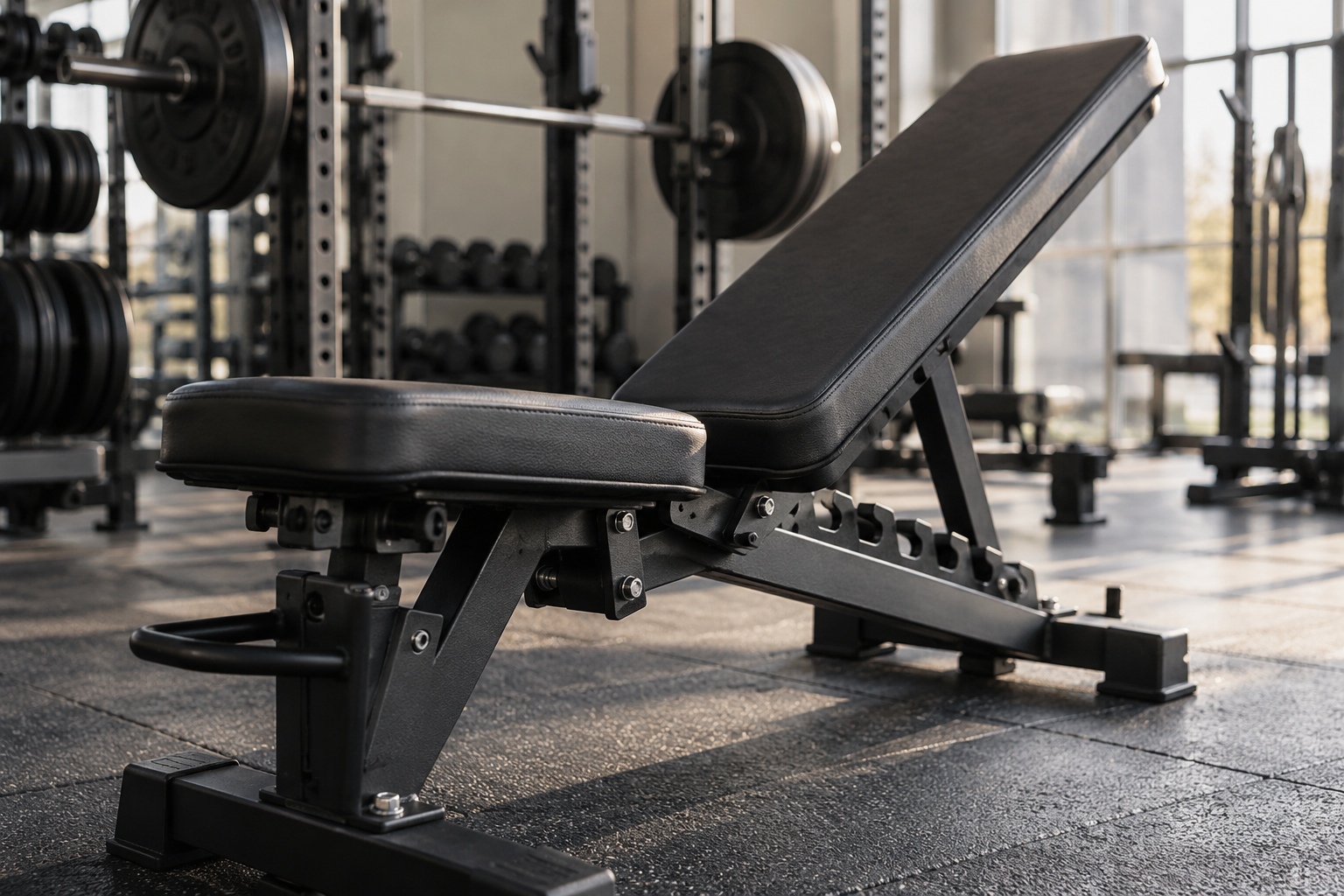
How to choose a high-capacity weight bench: technical criteria for a safe choice
Understanding how to choose a high-capacity weight bench is essential for anyone managing a professional weight room, designing a powerlifting area, or purchasing equipment intended for intensive use. The load capacity stated by the manufacturer is one of the first parameters to check, but it is not sufficient to determine the overall quality of the structure. Stability, geometry, materials, construction features, and conditions of use all affect the bench's true suitability for athletes' needs.
A bench designed to support heavy loads must offer predictable behavior during exercise, maintain a stable base, and allow correct body positioning. For a purchasing manager, the main risk consists in comparing products using exclusively the maximum load value, without verifying how this figure was determined and what operating conditions are provided by the manufacturer. Two benches with seemingly similar nominal capacities can in fact present significant differences in construction and intended use.
The choice becomes even more important when the bench is used daily by athletes with different levels of experience. In these contexts, a proper investment must consider both the required performance and management costs over time. This guide analyzes the main technical and commercial criteria for selecting a high-capacity bench, distinguishing truly useful features from specifications that, considered in isolation, can generate incomplete evaluations.
- What high capacity really means in a weight bench
- How to determine the necessary load capacity
- Structure, materials, and build quality
- Stability and geometry of the bench
- Dimensions and ergonomics for the weight room
- Flat or adjustable bench: which one to choose
- Safety and integration with racks and barbells
- Costs, maintenance, and equipment lifespan
- Technical checklist for comparing alternatives
- How to plan the investment in a professional bench
What high capacity really means in a weight bench
Capacity indicates the maximum load that a bench can support under the conditions specified by the manufacturer. In the professional equipment sector, this value is generally expressed in kilograms, but its meaning must be interpreted carefully. Some manufacturers indicate the total weight sustainable by the structure, while others distinguish the user's weight from the external load. Without this clarification, comparing two technical datasheets can lead to wrong conclusions.
A high-capacity weight bench should not be evaluated solely through the number reported in the commercial description. It is necessary to understand whether the value refers to a static load, specific test conditions, or an operational limit defined for the intended use. The stresses produced during an exercise can in fact vary depending on the movement, weight distribution, and the ways the athlete comes into contact with the structure.
For a professional gym, it is therefore advisable to request technical documentation that clarifies the stated capacity and any limitations. A verifiable figure allows for a better assessment of the equipment's compatibility with users and avoids purchases based on generic indications. The lack of sufficient information does not necessarily demonstrate poor quality, but it represents an element of uncertainty to be resolved before investing.
Difference between nominal capacity and operating conditions
Nominal capacity represents the value declared by the manufacturer according to criteria that must be specified in the documentation. Operating conditions, on the other hand, include the actual methods of use, weight distribution, and any anticipated limitations. A high value does not automatically authorize any use of the bench.
For example, a structure declared suitable to support a given total load must be used in compliance with the instructions regarding athlete positioning and permitted exercises. It is incorrect to interpret capacity as a guarantee of resistance to impacts, dropped weights, or unforeseen stresses.
How to verify the stated capacity
A complete technical datasheet should report the maximum allowable load, the intended use, and any test conditions. When available, test reports and references to applicable technical standards can help make the comparison more transparent.
The purchasing manager should request clarification when capacity is presented without indicating whether it includes the user's weight. This information is particularly important in strength-training areas, where the total load can become significant.
How to determine the necessary load capacity
The choice of capacity must start from the analysis of the users and planned exercises. A general-purpose gym may have different needs compared to a center specialized in powerlifting. In the first case, the bench might be used for workouts with dumbbells and barbells of varying intensity. In the second, it must be compatible with strength sessions where athletes employ particularly heavy loads.
To define the minimum requirement, it is necessary to consider the user's weight and the external load sustained during the exercise, verifying how these elements are counted in the declared capacity. The calculation must not be interpreted as a certification of the bench's safety, but as a preliminary tool to identify potentially suitable products.
It is also advisable to consider the growth of the facility's needs. A gym intending to develop a strength area might find itself using higher loads than those currently most frequent. Choosing a capacity consistent with future scenarios can avoid premature replacements, provided that the increase in capacity is accompanied by adequate construction features and documentation.
Athlete weight and external overload
Consider, by way of example, an 110 kg athlete performing a press with a barbell loaded to 180 kg. The arithmetic sum of the two values is equal to 290 kg. This figure can help set an initial evaluation, but it does not automatically describe the load actually transmitted to the bench during each phase of the movement.
During the press, in fact, part of the forces is transferred through the feet and the support system, while the barbell is supported by the athlete or the dedicated supports. Sizing must therefore refer to the conditions indicated by the manufacturer, without using the simple sum of weights as the sole safety criterion.
Why provide a capacity margin
Purchasing a bench destined to operate constantly near the stated limit can reduce the flexibility of the structure. A margin with respect to anticipated needs makes it possible to accommodate different users and manage any developments in activity.
However, there is no universal percentage margin applicable to all benches. The choice must respect the manufacturer's instructions and consider the actual conditions of use. A very high nominal value, devoid of information on the quality of the structure, does not represent superior security by itself.
Structure, materials, and build quality
The strength of a bench depends on the design of the entire structure. Frame, connections, welds, support points, and fastening systems all contribute to the ability to withstand anticipated stresses. Focusing exclusively on the thickness of the tubing can be misleading, because overall strength also depends on geometry and connection quality.
Professional benches frequently use metal structures designed to offer a balance between rigidity, weight, and practicality. Steel is a common material, but its simple presence does not allow one to determine the quality of the equipment. It is necessary to evaluate the declared characteristics, the design project, and the suitability for the intended use.
For a gym manager, construction quality also affects operational continuity. Components that loosen frequently, easily damaged coverings, or connections that are difficult to inspect can increase maintenance interventions. Robustness must therefore be considered together with ease of inspection and the availability of replacement components.
Steel frame and structural configuration
The weight bench frame must be designed to distribute stresses in a manner compatible with the intended use. The section of the tubing, the thickness of the material, and the arrangement of load-bearing elements influence the behavior of the structure, but none of these parameters can be evaluated in isolation.
A seemingly massive configuration is not necessarily superior to a lighter structure designed and verified correctly. For this reason, documentation relating to capacity and test conditions remains more meaningful than an evaluation based solely on outward appearance.
Welds, connections, and finishes
Welds and mechanical connections represent important points in the construction of the bench. Visible defects, deformations, or improperly assembled components require attention. A simple observation, however, does not allow one to certify the strength of the welds.
Surface finishes contribute to material protection and ease of cleaning. In a professional environment, where equipment is used frequently, it is also useful to check the resistance of the coating and the possibility of performing maintenance work without difficulty.
Stability and geometry of the bench
The stability of the weight bench is one of the most important requirements for professional use. A structure must maintain reliable support during the athlete's positioning, the execution of the exercise, and exiting the station. Unwanted oscillations can compromise the perception of control and make training less comfortable.
Stability depends on the geometry of the base, mass distribution, and the surface on which the bench is installed. A wide base can help improve support, but it must be evaluated together with the position of the supports and the ability to place the feet correctly. The best solution does not necessarily coincide with the one that takes up the most space.
For a weight room, it is important to check the behavior of the bench on the flooring actually present in the facility. Irregular surfaces, improperly laid flooring elements, or non-uniform supports can influence the stability of even properly designed equipment. Verification must be carried out in compliance with the installation instructions.
Base configuration and contact points
Benches can use bases with different geometries and numbers of support points. Some configurations favor foot positioning freedom, while others adopt wider cross elements. The evaluation must consider both stability and ergonomics during exercise.
Stable support must be verified under expected operating conditions, not just when the bench is empty. It is also important to check that any feet or non-slip elements are intact and compatible with the installation surface.
Flooring and positioning in the room
The installation surface must be even, sufficiently stable, and adequate for the characteristics of the equipment. Sports flooring can help protect the subfloor and manage conditions of use, but it does not automatically correct support defects or structural problems of the bench.
The position must also allow easy access to the station and adequate space for any spotters. In powerlifting areas, the arrangement relative to the rack and passageways takes on particular importance.
Dimensions and ergonomics for the weight room
A high-capacity bench must also allow for effective athlete positioning. Height, width, length, and padding characteristics influence the ability to maintain a stable posture during exercises. A very sturdy structure that is poorly suited to the users' characteristics can prove to be an operationally limiting choice.
In powerlifting, the height of the support surface and the width of the backrest can affect the ability to assume the desired position during the press. For competitive athletes, it is also necessary to verify the dimensions required by the regulations of the reference federation. A bench intended for a general-purpose gym can follow different criteria, provided it is suitable for the planned exercises.
The upholstery represents a further element to consider. A surface that is too slippery can make it harder to maintain position, while excessively soft padding can alter the sense of support. Ease of cleaning and wear resistance are also relevant aspects when equipment is shared by numerous users.
Height and width of the backrest
The height of the bench influences the contact of the feet with the floor and the ability to assume a stable position. A measurement suitable for a tall athlete might prove less practical for a shorter user. For this reason, in gyms with a heterogeneous clientele, it is advisable to carry out checks with people of different builds.
The width of the backrest must offer adequate support without unnecessarily interfering with arm movement. In facilities dedicated to powerlifting, compatibility with applicable sports specifications represents an additional criterion.
Padding, upholstery, and comfort
The padding must offer sufficiently uniform support and maintain its characteristics during use. Material density, thickness, and the construction of the underlying panel can influence the sensation of stability.
Durable and easily cleanable upholstery facilitates daily gym management. It is useful to check the availability of replacement padding, especially when the bench is intended for intensive and prolonged use.
Flat or adjustable bench: which one to choose
The choice between a flat and an adjustable bench depends mainly on the planned exercises. A professional flat bench generally features a simpler configuration, with a fixed support surface. This characteristic can favor positioning repeatability and reduce the number of moving components to check.
An adjustable bench, on the other hand, offers the possibility of modifying the inclination of the backrest and, in some models, the seat. This versatility can be useful in weight rooms offering numerous variations of dumbbell and barbell exercises. However, the presence of adjustment mechanisms introduces additional elements that must be evaluated in terms of stability, load capacity, and maintenance.
For a fitness center, there is no universally correct answer. A facility specialized in bench pressing may favor dedicated fixed stations, while a gym with limited space could benefit from adjustable equipment. The decision must consider frequency of use, training type, and space availability.
### When to prefer a professional flat bench
The professional flat bench for powerlifting is particularly relevant when the goal is to create a dedicated station for barbell pressing. A fixed surface allows for constant geometric characteristics, facilitating the repeatability of training conditions.
It is still necessary to check the declared capacity, stability, and compatibility with the supports used. A flat bench is not automatically suitable for competitive powerlifting just because it features a sturdy structure.
When to choose an adjustable bench
An adjustable bench can be an interesting solution when the same station must support incline presses, seated exercises, and dumbbell workouts. However, versatility must be accompanied by reliable locking mechanisms and adequate capacity in permitted configurations.
Before purchasing, it is advisable to check whether the maximum declared capacity remains identical at all inclinations or changes depending on position. Any limitations must be reported in the technical documentation.
Safety and integration with racks and barbells
A weight bench must not be evaluated as an isolated element. In stations dedicated to barbell pressing, safety also depends on supports, safety devices, equipment arrangement, and usage procedures. High capacity does not compensate for the absence of adequate systems for load management.
Compatibility with racks and support structures must be verified considering dimensions, accessibility, and barbell position. A bench that is too long, too wide at the base, or difficult to position can create operational problems even when its structural characteristics are adequate. The choice must therefore be made by observing the entire station.
To evaluate the different configurations available, it is useful to compare the characteristics of professional weight benches in relation to the exercises and structures already present in the gym. This approach makes it possible to identify concrete requirements before requesting a commercial offer, avoiding treating load capacity as the sole decision-making parameter.
Compatibility with racks and supports
The bench must be correctly positioned relative to the rack, allowing the athlete to reach the barbell without assuming forced positions. It is important to check the available space between structural elements and the ability to adjust supports to the necessary height.
When the station is used by multiple people, the ease of positioning the bench assumes significant operational value. Wheels and handles can facilitate movement, but they must be designed so as not to compromise stability during exercise.
Safety systems and spotting during exercise
Barbell presses may require adequate safety systems and, under certain conditions, the assistance of competent personnel. The presence of adjustable supports or devices designed to intercept the load can help manage risks, provided they are correctly sized and used.
Training procedures must comply with the instructions of the manufacturers of the equipment involved. The fact that a bench has a high capacity does not mean it is designed to directly receive the drop of a loaded barbell.
Costs, maintenance, and equipment lifespan
The purchase price of a professional bench represents only part of the overall cost. For a facility that uses equipment daily, it is important to consider maintenance, spare parts availability, any corrective interventions, and the expected lifespan of components. A bench that is economically convenient at the time of purchase can entail greater expenses if it requires frequent replacements.
Product comparison should therefore include the quality of documentation, warranty conditions, and the possibility of obtaining support. A manufacturer that provides clear indications on control procedures allows the manager to better organize routine maintenance. The availability of padding, feet, and fastening components can also affect operational continuity.
It is incorrect to assume that a more expensive bench is necessarily more resistant. Price can depend on numerous factors, including configuration, materials, finishes, ergonomic characteristics, and included services. To compare different offers, it is necessary to verify that they meet the same functional and technical requirements.
Initial cost and total cost of ownership
The total cost of ownership of a weight bench includes the initial expense and any costs incurred during the equipment's useful life. For example, a bench purchased for 500 euros with 100 euros of maintenance and spare parts over five years presents a hypothetical total cost of 600 euros, without considering other charges.
A second bench purchased for 650 euros might prove economically preferable if it required fewer interventions and offered a longer lifespan, but this convenience must be demonstrated through reliable data. The amounts in the example are purely illustrative and do not represent verified market prices.
Scheduled maintenance and checks
Routine maintenance can include checking connections, inspecting support surfaces, verifying padding, and observing any deformations or signs of wear. Operations must follow the manufacturer's instructions and must not involve unauthorized structural modifications.
In a professional gym, it is useful to record interventions performed and define clear responsibilities for periodic checks. In the presence of anomalies that could compromise use, equipment must be removed from service until appropriate evaluation.
Technical checklist for comparing alternatives
A structured checklist makes it possible to reduce the number of alternatives without relying on commercial impressions. The first step consists in defining the intended use: general-purpose weight room, strength area, powerlifting, or multi-function station. Subsequently, it is necessary to identify the required load and verify that the declared capacity is compatible with expected operating conditions.
The evaluation should also include stability, dimensions, ergonomics, build quality, and maintenance. For each product, it is useful to record available information and flag missing data. An alternative with a very high capacity value but lacking sufficient documentation may require further verification before being considered suitable.
Price should be compared only after excluding solutions that do not meet essential requirements. This method avoids choosing seemingly convenient equipment that could prove unsuitable for the gym. It also makes it possible to justify the decision to management or the investment manager.
Mandatory requirements and preferential characteristics
Mandatory requirements include compatibility with intended use, adequately documented load capacity, structural stability, and compliance with installation instructions. Preferential characteristics may include ease of movement, spare parts availability, specific finishes, and particular ergonomic solutions.
Separating these two groups prevents a secondary element, such as aesthetic appearance or an accessory function, from prevailing over fundamental requirements. Evaluation thus becomes simpler and verifiable.
Examples of choices in three professional contexts
In a general-purpose gym, an adjustable bench with adequate capacity and reliable mechanisms can offer greater versatility. In a center specialized in powerlifting, a dedicated flat bench compliant with sports regulations can better meet athletes' needs. In a facility with limited space, however, the choice may favor an easily movable model, provided it meets all technical requirements.
These scenarios demonstrate that high capacity is a requirement that must be contextualized. The most suitable solution depends on the interaction between expected loads, frequency of use, available space, and user characteristics.
How to plan the investment in a professional bench
Purchasing a high-capacity weight bench should be integrated into the overall planning of the strength area. Before allocating budget to a specific model, the manager should verify which exercises will be performed, what loads must be managed, and how the station will integrate with racks, barbells, and safety devices. A choice consistent with room design reduces the risk of purchasing oversized or insufficient equipment.
Load capacity remains a central parameter, but it must be interpreted alongside technical documentation. A very high declared value does not replace the verification of stability, geometry, and conditions of use. To protect the investment, it is preferable to request precise information from the supplier and compare products meeting equivalent requirements.
When the facility involves intensive use, maintenance and spare parts availability take on particular importance. A bench that can be easily inspected and maintained contributes to more orderly equipment management. The ability to replace wear-prone components can also represent an economic advantage in the medium term.
For a purchasing manager, an effective method consists in defining a capacity range consistent with expected users, identifying necessary dimensions, and verifying compatibility with existing stations. Only after this selection is it appropriate to compare prices, warranties, and support conditions. The process makes it possible to reduce alternatives without sacrificing fundamental requirements.
A technically defensible decision does not necessarily require purchasing the bench with the highest nominal value. Instead, it requires a documentable correspondence between equipment characteristics and operational needs. In this way, the budget is allocated to a solution proportionate to the gym, capable of supporting activity over time and sustaining professional use in compliance with conditions established by the manufacturer.
Comments (0)