
Trolley
You have no items in your shopping cart

 Budgets
 Dumbers
 Discs
 Benches
 Racks and Rigs
 Weights Holders
 Isotonic machines
 Calisthenics
 Cardio
 Kettlebells
 Flooring
 Gym Set
 Accessories
 Combat
 ARTI MARZIALI
 CONTAINER GYM
 Tug-Of-War
 Used Gym Equipment
 PILATES MACCHINARI
 GINNASTICA ARTISTICA
 CAMPI DA PADEL
 Prodotti in Pronta Consegna
 Informazioni
 IRONMAN
 Gift Card
- Donatif
- General information
- 0 I like it
- 4 Views
- 0 comments
- gym flooring, safety flooring, gym safety, shock-absorbing materials
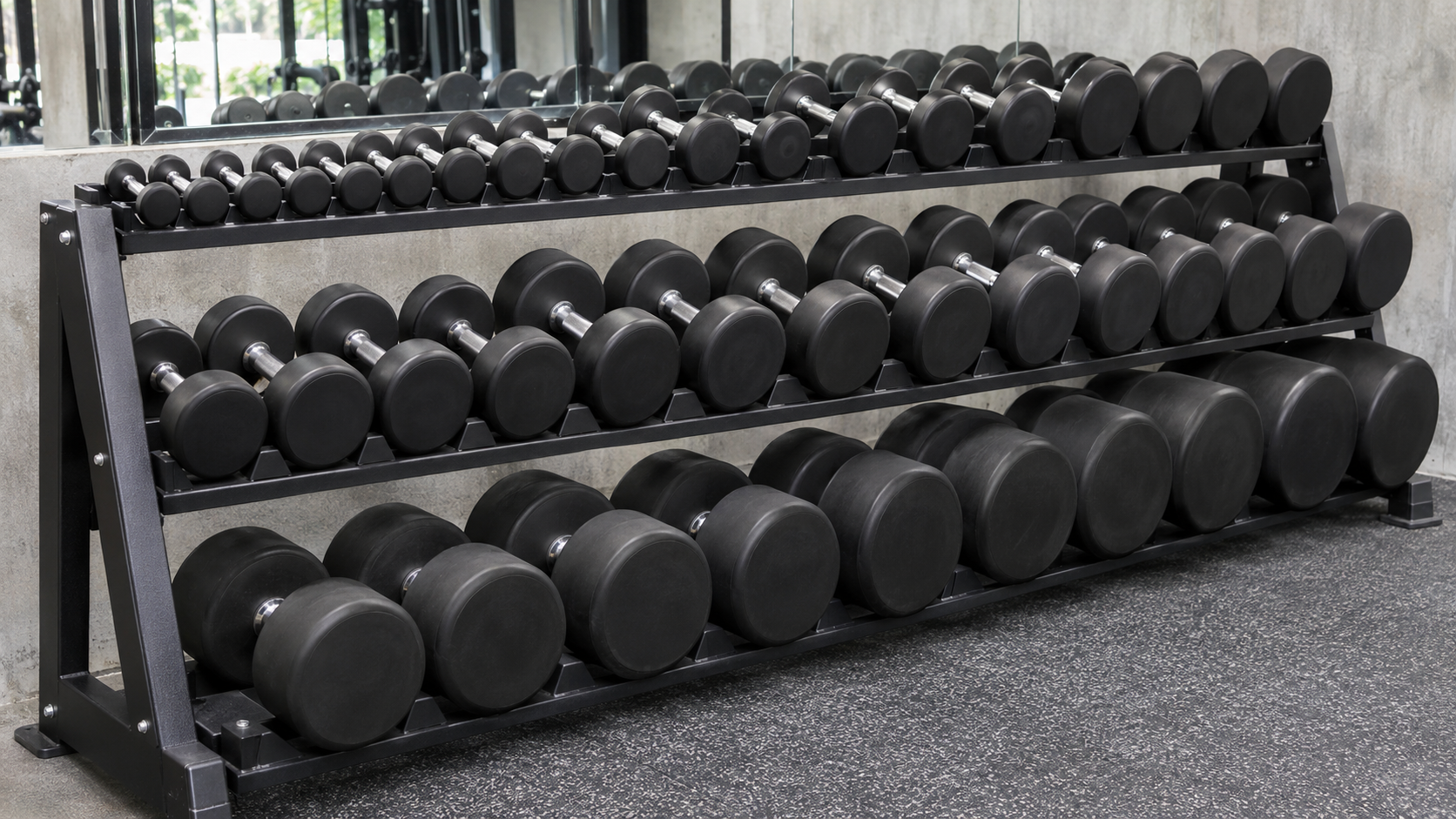
How to size a rack for a complete set of professional dumbbells
Choosing a rack for professional dumbbells requires an analysis that starts with the actual inventory of the weight room and ends with the verification of the structural characteristics of the support. For a commercial gym, a personal training center, or a fitness facility with a strength-training area, properly sizing the dumbbell rack means organizing the space according to the available equipment, the load progression, and the frequency of use. It is not enough to identify a model with a high number of supports: it is necessary to verify that each pair is appropriately placed and that removal and repositioning can occur without interference.
The first step consists of defining what is meant by a complete set. An inventory can include dumbbells with regular increments of 2 to 2 kg, a more articulated progression with different intervals, or a selection of loads built around the specific needs of users. The total number of pairs, the size of the heads, the length of the handles, and the maximum weight present in the inventory directly influence the necessary configuration. These elements must be recorded before comparing the capacities declared by manufacturers.
In this guide, we analyze an operational method to calculate the number of pairs, define the weight progression, and verify the compatibility between dumbbells and shelves. The goal is to arrive at a documentable choice based on actual measurements, capacities, and conditions of use. The evaluation also considers access spaces, load distribution, and future expansion possibilities, so as to avoid purchases based exclusively on commercial photographs or generic indications.
Defining the inventory of the complete dumbbell set
Before choosing a rack, it is necessary to transform the dumbbell supply into a precise inventory. The fundamental data is not only the total weight of the equipment, but the number of pairs actually present and their distribution by load range. A gym that has twelve pairs distributed between light and intermediate weights has different needs compared to a facility that uses twenty or thirty pairs with a continuous progression. The inventory allows these differences to be identified and translated into verifiable dimensional requirements.
It is advisable to record each pair as a distinct unit, reporting nominal weight, external dimensions, and construction characteristics. Two pairs of the same weight can in fact have different dimensions depending on the shape of the heads, the material, and the coating. The overall length can also vary significantly between hexagonal dumbbells, rubber-coated models, and professional versions with shaped heads. The simple indication of weight therefore does not allow one to establish how many elements can be placed on a given shelf.
A structured inventory also makes it possible to distinguish the current equipment from that planned for the medium term. If the gym project includes an expansion of the dumbbell park, the rack should be evaluated also considering the pairs that could be purchased later. This does not mean automatically oversizing the structure, but defining a capacity consistent with the development program and the space actually available.
Counting pairs and individual dumbbells
The count must clearly distinguish between complete pairs and single dumbbells. A pair is composed of two elements of the same weight, destined to be used together in most bilateral exercises. If a gym has fifteen pairs, the inventory contains thirty physical dumbbells, but the organizational requirement of the rack can be expressed in fifteen pair positions or in thirty individual supports, according to the construction system adopted. This distinction is important because commercial capacities are not always expressed with the same unit of measurement.
During the survey, it is also necessary to check for any incomplete pairs, damaged items, or dumbbells temporarily out of service. Automatically including these products in the sizing can lead to overestimating the necessary capacity or designing a layout that does not correspond to the actually usable equipment. It is preferable to maintain a column dedicated to the state of the equipment, distinguishing available products from those to be replaced or integrated.
A simple inventory table can report the weight, the number of pairs, the number of individual elements, and the main dimensions. For example, a supply composed of ten pairs requires twenty physical dumbbells. If the rack manufacturer declares a capacity of twenty dumbbells, the data might be sufficient, but only after verifying that each element has a compatible support and that the pairs can be recognized and repositioned correctly.
Recording dimensions and characteristics of dumbbells
Dimensions must be measured on the actual product or obtained from a reliable technical datasheet. The most useful measurements include the overall length of the dumbbell, the diameter or width of the heads, and the depth occupied when the tool is placed in the intended position. For models with hexagonal heads, it is also necessary to consider the shape of the contact surfaces, while for round ones, it is necessary to check the geometry of the support and the possibility of rolling.
The outer coating represents an additional element to consider. Dumbbells made of rubber, polyurethane, or other materials can present different dimensions and contact characteristics. The distance between the supports must allow the product to be inserted and removed without forcing and without the heads interfering with those of neighboring pairs. A layout theoretically compatible with nominal measurements might prove poco functional if it does not leave enough space for the grip.
For each type, it is useful to document at least one representative specimen, choosing the one with the largest footprint when it comes to verifying compatibility. If the set includes dumbbells from different manufacturers or lines, one should not assume that all pairs have dimensions proportional to weight. Measurements must be compared directly with the geometry of the supports indicated by the rack manufacturer.
Calculating weight progression and number of pairs
The weight progression determines the number of pairs that the rack will have to accommodate. To build a complete set, it is necessary to establish an initial and final load interval and define the increments between one pair and the next. A regular progression facilitates inventory management, but it is not the only possible solution: some facilities prefer closer increments in the light ranges and larger intervals in high loads. The choice must reflect the type of training offered and the composition of the clientele.
The calculation must start from an ordered list of available weights. For each value, a pair is recorded, barring special needs that justify different quantities. If the progression is uniform, the number of pairs can be calculated directly through the sequence of loads. If instead the increments change along the path, it is necessary to count each actually planned value, avoiding using a single formula that could return a result not corresponding to the inventory.
It is important not to confuse the number of different weights with the number of dumbbells. A series composed of eighteen different nominal weights requires eighteen pairs, therefore thirty-six physical dumbbells. This data must be clearly reported in the quote request, because a capacity expressed in single dumbbells is not directly comparable with a capacity expressed in pairs without performing the conversion.
Defining load intervals
A progression can be built starting from the minimum required load, the maximum expected load, and the desired increment. In a uniform sequence, for example, weights from 2 to 20 kg with increments of 2 kg can be considered. The available values are ten: 2, 4, 6, 8, 10, 12, 14, 16, 18, and 20 kg. The set therefore requires ten pairs, equivalent to twenty individual dumbbells. The example helps to understand how a seemingly simple interval translates into a concrete requirement for the rack.
If one wishes to extend the progression from 2 to 30 kg while maintaining increments of 2 kg, the number of pairs becomes fifteen. In this case, the structure will have to accommodate thirty dumbbells, distributed according to the configuration provided by the manufacturer. The comparison between the two scenarios highlights how the increase in the maximum load can affect the number of requested positions, even when the increment between weights remains unchanged.
Not all gyms, however, need uniform progressions. A facility oriented toward personal training might prefer a greater availability of intermediate loads, while a weight room with expert users might favor a wider range of heavy weights. In both cases, the progression must be documented before purchase. Subsequently modifying the number of pairs may in fact require a different number of shelves or a structure with greater width and load capacity.
Building supply scenarios
To make sizing more reliable, it is useful to develop at least three scenarios: current supply, short-term expected supply, and target supply. The current scenario photographs the pairs already present in the gym. The short-term one includes purchases already scheduled, while the target scenario represents the dumbbell park that the facility intends to reach within the planning period. This subdivision avoids confusing immediate needs with development hypotheses.
Consider a weight room with twelve current pairs, three pairs already planned for the next purchase, and another five pairs included in the expansion plan. The target capacity will be twenty pairs, equal to forty dumbbells. The rack will have to be chosen according to the scenario actually adopted. If the expansion is certain and imminent, purchasing a structure already compatible with twenty pairs may be more rational than replacing the support after a few months.
The scenarios must be accompanied by the dimensions of the planned products. The addition of five pairs does not necessarily determine a proportional increase in the space occupied, because heavier dumbbells can have larger heads than lighter ones. It is therefore necessary to verify the physical distribution of the new elements and not limit oneself to multiplying the number of pairs by a theoretical average width.
Evaluating the actual capacity of the rack
Once the number of pairs is defined, the next step consists of comparing it with the declared capacity of the rack. This comparison must be performed using the same unit of measurement. If the technical datasheet indicates the number of dumbbells, the value must be divided by two to obtain the theoretical capacity in pairs, provided that the configuration actually allows housing the two elements of each pair. If instead the capacity is indicated in pairs, it is necessary to check how many physical dumbbells are provided and how they are distributed on the shelves.
Nominal capacity does not always coincide with usable capacity in the specific configuration of the gym. A support can be designed to accommodate a certain number of standard dumbbells, but prove incompatible with models characterized by wider heads or particularly long handles. For this reason, the declared number must be accompanied by a dimensional check. The technical datasheet represents the reference for knowing the characteristics of the product, while the survey of the dumbbells allows verifying their concrete compatibility.
The evaluation must also include the total load. The sum of the weights of all dumbbells constitutes an important data point to verify the load-bearing capacity of the structure, but it does not replace the control of the load limits of individual shelves. A rack can have a high overall load capacity and still present specific limits for each level. The distribution of dumbbells must respect both requirements indicated by the manufacturer.
Distinguishing nominal capacity and usable capacity
Nominal capacity is the number of items that the manufacturer declares compatible with a given configuration. Usable capacity, on the other hand, is the number of dumbbells that can be placed while respecting actual dimensions, expected layout, and spaces necessary for removal. This distinction is fundamental when comparing different models, because two racks with the same declared capacity can present very different geometric characteristics.
To verify usable capacity, it is necessary to compare the usable width of the shelf with the sum of the dimensions of the dumbbells and the spaces needed between items. If a shelf has a usable length of 120 cm and the items to be placed occupy a total of 110 cm, 10 cm remain to be distributed according to the expected configuration. This data alone does not yet prove that the layout is functional: it is also necessary to check the distances between heads and the possibility of grabbing each dumbbell without moving neighboring ones.
It is preferable to avoid using the entire theoretical length of the shelf without considering tolerances and conditions of use. Real dimensions can vary slightly among products in the same weight range, and repositioning operations require adequate space. Capacity must therefore be confirmed through technical documentation and, when possible, through a test with the dumbbells actually intended for the rack.
Checking total load and load per shelf
The total load can be calculated by summing the weight of all pairs. If a rack houses ten pairs of 2, 4, 6, 8, 10, 12, 14, 16, 18, and 20 kg, the total weight of the dumbbells is equal to 220 kg. The calculation considers both elements of each pair. In fact, the sum of the nominal weights of the ten values is 110 kg and must be multiplied by two to obtain the effective load of the complete supply.
This result must be compared with the declared overall load capacity for the rack and with the specific limits of each level. If the dumbbells are distributed over two shelves, it is not correct to assume that each automatically supports half of the load. The actual layout might concentrate the heaviest weights on a single level. It is necessary to calculate the weight assigned to each shelf based on the real position of the pairs and compare it with the relative technical limit.
When the documentation does not clearly specify the load capacity of each level, it is advisable to request confirmation from the manufacturer before purchase. Structural resistance should not be deduced solely from the apparent weight of the rack or the visible thickness of the components. Verification must be based on declared values and defined conditions of use, also considering the support methods provided for the dumbbells.
Choosing the number of shelves and configuration
The number of shelves depends on the quantity of pairs, the dimensions of the dumbbells, and the geometry of the structure. A two-level rack may be sufficient for a limited supply, while a larger inventory might require a different configuration. However, it is not possible to establish the ideal number of shelves simply by counting the pairs: it is necessary to check the usable length of each level, the depth of the supports, and the available height to handle the dumbbells.
The configuration must also respect the weight progression. Arranging pairs in ascending or descending order makes it easy to quickly identify the desired load and simplifies inventory control. The layout should maintain a constant logic, avoiding arbitrarily separating pairs of the same weight or using different supports for equivalent products without a technical reason. Consistent organization also facilitates visual control of the presence of all items.
The choice between a compact structure, a longer rack, or a modular configuration depends on the layout of the room. Available surface area, distance from other equipment, and direction of access must be evaluated. A model that houses all pairs but requires insufficient handling space does not represent an effective solution. Sizing must therefore integrate capacity, geometry, and area organization.
Distributing pairs across shelves
Distribution can follow a logic based on weight, footprint, or frequency of use. In an arrangement ordered by load, pairs are placed in ascending or descending sequence, making weight identification immediate. If instead dimensions vary greatly, it may be necessary to verify a layout that respects the characteristics of the supports and the manufacturer's instructions, without compromising the readability of the inventory.
A practical example involves a set of sixteen pairs distributed over two shelves. The division into eight pairs per level can represent a starting point for the project, but should not be considered a universal rule. If heavier dumbbells occupy a greater width, it might be necessary to allocate more space to the level hosting them. Similarly, load breakdown must be verified separately for each shelf.
The final configuration should be reported in a simple diagram, in which each position is associated with a specific weight. This document allows checking the compatibility between inventory and support before purchase and can be used subsequently to organize the repositioning of equipment. The shelf map is particularly useful when the room has multiple sets or dumbbells belonging to different lines.
Checking the geometry of the supports
Supports represent the point of contact between the structure and the dumbbells. Their shape must be compatible with the geometry of the heads and the intended positioning system. A support designed for a given dumbbell shape might not offer the same stability with a different model. For this reason, compatibility must be verified through measurements and manufacturer indications, without assuming that all dumbbell types are interchangeable.
The depth of the support is another parameter to check. A support that is too small compared to the dimensions of the head might not guarantee the expected contact, while an inadequate geometry can make repositioning difficult. The distance between supports must also be sufficient to avoid interference between neighboring pairs. These aspects directly affect the practicality of the rack during normal weight room activities.
Before confirming the order, it is advisable to request technical drawings and detailed dimensions of the shelves, when available. A commercial photograph allows understanding the general appearance of the structure, but does not necessarily provide the information needed to verify effective spaces. Technical dimensions are indispensable for comparing the support with the dimensions recorded during the inventory.
Organizing space and weight room flow
Rack sizing does not end with the calculation of available positions. The structure must be placed in an area that allows users to pick up and reposition dumbbells without hindering passage. The chosen position affects the organization of the room, especially when the rack is located near benches, training stations, or other equipment. An effective layout takes into account access spaces and trajectories needed to handle loads.
The surface occupied by the rack must be distinguished from the operational space required around the structure. External dimensions indicate the physical footprint of the product, but do not necessarily include the area required to approach, grab dumbbells, and reposition them. During the design phase, it is therefore useful to represent both the structure and the surrounding functional space on the floor plan, verifying that the configuration does not interfere with other paths in the gym.
The arrangement of dumbbells should also encourage immediate consultation of weights. A clear sequence reduces unnecessary movement and makes it easier to keep the area tidy. The presence of readable labels, a coherent progression, and a stable position for each pair help make the system more manageable during peak hours.
Calculating footprint and operational space
To calculate the footprint, one must start from the external dimensions of the rack: width, depth, and height. These values must be reported on the floor plan in the expected position, taking into account any structural elements, columns, walls, and other equipment. Verification allows identifying any overlaps and comparing different configurations before proceeding with the purchase.
Operational space must be evaluated separately. In front of the shelves, there must be an adequate zone to approach and handle dumbbells according to the methods provided by the facility. It is not enough to verify that the rack physically fits into the area: one must check that access to different levels remains viable even when users engaged in nearby exercises are present. The width of walkways and the arrangement of other equipment must be considered in the overall project.
It is useful to perform a layout test using the actual dimensions of the product and simulating pick-up operations. If possible, the expected footprint can be delimited on the floor with removable tape to visually evaluate compatibility with the rest of the room. This preliminary check does not replace technical measurements, but helps identify interferences that might not emerge from a simple reading of nominal dimensions.
Improving accessibility and order
The arrangement of weights must make it simple to identify the desired pair. Labels can report the nominal value in a visible position, while ascending or descending order allows following an intuitive sequence. If the gym has multiple types of dumbbells, it is useful to maintain a recognizable separation between different lines, avoiding seemingly similar pairs being placed in positions inconsistent with the inventory.
Space management also depends on the characteristics of the shelves. Easy access requires that dumbbell heads can be grabbed without hitting adjacent ones and that repositioning does not require particularly complex maneuvers. Testing with the bulkiest elements allows identifying critical issues before the rack is definitively installed.
For a professional weight room, it is also useful to define a reordering procedure. Each pair should have an identifiable position, and staff should be able to quickly check for any missing items. This organization does not necessarily require complex systems: an updated inventory, numbering of positions, and a coherent layout can already improve the daily management of equipment.
Checking technical datasheet, load capacity, and construction features
The technical datasheet is the main reference to verify that the rack is suitable for the planned dumbbell set. Before comparing the price or aesthetics of the product, it is necessary to check dimensions, total load capacity, limits of individual shelves, and support characteristics. This data makes it possible to establish whether the support responds to the requirements defined during the inventory and design phase.
Construction quality must be evaluated through documented information, avoiding deducing resistance solely from the product image. Materials, component sections, joints, and assembly systems can contribute to overall solidity, but must be considered together with declared specifications. The availability of detailed technical documentation facilitates comparison between models and reduces the risk of purchasing a structure incompatible with the expected load.
A further aspect concerns installation and maintenance conditions. The rack must be assembled according to the manufacturer's instructions and used within declared limits. If special fastening conditions or constraints related to the supporting surface are provided, these indications must be considered before defining the final position in the gym.
Checking dimensions, load capacity, and materials
The first check concerns external and usable shelf dimensions. Total width does not necessarily coincide with space actually available for dumbbells, because side parts, uprights, and supports can reduce the usable surface. The datasheet should allow clearly distinguishing overall measurements from those of supports. When the latter are not indicated, it is appropriate to request them from the supplier before proceeding.
The second check concerns load capacity. It is necessary to know the overall limit of the structure and that of each level, if specified. The value must be compared with the expected effective load, calculated by summing the weight of all dumbbells destined for each shelf. Any differences between theoretical capacity and operational load must be clarified through manufacturer documentation, without applying arbitrary coefficients or personal interpretations.
The third check concerns materials and construction characteristics. The structure must be described in sufficient detail to allow technical evaluation of the product. It is also useful to check the finish of contact surfaces, the presence of any protective coatings, and cleaning instructions. These elements contribute to equipment management in a professional gym context, where the rack is used frequently.
Requesting documentation and clarifications from the supplier
When available information does not allow completing sizing, it is preferable to request clarifications before ordering. An effective technical request should include the number of pairs, nominal weights, dumbbell dimensions, and expected total load. Attaching an inventory table allows the supplier to evaluate compatibility with greater precision and indicate any limitations of the proposed configuration.
Among the most important questions are effective capacity in pairs, load capacity per shelf, usable width of supports, and compatibility with head shape. It is also useful to ask whether the declared configuration presupposes a particular dumbbell arrangement. In this way, one avoids interpreting capacity data as a universal guarantee valid for any model on the market.
Received documentation should be kept together with the room inventory and floor plan. This material constitutes a useful basis for subsequent checks, shelf organization, and potential equipment expansions. A documented decision is easier to control and update compared to a choice based on verbal indications or general impressions.
Practical sizing examples for different gyms
Examples allow applying the method to different situations. A small personal training room, a commercial gym, and a fitness center with a strength-oriented supply can have very different needs in terms of number of pairs and load distribution. The procedure, however, remains the same: define inventory, calculate progression, record dimensions, sum loads, and compare results with the technical characteristics of the rack.
It is important to consider examples as calculation models and not as universal configurations. The number of pairs reported does not automatically determine the necessary width, because dumbbell size depends on the manufacturer and weight range. Similarly, total load alone does not establish the capacity of individual shelves. Each scenario must be completed with real product measurements and data from the selected structure.
Scenario comparison is also useful for evaluating the opportunity to purchase a larger rack compared to initial supply. If growth in the dumbbell park is already planned, it may be convenient to include it in the initial project. If instead expansion is merely hypothetical, it is appropriate to compare the cost of a modular structure with that of a support sized exclusively for current needs.
Scenario of a small personal training room
Consider a personal training room with eight pairs of dumbbells, distributed over a load progression defined by the manager. The first data to record is the total number of items: sixteen dumbbells. Subsequently, dimensions of each pair are recorded and the total weight of the supply is calculated. These data allow comparing a compact rack with a multi-level configuration, verifying which solution respects available footprints.
In a facility of contained dimensions, the width of the rack can represent an important constraint. However, it is not correct to choose the shortest model without checking the possibility of comfortably picking up dumbbells. Distribution must leave enough space for hands and allow repositioning elements without interfering with adjacent pairs. Dimensional testing thus assumes particular importance.
The manager should also evaluate whether current progression is destined to remain stable. If new loads are planned in the short term, additional capacity can be considered right from selection. A rack compatible with future supply avoids having to modify room organization after purchasing new dumbbells, provided support load capacity and support geometry are adequate for subsequent products as well.
Scenario of a commercial gym with expansion
A commercial gym might start from twenty pairs and plan an expansion up to thirty pairs. The first phase consists of calculating the number of items: forty dumbbells in initial supply and sixty in target configuration. Sizing should compare both situations, verifying whether the chosen rack can accommodate the entire future set without exceeding capacity or compromising access spaces.
In this scenario, total weight can become particularly significant. If progression includes pairs with different loads, it is necessary to sum the effective weight of each item and distribute the result among shelves. The presence of heavy loads can modify structural distribution even when the number of pairs increases by only ten units. It is therefore necessary to verify geometric and load-bearing capacity separately.
For a gym with a defined growth program, it may be useful to compare a higher capacity rack with two coordinated structures. The most suitable solution depends on floor plan, station distribution, and available technical specifications. A single rack can simplify organization, while two separate supports can offer greater flexibility in space management. The choice must derive from the overall project and not solely from the maximum declared number of pairs.
Errors to avoid and checks before purchase
One of the most common errors consists of selecting the rack starting from the number of dumbbells indicated in a commercial description, without verifying how capacity is calculated. Data might refer to individual items, pairs, or a specific product type. Before comparing two models, it is therefore necessary to standardize units of measurement and check effectively planned configuration.
A second error concerns underestimating dimensions. Even when the number of supports seems sufficient, head length and distance between items can make using all available positions impossible. Evaluation based solely on nominal weight does not allow identifying these incompatibilities. Measurements must be recorded and compared with support technical dimensions.
A third error consists of considering exclusively overall load capacity. Total weight must be verified together with individual shelf limits and expected distribution. Rack placement in the room must also be checked, because a technically compatible facility might not be functional if placed in an area with insufficient access or interferences with other equipment.
Avoiding errors in pair calculation
Counting must always be expressed with a distinction between pairs and single dumbbells. If a commercial datasheet indicates twenty-four dumbbells, one cannot automatically conclude that the product is suitable for twenty-four pairs. Conversion must be performed correctly and compared with support configuration. The same attention is necessary when summing loads, because the nominal weight of a pair must be multiplied by two.
Another error consists of considering only weights already purchased, ignoring pairs planned in development plans. The most effective solution is keeping current inventory, scheduled purchases, and supply targets separate. This distinction allows comparing different capacity levels without confusing immediate needs with future ones. The result is sizing more coherent with facility design.
Finally, one must avoid assuming pairs of the same weight always have identical dimensions. If dumbbells from different lines are present, compatibility must be verified for each type. A precise inventory and dimensional table reduce the risk of purchasing a support that, despite having sufficient numerical capacity, fails to properly accommodate all items.
Preparing a technical checklist for the quote
Before requesting a quote, it is useful to prepare a document containing the number of pairs, available weights, total number of individual dumbbells, and overall weight. Dimensions of bulkiest models and expected progression must be added to this information. In this way, supplier has necessary data to verify rack compatibility with real supply.
Request should also include external structure dimensions, usable shelf length, overall load capacity, and capacity of individual levels. It is appropriate to request indications on support geometry and any limitations related to head shape. If the rack is destined for expansion, availability of compatible modules and technical conditions for future configuration must be verified.
Finally, checklist should provide layout control. Rack position, access space, and distance from other equipment must be verified before ordering. Once all information is gathered, comparison between available solutions becomes simpler and more objective. Choice can be motivated through measurable requirements rather than relying on generic characteristics or declared capacity alone.
Evaluating investment based on supply and gym growth
Choosing a professional rack must be considered an integral part of investment in the weight room. Support is not a simple furnishing element, but an organizational component that must be compatible with the dumbbell park, space configuration, and facility usage methods. A correct decision therefore starts from defined and verifiable requirements that allow comparing alternatives coherently.
Initial cost should be evaluated together with effective capacity, load capacity, construction quality, and possibility of maintaining an orderly layout over time. An economical rack incompatible with dumbbell dimensions may require subsequent modifications or early replacement. Conversely, a structure with characteristics adequate for expected supply allows better inventory management and avoids unnecessary purchases, provided oversizing does not entail inefficient use of available space.
To complete evaluation, it is useful to compare models present in the category professional dumbbell racks, considering technical characteristics and compatibility with actually used dumbbells. Comparison should include at least capacity, dimensions, shelf configuration, and declared load capacity. Information gathered during inventory can be used as reference to identify solutions most coherent with gym needs.
A final check concerns the possibility of updating supply without compromising existing organization. If project provides for new weights, it is appropriate to verify in advance whether the rack can accommodate additional pairs and whether available shelves are compatible with their dimensions. Modularity can represent an advantage, but must be confirmed by technical documentation and not presumed based on structure appearance.
Decisive criterion remains correspondence between inventory, load progression, dimensions, and support characteristics. A correctly sized rack is one that accommodates all expected pairs, respects load limits, allows adequate access, and integrates into room layout. Documenting these parameters before purchase allows owner or weight room manager to make a motivated technical choice and plan investments destined for the dumbbell area with greater precision.
Comments (0)