
Trolley
You have no items in your shopping cart

 Budgets
 Dumbers
 Discs
Discs
 Benches
 Racks and Rigs
 Weights Holders
 Isotonic machines
 Calisthenics
 Cardio
 Kettlebells
 Flooring
 Gym Set
 Accessories
 Combat
 ARTI MARZIALI
 CONTAINER GYM
 Tug-Of-War
 Used Gym Equipment
 PILATES MACCHINARI
 GINNASTICA ARTISTICA
 CAMPI DA PADEL
 Prodotti in Pronta Consegna
 Informazioni
 IRONMAN
 Gift Card
- Donatif
- General information
- 0 I like it
- 647 Views
- 0 comments
- gym flooring, safety flooring, gym safety, shock-absorbing materials
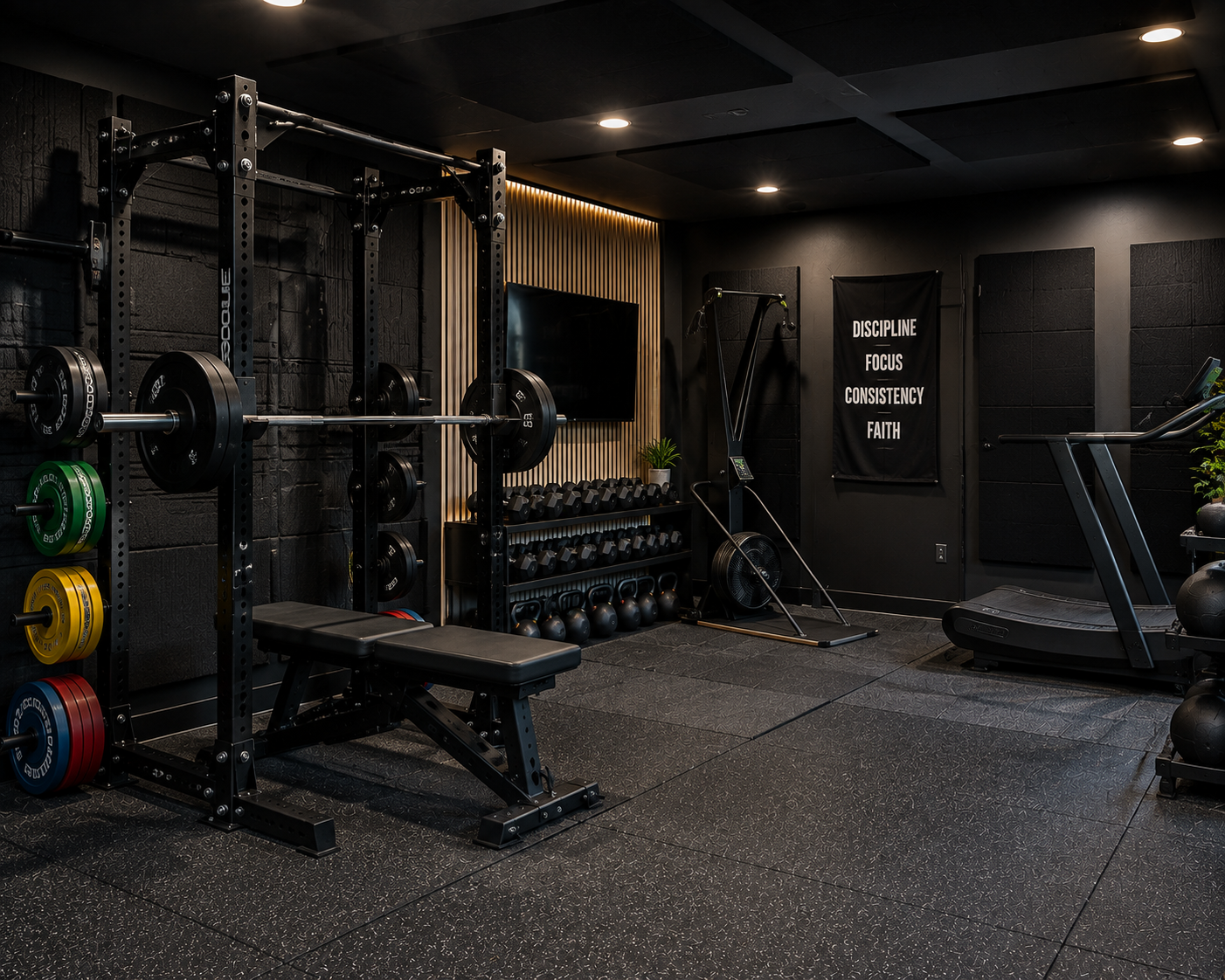
Guide to Soundproofing a Home Gym in an Apartment Building: Stop Vibrations and Noise
Creating a home gym in an apartment is an increasingly popular solution for training consistently, but it involves a challenge that is often underestimated: managing noise and vibrations. Jumps, free weights, barbells, and cardio equipment can transmit energy directly to the building's structure, creating discomfort for neighbors and increasing the risk of condominium disputes.
Many enthusiasts look for budget-friendly solutions by relying on thin fitness mats or yoga mats, convinced that they are sufficient to dampen noise. In reality, these products are designed primarily to improve comfort during training and do not possess the technical characteristics necessary to effectively limit impact noise and the propagation of vibrations through the floor slab.
In this guide, we analyze how to design a truly effective condominium gym soundproofing, delving into the role of SBR rubber, technical tatami mats, and professional flooring in reducing decibels, protecting the floor, and safeguarding condominium tranquility.
- How noise propagates
- Airborne noise and impact noise
- SBR rubber and acoustic insulation
- Tatami and technical flooring
- How to choose flooring
- Common mistakes
- Installation and maintenance
- Evaluating the best investment
How noise propagates in a home gym
To understand how to reduce disturbance, it is necessary to distinguish the perceived noise from that which is actually transmitted to the building's structure. When a barbell is placed on the floor or plyometric exercises are performed, the energy generated does not remain in the room but passes through the floor slab in the form of vibrations.
These vibrations are transmitted to walls, ceilings, and load-bearing structures, reaching adjacent apartments even when the volume perceived in the room seems contained. It is precisely this structural transmission that generates most complaints in apartment buildings.
Technical flooring designed for shock absorption limits the amount of energy that reaches the structure, helping to decrease the noise perceived by other residents.
How vibrations are transmitted
Every impact generates mechanical waves that travel through the floor and spread throughout the entire building. The greater the energy of the impact, the greater the propagation.
Why the neighbor hears more noise
Structural noise can be much more evident in the apartments below compared to what is perceived by the person training, making it difficult to assess the real disturbance without considering the propagation through the floor slab.
Difference between airborne noise and impact noise
One of the most frequent mistakes is trying to find a single solution for all types of noise. In reality, airborne noise, such as music or television, requires different interventions compared to the impact noise produced during training.
Impact noise arises from direct contact between equipment and the floor. Barbells, kettlebells, dumbbells, and jumps produce mechanical stresses that require high-density elastic materials capable of dissipating energy.
For a home gym, the most important parameter is therefore the flooring's ability to absorb shocks before they reach the building's structure.
Airborne noise
Music, conversations, and television can be dampened with interventions on walls and windows, but they have relatively little impact during weight training.
Impact noise
Dropping weights, running, jumping, and explosive movements generate vibrations that require materials specifically designed for structural insulation.
Why SBR rubber is one of the best solutions
SBR rubber is one of the most used materials in sports flooring thanks to its combination of elasticity, resistance, and shock-absorption capacity. Used correctly, it helps limit the propagation of vibrations and simultaneously protects the existing floor.
A modern insulating rubber floor distributes the load over a wider surface, reducing the concentration of forces generated during exercises with barbells and free weights.
Thickness plays a decisive role: increasing the thickness generally increases the ability to dampen impacts, especially during high-intensity training.
Importance of density
Rubber that is too soft tends to deform excessively, while rubber that is too rigid disperses less energy. The choice of density must be proportional to the expected loads.
Protection of the existing surface
In addition to acoustic insulation, rubber protects parquet, stoneware, and delicate floors from impacts, scratches, and permanent compression.
Technical tatami: when it is the ideal choice
Tatami is often associated exclusively with martial arts, but it can be a valid solution for some home gyms, especially when training includes bodyweight exercises, mobility, stretching, and disciplines that involve controlled falls.
Thanks to the high-density EVA structure, tatami offers high comfort during floor exercises and helps dampen some of the vibrations generated by body movements.
For training with very heavy weights, SBR rubber generally remains more suitable, while tatami is an excellent solution in multifunctional areas.
Comfort and safety
The surface reduces the risk of injury during floor exercises and improves the overall training experience.
When it is not enough
In the presence of heavy barbells or frequent deadlifts, it is advisable to use materials specifically designed to support high dynamic loads.
How to choose flooring based on training
Every home gym has different characteristics, and the choice should start from the type of training performed daily. Those who practice weightlifting primarily need different materials than those who do yoga or functional training.
It is important to evaluate the maximum weight used, the frequency of training, and the type of floor slab, especially in historic buildings where vibrations can propagate more easily.
Careful planning allows for a significant reduction in weight noise, improving comfort for both the person training and the neighbors.
Weight training
Barbells, racks, and dumbbells require greater thickness and materials with high impact absorption capacity.
Functional training
Circuits, bodyweight exercises, and mobility can be managed effectively with more versatile solutions that combine comfort and insulation.
Common mistakes in soundproofing
One of the most common mistakes is thinking that a simple fitness mat can replace technical flooring. These products are generally too thin to effectively dissipate the energy produced by impacts.
Another frequent mistake concerns choosing solely based on price. Cheap materials can deteriorate quickly, lose elasticity, and offer lower performance over time.
Neglecting thickness is also a wrong assessment: a few millimeters can make a significant difference in vibration absorption.
The limit of traditional mats
Products intended for yoga or light fitness are not designed to support heavy loads or to limit structural noise.
Looking only at the initial cost
A professional solution guarantees greater durability, better insulation, and fewer replacements in the long run.
Installation and maintenance of flooring
Correct installation directly affects the performance of the flooring. Well-made joints, regular surfaces, and compatible materials improve both comfort and the effectiveness of the insulation.
Routine maintenance requires simple cleaning operations with suitable detergents, avoiding aggressive products that could compromise the durability of the surface.
Periodically checking for deformations or wear allows you to maintain high performance over time and preserve safety during training.
Professional installation
Careful installation prevents unwanted movement of the flooring and contributes to the stability of the entire system.
Cleaning and durability
Regular maintenance keeps the technical characteristics of the flooring unchanged even after years of use.
How to evaluate the best investment for a home gym
The choice of flooring should consider not only the initial budget but also the type of training, the frequency of use, and the need to preserve peaceful relationships with neighbors. Investing in technical materials means reducing the risk of damage to the floor and limiting the vibrations transmitted to the building.
For those who want to create an efficient and durable home gym, it is advisable to look towards professional products and carefully evaluate thickness, density, and intended use. You can learn more about the different solutions dedicated to sports flooring by consulting condominium gym soundproofing available for home gyms and fitness environments.
Careful planning allows you to train with greater peace of mind, protect the property, improve comfort, and significantly reduce the risk of condominium conflicts, transforming your home gym into a truly functional and pleasant space to use.
Comments (0)