
Trolley
You have no items in your shopping cart

 Budgets
 Dumbers
 Discs
Discs
 Benches
 Racks and Rigs
 Weights Holders
 Isotonic machines
 Calisthenics
 Cardio
 Kettlebells
 Flooring
 Gym Set
 Accessories
 Combat
 ARTI MARZIALI
 CONTAINER GYM
 Tug-Of-War
 Used Gym Equipment
 PILATES MACCHINARI
 GINNASTICA ARTISTICA
 CAMPI DA PADEL
 Prodotti in Pronta Consegna
 Informazioni
 IRONMAN
 Gift Card
- Donatif
- General information
- 0 I like it
- 778 Views
- 0 comments
- gym flooring, safety flooring, gym safety, shock-absorbing materials
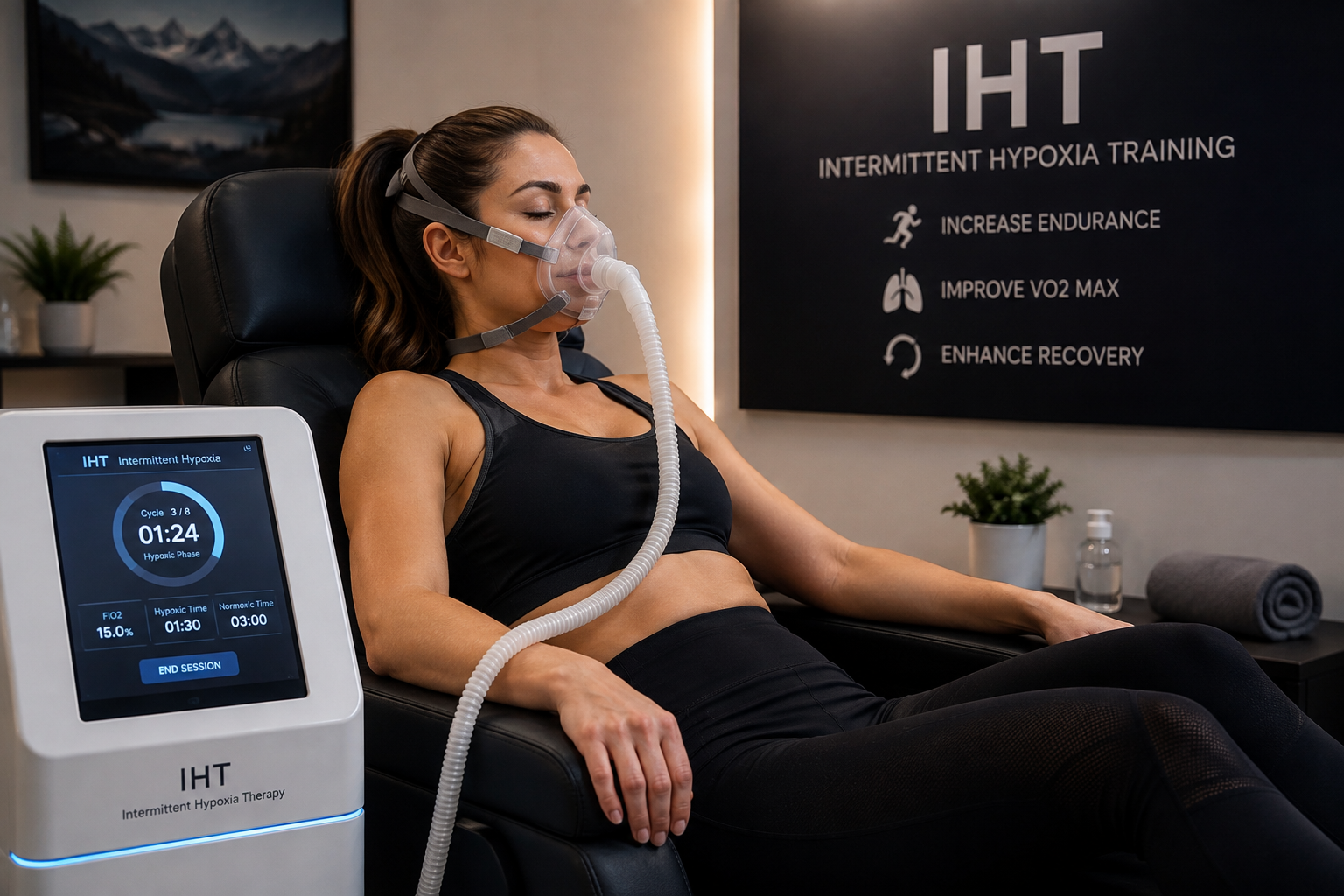
Intermittent Hypoxia (IHT) vs Continuous Exposure: Which to Choose for Performance
Simulated altitude training represents one of the most interesting strategies for athletes looking to introduce new stimuli into their preparation. Thanks to modern technologies, it is now possible to recreate controlled hypoxic conditions without necessarily having to move to high mountains, using hypoxic chambers designed to precisely manage oxygen availability in the environment.
Within this approach, there are different usage methodologies, including continuous exposure and intermittent hypoxia, also known as IHT. Although both aim to stimulate adaptations linked to reduced oxygen availability, the way they are applied and integrated into training protocols is profoundly different.
Understanding the difference between intermittent hypoxia protocols and prolonged stay in a hypoxic environment allows you to choose a strategy that is more consistent with personal goals, available time, and preparation level. For those using a hypoxic solution in an advanced home gym, customization thus becomes a fundamental element to get the maximum value from the technology.
- What is intermittent hypoxia and how it works
- How continuous exposure in a hypoxic chamber works
- Main differences between IHT and continuous exposure
- The benefits of IHT training for advanced athletes
- Live High Train Low and comparison with IHT
- How to choose the most suitable hypoxic protocol
- Customization and management of the hypoxic stimulus
- The evolution of simulated altitude training
What is intermittent hypoxia and how it works
Intermittent hypoxia consists of programmed alternation between periods characterized by reduced oxygen availability and recovery periods in normoxic conditions. Unlike continuous exposure, the body does not remain constantly immersed in a hypoxic environment, but receives the stimulus through alternating cycles.
This approach allows for more precise control over the duration and intensity of exposure, creating protocols adaptable to the athlete's needs. The ability to modify intervals makes IHT a particularly interesting methodology for those who want to integrate hypoxia without dedicating long periods to staying at simulated altitude.
The goal of IHT is to use the hypoxic stimulus as a specific training variable, inserting it within a broader program that includes physical work, recovery, and monitoring of individual response.
The principle of hypoxic intervals
The concept behind IHT is to create a controlled sequence of stress and recovery. During the hypoxic phase, the body perceives a lower availability of oxygen, while during the recovery phase it can re-establish more favorable conditions.
The management of intervals makes it possible to modulate the stimulus based on goals and the level of adaptation achieved.
Using the hypoxic chamber for IHT
A hypoxic chamber allows these cycles to be programmed precisely, regulating environmental parameters according to the chosen protocol.
This makes IHT a particularly interesting solution for those looking for a flexible method that is easily integrated into their daily routine.
How continuous exposure in a hypoxic chamber works
Continuous exposure involves a prolonged stay in an environment characterized by a reduced oxygen concentration. This method is mostly inspired by the condition of staying at high altitude, where the body remains exposed to the hypoxic stimulus for longer periods.
Inside a hypoxic chamber, continuous exposure can be used to create protocols dedicated to simulating altitude stays. The duration of the stay and the level of hypoxia are generally adapted to the user's goals.
This approach requires careful planning because the duration of the stimulus represents a decisive element in the body's response.
Characteristics of prolonged exposure
Continuous stay makes it possible to maintain a stable hypoxic condition for an extended period.
This methodology can be interesting for those who want to more faithfully replicate a simulated high-altitude environment.
Importance of load management
Even in continuous exposure, it is essential to consider the overall load generated by the hypoxic environment.
The duration of exposure must be balanced with training, recovery, and individual characteristics.
Main differences between IHT and continuous exposure
The comparison between IHT and continuous exposure mainly concerns how the hypoxic stimulus is distributed. IHT uses alternation and interval control, while continuous exposure maintains constant hypoxic conditions for longer periods.
This difference influences how the athlete integrates the methodology into their routine. Those with limited time may find IHT a more flexible solution, while those seeking a simulation closer to altitude stays may prefer continuous protocols.
Therefore, there is no universally superior methodology: the choice depends on the goal, the discipline practiced, and the ability to organize the journey.
Flexibility of IHT
IHT generally allows for greater adaptability because sessions can be inserted within the training week without requiring long periods of stay.
This characteristic makes it interesting for sportspeople with work commitments or for those using an advanced home gym.
Continuity of the hypoxic stimulus
Continuous exposure, on the other hand, offers a longer duration of the hypoxic stimulus.
However, choosing this method requires more careful management of time and recovery.
The benefits of IHT training for advanced athletes
IHT training is a valued methodology because it allows hypoxia to be integrated into dynamic and personalized programs. The ability to alternate different phases makes it possible to build protocols that are more easily adaptable to individual response.
For advanced athletes, where every detail of preparation can influence performance, the ability to modulate the stimulus represents an important advantage.
IHT can also be used in combination with other training strategies, creating a more complete programming.
Optimizing available time
One of the main advantages of IHT concerns time efficiency. Many athletes look for tools capable of offering advanced stimuli without requiring radical changes to their routine.
The interval structure allows work to be concentrated into organized and easily programmable sessions.
Control of the stimulus
IHT allows precise management of the exposure level, permitting progressive modifications over time.
This approach favors greater customization of the path.
Live High Train Low and comparison with IHT
The concept of Live High Train Low vs IHT compares two different strategies for using hypoxia. The Live High Train Low model generally involves staying in hypoxic conditions and training intensely in normoxic conditions.
IHT, on the other hand, concentrates the hypoxic stimulus directly within programmed sessions, alternating periods of exposure and recovery.
Both approaches can be used for specific purposes, but they present different organizational characteristics.
Differences in daily management
The Live High Train Low model often requires more complex management because it implies a separation between the living environment and the training environment.
IHT can be simpler to integrate thanks to the possibility of carrying out dedicated sessions.
Choosing based on goals
The choice must consider sports goals, time availability, and experience level.
A personalized protocol allows for greater consistency in the journey.
How to choose the most suitable hypoxic protocol
The choice between intermittent hypoxia and continuous exposure must start from an analysis of individual needs. Every athlete presents different characteristics, and the most effective methodology is the one that successfully fits into the overall program.
Those who use a home hypoxic chamber must evaluate above all frequency of use, performance goals, and recovery capacity.
A reasoned approach avoids generic protocols and makes better use of the possibilities offered by technology.
Evaluating level and goals
The preparation level influences the choice of protocol.
Athletes with more experience can use more complex and personalized strategies.
Monitoring individual response
The collection of data and sensations makes it possible to modify the program over time.
Monitoring makes the journey more precise and sustainable.
Customization and management of the hypoxic stimulus
Customization represents one of the most important elements when using hypoxia as a performance tool. The same exposure can generate different responses in different people.
For this reason, effective programming must consider factors such as athletic level, training frequency, and seasonal goals.
Hypoxic chamber technology makes it possible to build flexible and adaptable paths.
Progression of the stimulus
A gradual progression allows the hypoxic load to be increased while maintaining a balance between stimulus and recovery.
This principle is fundamental for building long-term results.
Inserting hypoxia into the routine
Efficacy also depends on the ability to maintain continuity over time.
A sustainable method is often more useful than a protocol that is difficult to maintain.
The evolution of simulated altitude training
The evolution of hypoxic technologies is making advanced protocols increasingly accessible even in domestic contexts. The ability to control the environment allows users to experiment with methodologies once available mainly in specialized facilities.
IHT represents an interesting solution for those who want to integrate simulated altitude flexibly, while continuous exposure remains a valid strategy for specific goals.
The best choice stems from the ability to combine technology, programming, and customization, transforming hypoxia into a controlled variable within the performance path.
Comments (0)