
Trolley
You have no items in your shopping cart

 Budgets
 Dumbers
 Discs
Discs
 Benches
 Racks and Rigs
 Weights Holders
 Isotonic machines
 Calisthenics
 Cardio
 Kettlebells
 Flooring
 Gym Set
 Accessories
 Combat
 ARTI MARZIALI
 CONTAINER GYM
 Tug-Of-War
 Used Gym Equipment
 PILATES MACCHINARI
 GINNASTICA ARTISTICA
 CAMPI DA PADEL
 Prodotti in Pronta Consegna
 Informazioni
 IRONMAN
 Gift Card
- Donatif
- General information
- 0 I like it
- 764 Views
- 0 comments
- gym flooring, safety flooring, gym safety, shock-absorbing materials
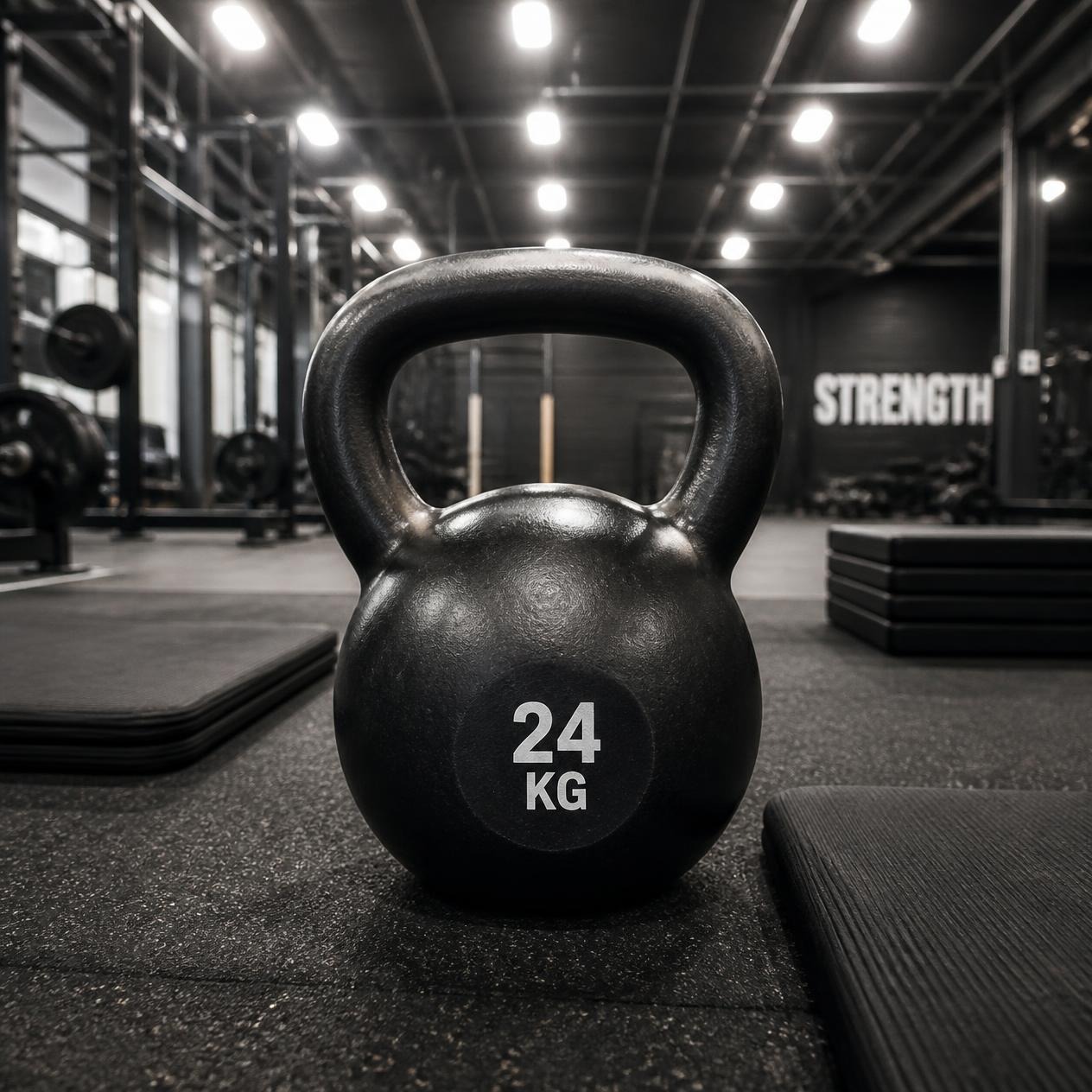
24 kg Kettlebell: A Guide to Choosing Between Cast Iron, Steel, and Rubber Coating
The 24 kg kettlebell represents one of the most used weights by athletes who have already developed a good strength base and wish to improve performance, power, and conditioning. It is a load considered a standard in advanced functional training, suitable for swings, cleans, snatches, military presses, squats, and numerous other multi-joint exercises. However, choosing a 24 kg kettlebell does not simply mean buying a weight: construction quality, material, surface finish, center of gravity balance, and dimensional precision directly affect the training experience.
Many users evaluate only the price or aesthetic appearance, underestimating differences that can influence comfort, safety, and equipment durability. Two kettlebells of the same weight can offer completely different sensations during a swing or a snatch simply because of how they were designed and manufactured.
In this guide, we analyze the characteristics of different materials, compare cast iron, steel, and protective coatings, delve into aspects related to grip, balance, and construction quality, helping you identify the most suitable solution for both a home gym and a professional gym.
- Why choose a 24 kg kettlebell
- Cast iron, steel, and rubber coating
- The role of balance
- Grip and ergonomics
- Home gym or professional gym
- How to recognize a quality product
- Durability and maintenance
- How to make the best decision
Why choose a 24 kg kettlebell
The 24 kg kettlebell represents a natural evolution after mastering technique with lower weights. It allows you to increase work on explosive strength, improve metabolic conditioning, and develop a greater capacity for power production.
For many trained men, it constitutes the benchmark for fundamental functional training exercises, while for instructors and fitness centers, it represents one of the most requested weights during group sessions.
The choice of a well-built product therefore takes on particular importance because this weight is often used intensively and subjected to numerous repetitions during each workout.
Who it is for
A 24 kg kettlebell is generally intended for intermediate or advanced athletes who possess consolidated technique and wish to increase the load while maintaining execution quality.
The most common exercises
Swings, cleans, snatches, goblet squats, front squats, presses, and farmer's walks are just some of the applications in which this weight finds its ideal use.
Cast iron, steel, and rubber coating
The first evaluation concerns the construction material. The comparison between cast iron vs. steel kettlebells is one of the most discussed aspects among enthusiasts because each solution presents specific advantages.
Cast iron offers robustness, low costs, and high impact resistance. Steel kettlebells used in competitions, on the other hand, maintain constant dimensions regardless of weight, favoring greater technical uniformity during training.
Models with rubber coating add extra protection against impacts and scratches, also reducing noise during placement, a feature particularly appreciated in homes and personal training studios.
Advantages of cast iron
Cast iron represents the most widespread solution thanks to the excellent ratio between quality, durability, and price. A good casting process ensures a uniform surface and excellent reliability over time.
When to choose steel
Steel kettlebells are designed for those seeking dimensional precision, constant balance, and sensations very similar to the standards used in kettlebell sport competitions.
The role of balance
Not all 24 kg kettlebells behave the same way. The secret lies in the distribution of mass and the correct positioning of the center of gravity, elements that determine the fluidity of movement and control during dynamic phases.
Precise balance allows the kettlebell to follow predictable trajectories, reducing unwanted oscillations. This improves the quality of the swing and makes the execution of cleans and snatches more natural.
Products made with accurate production processes offer very tight dimensional tolerances and guarantee uniform behavior from one unit to another.
Why it influences technique
A correct center of gravity facilitates tool control, reduces compensations, and allows for better transmission of the force generated by the hips.
Importance of tolerances
Apparently minimal construction differences can significantly influence comfort during long and repetitive workouts.
Grip and ergonomics
The handle constitutes one of the most important elements in choosing a professional kettlebell. Handle diameter, surface finish, and quality of workmanship directly affect safety.
A surface that is too smooth reduces control, while one that is too rough can cause skin irritation and premature calluses. The best compromise is represented by a uniform finish that promotes grip even during intense workouts.
The shape of the window must also allow for comfortable forearm insertion during cleans and presses without creating excessive pressure points.
Handle dimensions
A correct diameter allows for a secure grip without unnecessarily fatiguing the hand muscles.
Surface finish
The quality of the paint affects both aesthetics and the ability to maintain a constant grip over time.
Home gym or professional gym
Needs change significantly based on the context of use. In a home gym, it is important to limit noise and protect the flooring, while in professional facilities, resistance to intensive use takes on greater importance.
Rubber-coated models can be an interesting solution for those who want to reduce acoustic impact, although the coating must not compromise balance and movement quality.
For commercial gyms, robustness, uniformity between different weights, and ease of maintenance are particularly important.
Home training
In domestic environments, it is advisable to also evaluate the type of floor and the presence of neighbors, choosing products that limit vibrations and noise.
Intensive use
Weight rooms require kettlebells designed for thousands of uses annually while maintaining constant technical characteristics.
How to recognize a quality product
Construction quality is recognized by observing the uniformity of the casting, the absence of imperfections, the precision of the handle, and the surface finish. Even small details can make a difference over years of use.
A specialized manufacturer performs rigorous dimensional checks, uses selected materials, and guarantees tight tolerances between different units of the same series.
To learn more about equipment dedicated to functional training, you can consult best kettlebell for home gym, where further information on professional solutions is available.
Production controls
Accurate production processes ensure reliability, safety, and greater durability over time.
Quality-price ratio
A slightly higher investment can translate into more durable equipment and a significantly better training experience.
Durability and maintenance
A quality kettlebell requires minimal intervention. It is sufficient to keep it clean, remove magnesium residue, and periodically check for any signs of surface wear.
Storing equipment in dry environments helps preserve finishes and coatings, avoiding corrosion, especially in cast iron models.
Proper maintenance extends the useful life of the equipment and keeps grip characteristics constant even after years of use.
Routine cleaning
A dry cloth and non-aggressive detergents are generally sufficient to keep the kettlebell in optimal condition.
Proper storage
The use of dedicated racks protects both the equipment and the gym floor.
How to make the best decision
The choice of the ideal 24 kg kettlebell depends on technical level, training goals, and the context of use. Evaluating only the price risks leading to less balanced and less durable products.
Analyzing materials, balance, ergonomics, construction quality, and processing precision allows you to make a more informed purchase that is destined to last over time.
A well-designed kettlebell improves the fluidity of movements, increases comfort during every session, and represents an investment capable of accompanying years of high-performance training.
Comments (0)