
Trolley
You have no items in your shopping cart

 Budgets
 Dumbers
 Discs
Discs
 Benches
 Racks and Rigs
 Weights Holders
 Isotonic machines
 Calisthenics
 Cardio
 Kettlebells
 Flooring
 Gym Set
 Accessories
 Combat
 ARTI MARZIALI
 CONTAINER GYM
 Tug-Of-War
 Used Gym Equipment
 PILATES MACCHINARI
 GINNASTICA ARTISTICA
 CAMPI DA PADEL
 Prodotti in Pronta Consegna
 Informazioni
 IRONMAN
 Gift Card
- Donatif
- General information
- 0 I like it
- 639 Views
- 0 comments
- gym flooring, safety flooring, gym safety, shock-absorbing materials
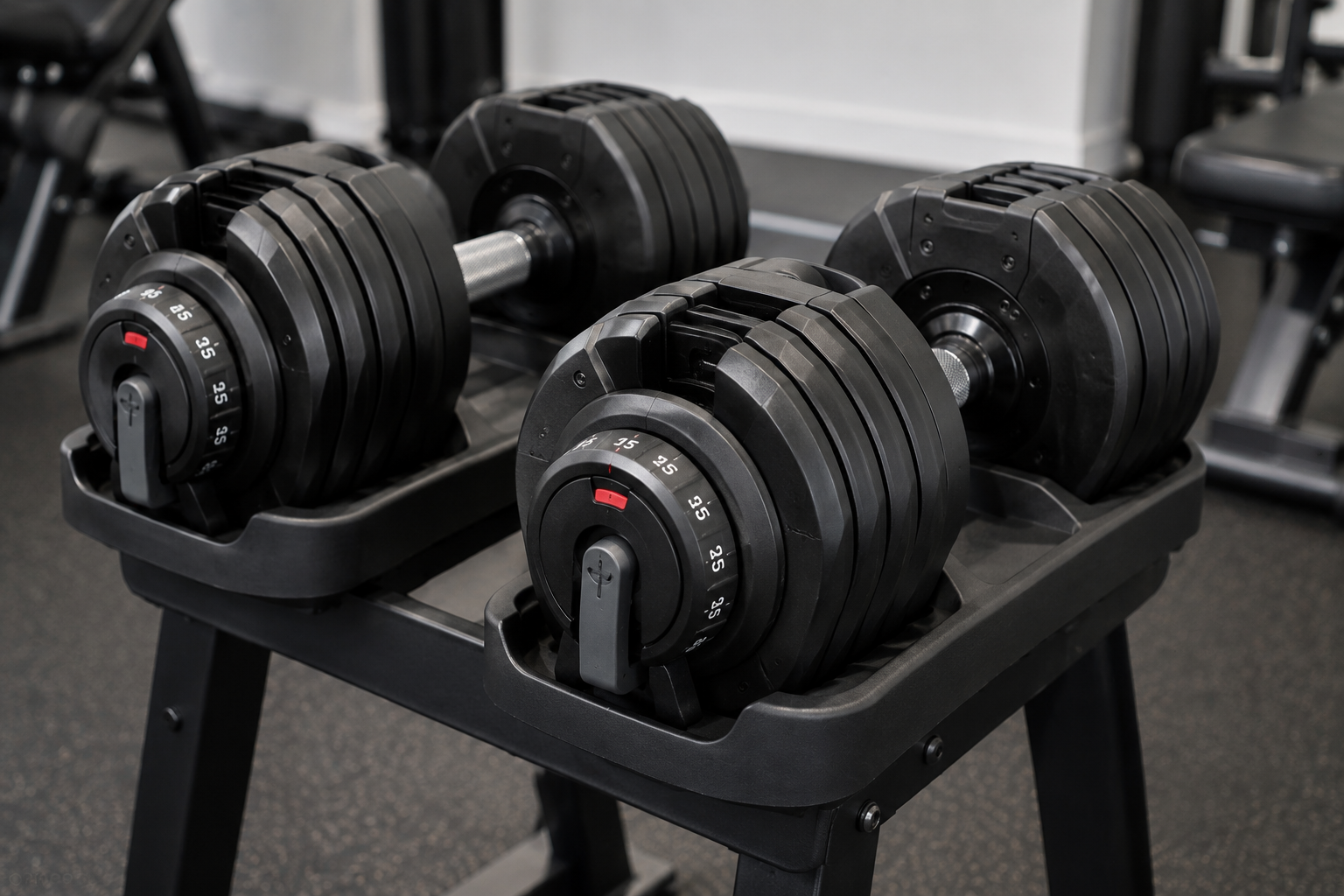
Modular vs. Quick-Adjust Dumbbells: Which to Choose for Your Home Workout
When setting up a home gym, choosing the most suitable dumbbell system may seem like a simple decision, but it actually involves several factors: available time, occupied space, budget, frequency of use, and training goals. Two of the most popular solutions are traditional modular dumbbells with plates and modern quick-adjust systems.
Both systems have interesting features, but they cater to different needs. Modular dumbbells offer great versatility and customization possibilities, while a quick-adjust weight dumbbell focuses primarily on the speed of load changes and simplifying the training experience.
For those with little time to train, even a few minutes saved between sets can impact the quality of the session. For this reason, it is important to evaluate the system not just as an initial cost, but as an investment in your daily routine.
- Differences between modular and quick-adjust dumbbells
- Advantages of traditional modular dumbbells
- Advantages of quick-adjust systems
- How much time affects weight changes
- Which solution is better for a home gym
- Initial cost and long-term value
- How to choose the most suitable system
Differences between modular and quick-adjust dumbbells
The main difference between the two systems concerns the way the weight is modified. Traditional modular dumbbells use plates that are added or removed manually from the bar, allowing for custom configurations based on the desired load.
Quick-adjust systems, on the other hand, integrate a mechanism that allows you to select the weight through a quick control. The user can therefore switch from one configuration to another without having to manually handle each plate.
This difference directly influences training management, especially when performing programs with many intensity changes or consecutive exercises with different loads.
How modular dumbbells work
Modular dumbbells use a simple system based on bars, plates, and locking systems. The structure allows you to freely choose the weight by adding or removing elements as needed.
This configuration is particularly appreciated by those who wish to gradually build their equipment and reuse plates they already have.
How quick-adjust dumbbells work
Quick-selection systems use an integrated mechanism that allows you to change the load via a selector. The weight is configured without having to manually disassemble the dumbbell.
The main advantage is operational speed, which makes the equipment particularly suitable for those who want to optimize every minute of their session.
Advantages of traditional modular dumbbells
Modular dumbbells represent a proven solution that is still widely used both in home environments and in gyms. Their main strength is flexibility: the user can modify the load by freely choosing which plates to use.
28mm modular dumbbells are one of the most common configurations because they allow you to take advantage of numerous compatible plates already on the market.
This system offers a simple and easily customizable approach, which is particularly interesting for those who do not need frequent changes during their workout.
Maximum freedom in configuration
One of the strengths of modular systems is the ability to create exactly the desired weight. The user can choose small or large increments based on the type of exercise.
This feature is especially useful for those following programs with precise load progressions.
Using plates already available
An important advantage concerns compatibility with equipment purchased previously. Those who already own plates can integrate them into the system without necessarily having to buy a completely new set.
This allows you to optimize the initial investment and reduce waste.
Advantages of quick-adjust systems
Quick-adjust systems are designed for those who consider time a fundamental element of training. The ability to change weight quickly eliminates many of the manual operations required with traditional systems.
For those with a limited window to train, such as a worker who only has 45 minutes a day, this difference can become significant.
The convenience allows you to maintain a more constant rhythm and focus more on the exercises.
Fast weight change
The main advantage of quick-adjust systems is the speed with which you can switch from one load to another. This is particularly useful in circuit training, supersets, and sessions with many variations.
Reducing downtime allows you to make better use of the available time.
Greater operational simplicity
An integrated system reduces the number of components to manage during training. There is no need to look for plates, unscrew locks, or constantly organize the material.
This simplicity improves the overall experience, especially in home spaces.
How much time affects weight changes
Time is one of the most important resources for those who train at home. Many people choose home fitness precisely to eliminate travel and integrate physical activity into their daily routine.
When a session lasts less than an hour, every unnecessary pause can reduce the total volume of work performed.
The choice of dumbbell system can therefore directly influence the efficiency of the workout.
Limiting downtime
In programs where recovery between sets is controlled, having to manually change the weight can alter the planned structure.
A faster system allows you to better adhere to the scheduled times.
Training in a more organized way
Easier equipment management helps maintain greater concentration during the session.
The athlete can dedicate more attention to technique and progression rather than preparing the material.
Which solution is better for a home gym
The available space is another determining element in the choice. A home gym must be functional but also easy to keep tidy.
Modular systems generally require more component management, while adjustable solutions allow you to concentrate more possibilities into a single piece of equipment.
The choice therefore depends on the relationship between available space and personal needs.
Managing a small home gym
In small environments, reducing the number of tools present can significantly improve organization.
A compact system allows you to free up space and keep the training area tidier.
Creating a flexible environment
The ability to quickly adapt the equipment allows you to use the same space for different types of training.
Initial cost and long-term value
The purchase price is often the first element evaluated, but it does not always represent the real cost of a solution. It is also necessary to consider durability, practicality, and frequency of use.
A less expensive but slower-to-use system might have less value for those who train frequently.
Conversely, a more advanced solution can represent an investment in the quality of your routine.
Don't just look at the initial cost
A smart purchase considers the number of years of use and the benefit obtained daily.
Equipment should be evaluated as a tool that supports the achievement of goals.
From cost to investment
The difference between an economical choice and an effective choice often concerns the value generated over time.
A system that allows you to train better and with greater consistency can have a higher return compared to simple initial savings.
How to choose the most suitable system
The choice between modular and quick-adjust dumbbells depends on your priorities. Those looking for maximum customization and who already own compatible plates may find modular systems to be a very valid solution.
Those who instead want to optimize time, simplicity, and space management may prefer a quick-adjust system.
There is no single universal answer: the best system is the one that integrates with your training style and allows you to maintain consistency over time.
Evaluating your usage
Frequency of workouts, available space, and the type of programs followed are fundamental elements in the decision.
Thinking about future growth
Choosing equipment capable of accompanying your journey allows you to avoid unnecessary replacements and build a truly efficient home gym.
Comments (0)