
Trolley
You have no items in your shopping cart

 Budgets
 Dumbers
 Discs
Discs
 Benches
 Racks and Rigs
 Weights Holders
 Isotonic machines
 Calisthenics
 Cardio
 Kettlebells
 Flooring
 Gym Set
 Accessories
 Combat
 ARTI MARZIALI
 CONTAINER GYM
 Tug-Of-War
 Used Gym Equipment
 PILATES MACCHINARI
 GINNASTICA ARTISTICA
 CAMPI DA PADEL
 Prodotti in Pronta Consegna
 Informazioni
 IRONMAN
 Gift Card
- Donatif
- General information
- 0 I like it
- 68 Views
- 0 comments
- gym flooring, safety flooring, gym safety, shock-absorbing materials
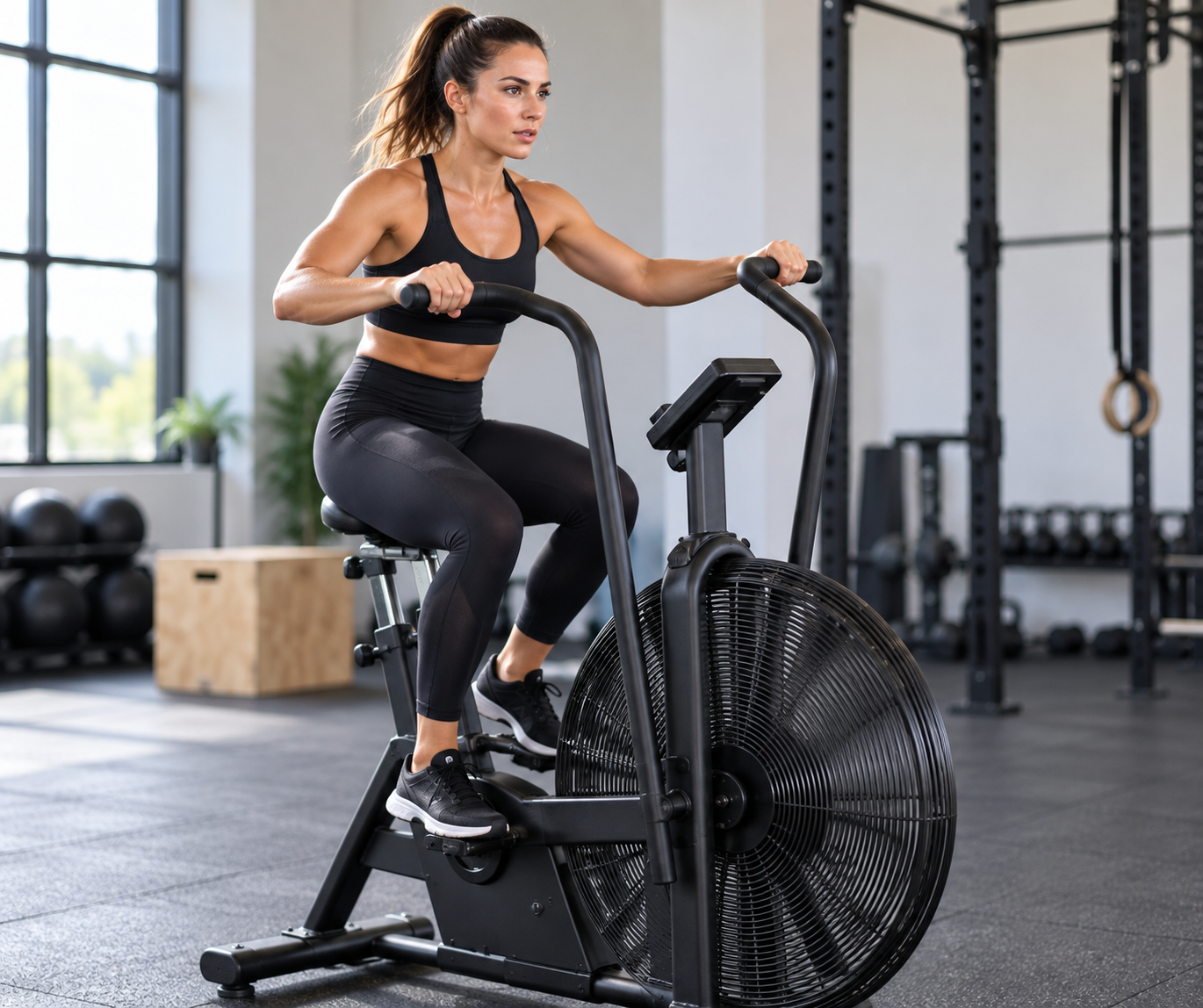
Air bike maintenance: chain or belt and fasteners
Proper air bike maintenance consists of performing scheduled transmission checks, periodically verifying fasteners, keeping the fan clean, and inspecting wear-and-tear parts according to the manufacturer's instructions. A preventive maintenance plan helps preserve the machine's performance, safety, and continuity of use.
Air bikes used in home gyms, commercial fitness facilities, and functional boxes are often subjected to intense use. For this reason, it is important to schedule regular checks rather than intervening only when a malfunction occurs. Identifying signs of wear early on helps limit downtime and reduces the likelihood of more complex breakdowns.
Each model may use a chain or belt transmission. Maintenance procedures vary depending on the solution adopted, which is why it is always necessary to consult the specific machine's technical manual before performing any intervention.
- What to check during maintenance?
- Chain or belt: what changes?
- Why check the fasteners?
- How to clean the fan?
- How to recognize signs of wear?
- How often should checks be performed?
- Mistakes to avoid
- Why maintenance protects your investment
What to check during maintenance?
Periodic checks should include the general condition of the machine, frame stability, correct functioning of adjustments, transmission integrity, and tightening of the main mechanical elements.
It is also advisable to check for unusual noises, mechanical play, or difficulty during pedaling and handle movement. Any anomalies require further investigation before continuing to use the machine.
Operations must be performed exclusively following the procedures provided by the manufacturer of the specific air bike.
Visual inspection
A quick check before use makes it possible to identify loose components, damaged parts, or obvious signs of wear.
Main components
The frame, cranks, handles, adjustment systems, and transmission should be part of the periodic inspection program.
Chain or belt: what changes?
The transmission represents one of the main elements of the air bike. Some models use a chain while others adopt a belt. Maintenance methods, control intervals, and any permitted operations depend on the installed system.
Before any intervention, it is therefore fundamental to verify which solution is provided by the manufacturer and follow exclusively the instructions reported in the technical documentation.
It is not correct to apply procedures valid for a transmission system to a model designed with a different solution.
Chain transmission
For models that use a chain, it is advisable to follow the manufacturer's instructions regarding checks, tensioning, and any maintenance operations provided for.
Belt transmission
Air bikes equipped with a belt require specific checks established by the manufacturer, avoiding interventions not provided for by the technical documentation.
Why check the fasteners?
Fasteners contribute to the stability of the machine and should be checked periodically, especially when the air bike is used frequently in professional settings.
Over time, stresses may make it necessary to check the points indicated by the manufacturer. Checks must be carried out using the recommended procedures and tools.
Any component showing play or instability should be checked before proceeding with the workout.
Check points
Technical manuals generally identify the components that require periodic checks of the fasteners.
Warning signs
Metallic noises, abnormal oscillations, or variations in machine stability may require a technical inspection.
How to clean the fan?
The fan should be kept clean to avoid the accumulation of dust and debris that could compromise the proper functioning of the machine.
Cleaning operations must be carried out while the machine is stopped using the methods indicated by the manufacturer, avoiding non-recommended products or tools.
External surfaces, handles, and the frame should also be sanitized regularly, especially in gyms and boxes with high traffic.
Routine cleaning
Constant cleaning helps preserve surfaces and facilitates periodic inspections.
Fan area
Keeping the fan area clear and clean facilitates proper functioning and subsequent maintenance operations.
How to recognize signs of wear?
Unusual noises, variations in pedaling fluidity, mechanical play, and difficulty in adjustments represent signs that merit a technical check.
Deformed, damaged components or those with obvious signs of deterioration should also be checked before continuing to use the machine.
When it is not possible to restore the conditions set by the manufacturer, it is advisable to contact technical assistance or replace the affected components using compliant spare parts.
Abnormal noises
Any significant variation compared to normal operation requires a check before the next use.
Difficult adjustments
If the saddle or handlebar does not lock correctly, it is advisable to stop using the machine and check the adjustment system.
How often should checks be performed?
The frequency of maintenance depends on the intensity of use of the air bike and the manufacturer's instructions. A machine used daily in a commercial gym generally requires more frequent checks than one intended for home use.
It is advisable to distinguish between visual checks before use, routine cleaning, and scheduled technical inspections by documenting the interventions performed.
Following a maintenance schedule helps maintain constant performance and safety over time.
Daily checks
Before each workout, it is useful to quickly verify stability, adjustments, and general conditions of the machine.
Scheduled interventions
Technical checks should be planned according to the manufacturer's documentation.
What mistakes should be avoided?
One of the most frequent mistakes is intervening on the transmission without consulting the technical manual of the specific machine or completely neglecting preventive maintenance.
It is also advisable to avoid using unsuitable products for cleaning, ignoring abnormal noises, or continuing to train when the machine shows instability or loose components.
The use of spare parts not compliant with the manufacturer's specifications can also compromise the proper functioning of the equipment.
Ignoring the manual
Each model has specific procedures that must be respected during maintenance and component replacement.
Delaying interventions
Preventive maintenance is generally more effective compared to interventions carried out exclusively after a breakdown appears.
Why maintenance protects your investment?
Proper air bike maintenance makes it possible to preserve the efficiency, safety, and operational continuity of the machine, helping to reduce the risk of sudden downtime and prolonging its useful life. Scheduling checks, cleaning, and technical inspections is therefore a choice that protects the investment both in home gyms and professional facilities.
Before performing any intervention, it is advisable to consult the manufacturer's technical documentation to verify the procedures provided for the transmission, fasteners, and maintenance operations. For frequencies, operating methods, and component replacement, it is appropriate to refer exclusively to the manuals of the specific air bike and use spare parts compliant with the manufacturer's instructions. To learn more about solutions dedicated to cardio training, you can consult the cardio machines category.
Comments (0)