
Trolley
You have no items in your shopping cart

 Budgets
 Dumbers
 Discs
Discs
 Benches
 Racks and Rigs
 Weights Holders
 Isotonic machines
 Calisthenics
 Cardio
 Kettlebells
 Flooring
 Gym Set
 Accessories
 Combat
 ARTI MARZIALI
 CONTAINER GYM
 Tug-Of-War
 Used Gym Equipment
 PILATES MACCHINARI
 GINNASTICA ARTISTICA
 CAMPI DA PADEL
 Prodotti in Pronta Consegna
 Informazioni
 IRONMAN
 Gift Card
- Donatif
- General information
- 0 I like it
- 7 Views
- 0 comments
- gym flooring, safety flooring, gym safety, shock-absorbing materials
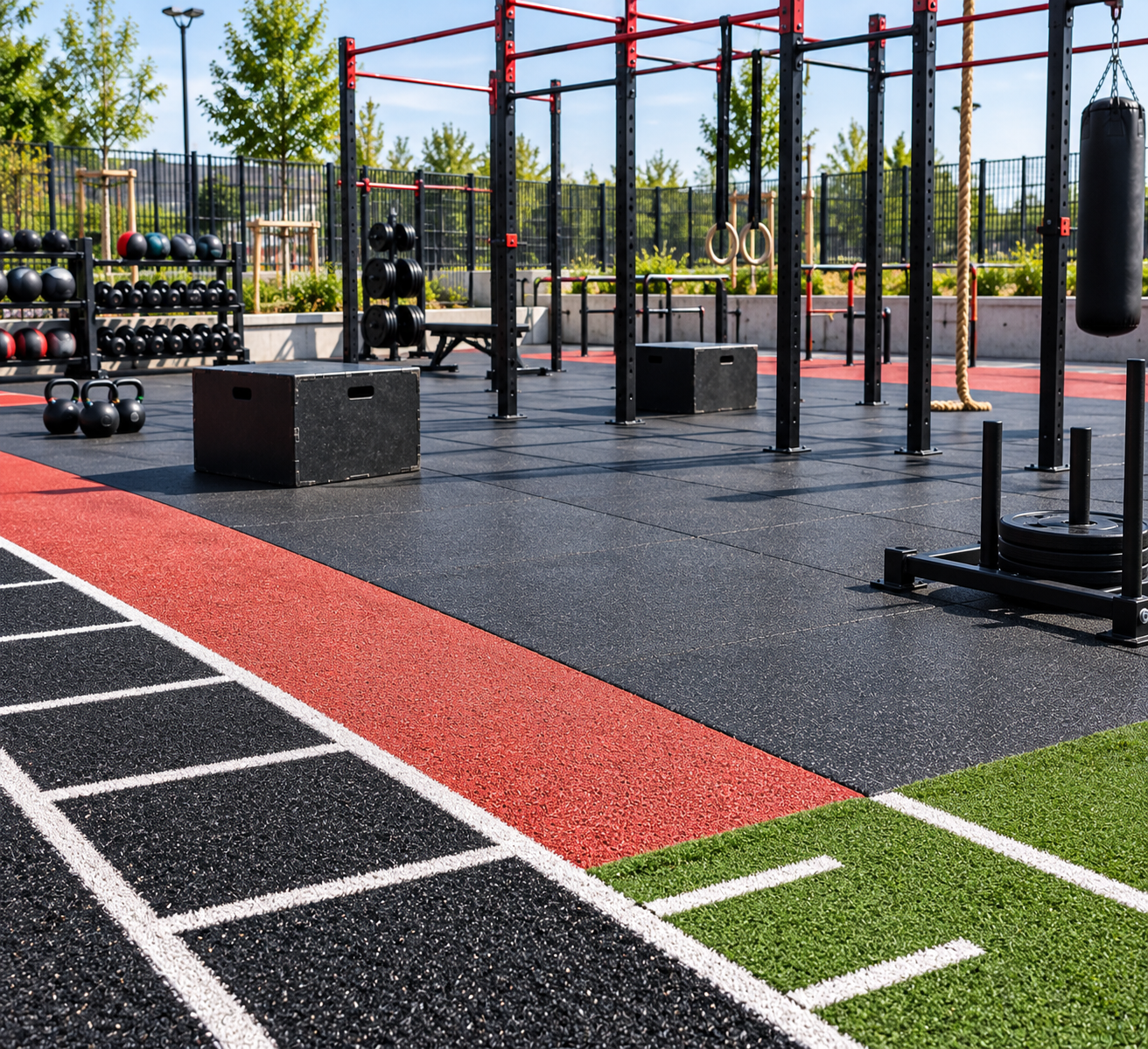
Outdoor sports flooring maintenance: guide to outdoor safety flooring
Outdoor sports flooring maintenance is one of the aspects that most affects user safety, investment durability, and the continuity of use of the fitness area. Proper management does not simply consist of periodic cleaning, but includes scheduled checks, drainage verification, wear monitoring, and preventive interventions.
For outdoor safety flooring, it is advisable to set up a maintenance plan based on the frequency of use, climatic conditions, and the manufacturer's instructions. Regular inspections allow for the prompt identification of anomalies that could compromise the performance of the surface.
This guide offers operational criteria intended for sports facility managers, outdoor gyms, public bodies, and professionals who wish to organize verifiable maintenance without turning the topic into a general overview of product selection.
- Quick answer
- What to check periodically
- Control frequencies and signs of wear
- Cleaning and routine maintenance
- Preventive actions to increase durability
- When to intervene or replace the surface
- FAQ on maintenance
- Managing maintenance as an investment
How is outdoor sports flooring maintenance performed?
Maintenance of outdoor safety flooring consists of keeping the surface clean, checking proper water drainage, inspecting joints, stability, deformations, and the state of wear by scheduling interventions before defects can compromise safety and functionality.
Activities must be documented through control logs that record the date, inspected area, any anomalies found, and actions taken. This methodology facilitates intervention planning and allows for monitoring the evolution of the flooring conditions.
When the manufacturer provides a maintenance manual, it is appropriate to follow the procedures outlined, supplementing them with additional checks in case of intensive use or particularly harsh environmental conditions.
What criteria should be used during the inspection?
Verifications should include surface uniformity, absence of unstable elements, drainage functionality, condition of joints, and general cleaning of the area.
Why record interventions?
Organized documentation makes it possible to schedule preventive maintenance, demonstrate correct facility management, and plan future investments with objective data.
What to check periodically
A visual check represents the first level of control and should involve the entire surface without being limited to the most heavily used areas.
Points to monitor include the presence of water pooling, shifting of modular elements, damage due to atmospheric agents, localized wear, and sub-base conditions if obvious anomalies are evident.
Along external fitness paths, it is also important to check areas subjected to greater impact, such as landing zones and those close to equipment.
Check drainage
Proper drainage avoids persistent pooling that can favor the accumulation of dirt and accelerate the degradation of the surface. It is useful to check that drains and channels are free of leaves, earth, and debris.
Check joints and fasteners
Any gaps between elements or deteriorated fastening systems require timely checking to prevent the problem from spreading to adjacent surfaces.
Control frequencies and signs of wear
The frequency of verifications depends on the level of use and exposure to atmospheric agents. Public or high-traffic areas require closer checks compared to spaces with occasional use.
An organized program can include frequent visual checks, periodic functional verifications, and in-depth inspections scheduled throughout the year.
The main signs of wear include loss of flatness, permanent deformations, detachments, marked discoloration due to UV rays, reduction of surface characteristics, and the presence of damaged parts.
Routine checks
Visual verifications allow for the rapid identification of any anomalies without interrupting the structure's activity.
In-depth inspections
During scheduled verifications, it is also appropriate to check for any sub-base subsidence, the continuity of joints, and the overall condition of the surface.
Cleaning and routine maintenance
Cleaning represents an essential component of maintenance but must be carried out in ways compatible with the installed material.
Generally, it is advisable to regularly remove leaves, soil, sand, and other residues that can hinder water runoff or encourage the growth of moss and vegetation.
To explore the characteristics of available materials in more depth, you can consult the section dedicated to outdoor safety flooring.
How to carry out washing
Use the procedures indicated by the manufacturer, avoiding products incompatible with the surface material. In case of doubt, it is preferable to test on limited areas.
Management of leaves and residues
Frequent removal of debris limits moisture accumulation and helps keep the drainage system efficient.
Preventive actions to increase durability
Prevention makes it possible to reduce the number of extraordinary interventions and preserve the characteristics of the surface over time.
Among the most useful activities are controlling surrounding vegetation, periodically checking the water collection system, and monitoring exposure to environmental factors.
Proper management of the area also makes it possible to limit damage caused by improper handling of equipment or loads not foreseen by the project.
Monitor UV resistance
Prolonged exposure to the sun can alter the aesthetic appearance of the surface over time. It is useful to check for significant variations by periodically comparing the most exposed areas with protected ones.
Check outdoor safety flooring thickness
In the presence of localized replacements, it is important to maintain uniformity with the original project, avoiding differences that could create uneven levels.
When to intervene or replace the surface
Not all anomalies require the complete replacement of the flooring. In many cases, it is possible to intervene locally after identifying the cause of the problem.
It is necessary to evaluate the extent of the damage, the size of the affected area, the availability of compatible spare parts, and the instructions provided by the manufacturer.
If the surface no longer guarantees the expected performance or presents widespread damage, it is appropriate to schedule a more extensive restoration intervention.
When a repair is sufficient
Limited defects, damaged modular elements, or small detachments can often be managed without replacing the entire area.
When to consider replacement
Replacement becomes appropriate when wear is generalized or when local interventions no longer allow for the restoration of functionality and safety.
FAQ on outdoor sports flooring maintenance
How often should an outdoor surface be checked?
Frequency depends on the intensity of use, climatic conditions, and manufacturer instructions. Public areas require more frequent verifications compared to facilities with limited use.
How to recognize a drainage problem?
The repeated presence of pooling after rainfall, accumulation of debris, or slowed water runoff represent signs that deserve checking.
Is it necessary to use specific products?
It is advisable to follow the manufacturer's instructions, avoiding products that could prove incompatible with the surface material.
Are there technical references to consult?
For the design and management of surfaces, it is appropriate to refer to the manufacturer's technical documentation and, where applicable, relevant technical standards such as the EN 1177 series for aspects related to impact-attenuating surfaces in play areas and other standards referenced by the specific project. Verifications must always be contextualized to the intended use of the facility.
Managing maintenance as an investment
Scheduled maintenance makes it possible to preserve the functionality of the outdoor safety flooring, reduce extraordinary interventions, and improve the financial planning of the facility.
For sports facility managers, fitness centers, and public bodies, the availability of documented procedures facilitates the control of surface conditions, supports decisions on future interventions, and helps maintain performance consistent with the initial project over time.
An approach based on periodic checks, preventive maintenance, and the recording of verifications allows for operational decisions based on measurable elements without waiting for degradation to become obvious or compromise the usability of the area.
Comments (0)