
Trolley
You have no items in your shopping cart

 Budgets
 Dumbers
 Discs
Discs
 Benches
 Racks and Rigs
 Weights Holders
 Isotonic machines
 Calisthenics
 Cardio
 Kettlebells
 Flooring
 Gym Set
 Accessories
 Combat
 ARTI MARZIALI
 CONTAINER GYM
 Tug-Of-War
 Used Gym Equipment
 PILATES MACCHINARI
 GINNASTICA ARTISTICA
 CAMPI DA PADEL
 Prodotti in Pronta Consegna
 Informazioni
 IRONMAN
 Gift Card
- Donatif
- General information
- 0 I like it
- 1 Views
- 0 comments
- gym flooring, safety flooring, gym safety, shock-absorbing materials
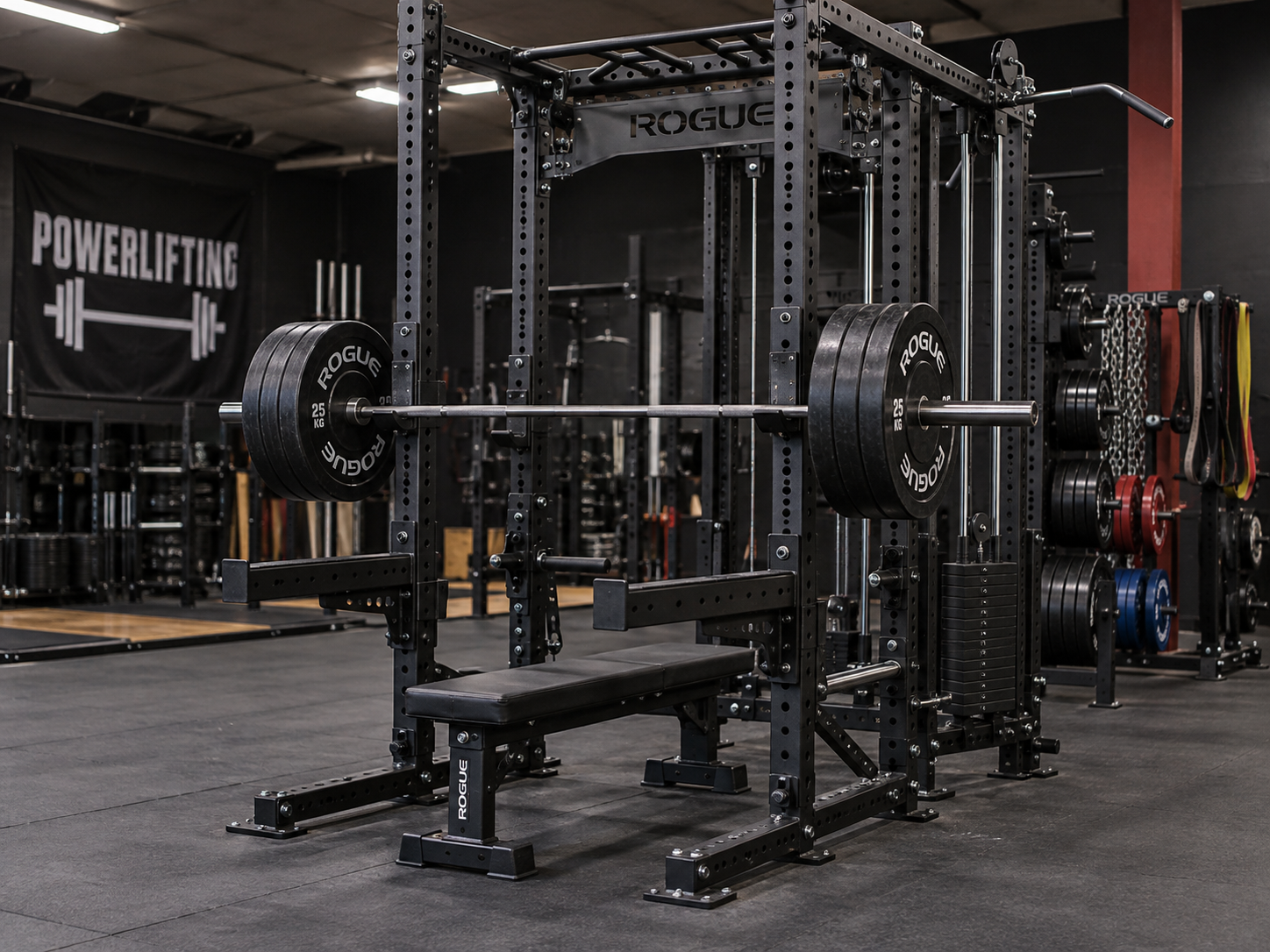
Power rack vs combo rack: which to choose for powerlifting equipment
Anyone setting up a station dedicated to powerlifting often faces a recurring question: is it better to choose a power rack or a combo rack? The answer depends on the intended use, the level of the athletes, the available space, and the standards you want to meet. There is no single solution that works in every context, but there are verifiable technical criteria that allow you to make an informed decision.
In summary, the power rack is a versatile structure suitable for individual workouts, home gyms, and multi-functional gyms, while the combo rack is designed to meet the needs of competitions and specific powerlifting preparations, allowing quick adjustments for squats and bench press without altering the platform setup.
Before investing in a new station, it is therefore advisable to evaluate the load capacity declared by the manufacturer, compatibility with Olympic barbells, dimensions of the available area, the possibility of installing accessories, and compliance with the standards used in federal competitions when required.
- Main differences between power rack and combo rack
- Which criteria to use for the choice
- Comparison table
- When to choose a power rack
- When to choose a combo rack
- Common mistakes to avoid
- How to complete a powerlifting station
- Evaluating the investment
What are the main differences between a power rack and a combo rack?
The power rack consists of four uprights connected together that create a safety cage. Inside the structure are the barbell supports and adjustable safety bars. This configuration allows you to train squats, bench press, military press, and numerous accessory exercises using a single structure.
The combo rack, on the other hand, was created for a very specific purpose. It is designed to allow the rapid configuration of both the squat and the bench press while maintaining the same structure. Adjustments allow you to adapt the height and position of the supports without moving the bench or modifying the entire station.
In competitions organized according to federal technical regulations, the combo rack is frequently used because it speeds up athlete changes and maintains uniformity in adjustments. For a commercial gym, this advantage must be weighed against the type of clientele served.
How does the construction structure change?
The power rack prioritizes robustness, modularity, and the possibility of expansion with accessories such as pull-up bars, spotter arms, storage systems, and additional supports.
Why is the combo rack different?
The combo rack integrates dedicated adjustments that allow you to quickly switch from the squat configuration to the bench press configuration, a feature particularly appreciated during sporting events and specific workouts.
Which criteria to use for the choice?
The decision should start from the objective of the facility. A home gym or a general weight room often benefits from the versatility of a power rack, while a center dedicated primarily to competitive powerlifting can take advantage of the features of the combo rack.
It is necessary to verify the maximum load capacity declared by the manufacturer, the quality of the welds, the thickness of the steel, the presence of precise adjustment systems, and compatibility with accessories already present in the gym. This data must be reported in the manufacturer's technical documentation.
Available space is also decisive. A correct layout must allow barbell loading, spotter movement, and the use of the platform without interference with other equipment.
How much does load capacity matter?
Certified load capacity represents one of the fundamental parameters because it must be adequate for the loads actually used and the level of athletes who will frequent the facility.
Which accessories to check?
It is useful to check compatibility with safety bars, supports, J-cups, plate storage systems, and other solutions that allow you to expand the functionality of the station over time.
Comparison table
The following table summarizes the main elements to consider during evaluation.
| Feature | Power Rack | Combo Rack |
|---|---|---|
| Versatility | Very high | Specialized |
| General training | Excellent | Good |
| Competition preparation | Good | Highly suitable |
| Quick squat and bench change | Limited | High |
| Expandability | Very broad | More limited |
| Home gym | Very suitable | Depends on space |
This comparison does not replace the verification of the technical specifications of the individual model but helps to understand the design differences.
When possible, it is advisable to also compare external measurements, available adjustments, and included accessories.
Which measurements to check?
Depth, width, total height, distance between uprights, and operational footprint directly affect the usability of the station.
Are there reference standards?
For facilities hosting competitions, it is advisable to check the technical regulations of the reference federation and the equipment's compatibility with these requirements.
When is it better to choose a power rack?
The power rack is often the ideal solution when the gym hosts users with different objectives. In addition to typical powerlifting exercises, it allows you to perform numerous general strength exercises.
Modularity is one of the main advantages. Over time, it is possible to add accessories without replacing the entire structure, making the investment more flexible.
Anyone wishing to create a powerlifting rack station generally finds in the power rack a solution capable of adapting to different training methods.
Is it suitable for the home gym?
Yes, especially when the available space must accommodate multiple exercises with a single structure.
Is it suitable for commercial gyms?
In traditional weight rooms, it offers high operational flexibility and makes it possible to satisfy very different needs.
When is it better to choose a combo rack?
The combo rack finds its ideal placement in specialized centers where the main activity involves competitive powerlifting or the technical preparation of advanced athletes.
Speed of adjustment makes it possible to reduce times during sessions with multiple athletes and reproduces conditions very similar to those found during official competitions.
For those preparing for federal competitions, this continuity can represent an organizational advantage, especially when workouts are carried out with specific protocols.
Why is it used in competitions?
The ability to quickly modify adjustments facilitates the succession of athletes while keeping the station ready for squats and bench press.
Which centers benefit most from it?
Sports associations, competitive teams, and facilities focused exclusively on powerlifting are the contexts in which the combo rack is chosen most frequently.
Which mistakes to avoid during the choice?
A frequent mistake consists in evaluating exclusively the initial price while neglecting the intended use, expandability, and compatibility with the rest of the equipment.
It is equally important to verify that the dimensions are appropriate for the room and that the necessary space is available for barbell loading and spotter assistance.
Finally, it is advisable to avoid purchasing structures without clear technical documentation regarding materials, load capacities, and assembly instructions.
Does space really matter?
An incorrect layout can limit safety and operational comfort even when the structure is technically sound.
Why verify construction quality?
Materials, finishes, and precision of adjustments affect the durability of the structure and the daily user experience.
What equipment is needed to complete a powerlifting station?
Choosing the rack is only part of the investment. A complete station also includes a barbell compliant with your needs, a stable bench, compatible plates, collar systems, and adequate technical flooring.
The platform helps protect the floor, improve stability, and delineate the work area. In this case as well, it is necessary to verify materials, dimensions, and compatibility with the installed rack.
For a professional gym, it is useful to plan any future expansions right from the start so as to maintain uniformity in the setup.
How important is the platform?
An adequate platform improves the organization of the training area and contributes to surface protection during the use of heavy loads.
Which accessories are truly useful?
Plate storage supports, adjustable safety systems, and compatible accessories allow you to make the most of the station over time.
How to evaluate the investment over time?
The choice between a power rack and a combo rack should be made considering the total cost of ownership and not just the purchase price. Durability, maintenance, the possibility of upgrading, and adaptability to the future needs of the facility affect the real value of the investment.
A growth-oriented gym may favor an easily expandable solution, while a specialized center might prefer a structure designed to replicate the competitive context as closely as possible.
By analyzing the facility's goals, user types, available space, powerlifting rack and bench, compatibility with accessories, and technical requirements declared by the manufacturer, it is possible to identify the most coherent solution without relying solely on personal preferences.
Comments (0)