
Trolley
You have no items in your shopping cart

 Budgets
 Dumbers
 Discs
Discs
 Benches
 Racks and Rigs
 Weights Holders
 Isotonic machines
 Calisthenics
 Cardio
 Kettlebells
 Flooring
 Gym Set
 Accessories
 Combat
 ARTI MARZIALI
 CONTAINER GYM
 Tug-Of-War
 Used Gym Equipment
 PILATES MACCHINARI
 GINNASTICA ARTISTICA
 CAMPI DA PADEL
 Prodotti in Pronta Consegna
 Informazioni
 IRONMAN
 Gift Card
- Donatif
- General information
- 0 I like it
- 20 Views
- 0 comments
- gym flooring, safety flooring, gym safety, shock-absorbing materials
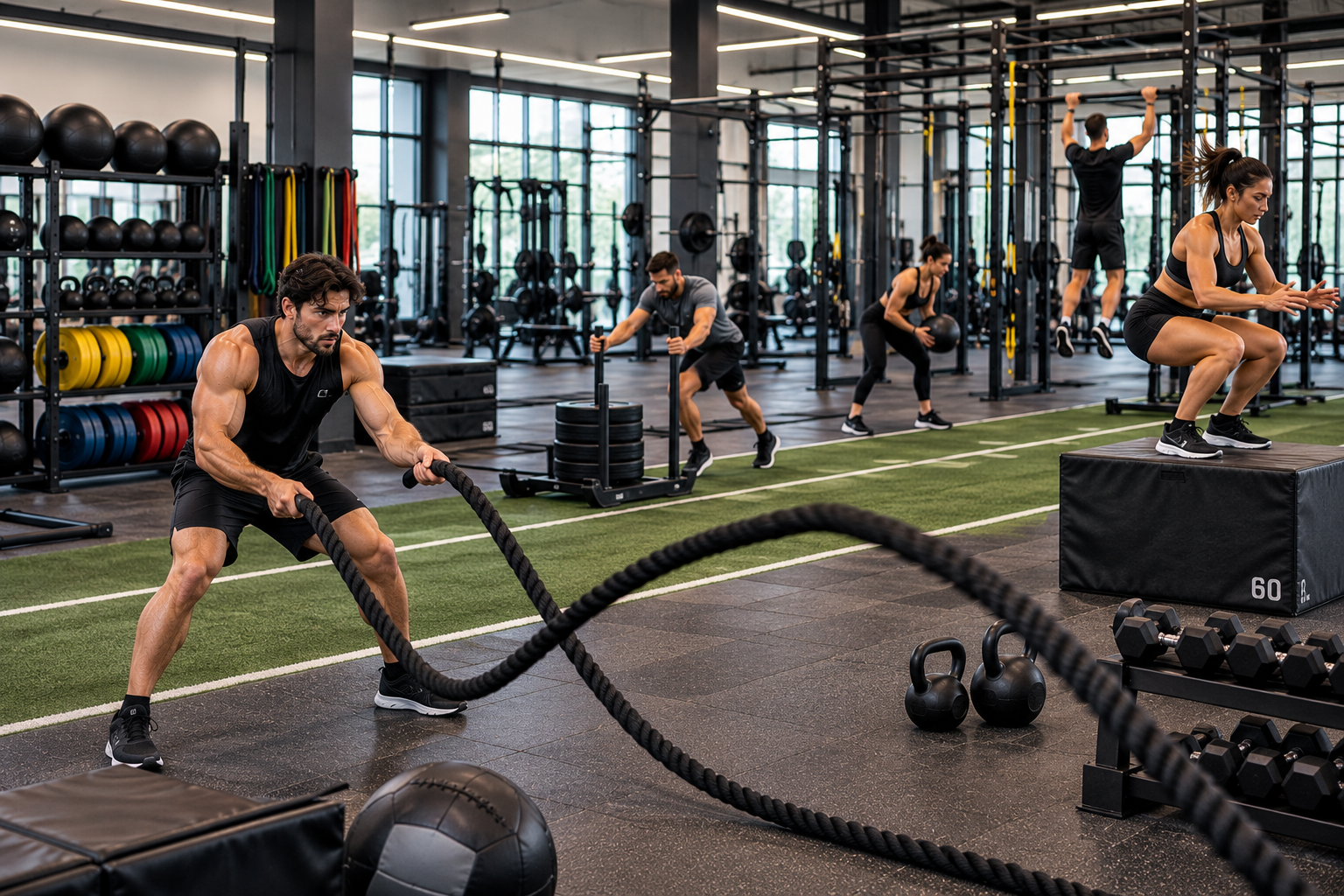
General vs specific preparation: how to choose your athletic training path
Athletic training is commonly divided into general and specific preparation. Although both share the goal of improving sports performance, they address different needs and are used at different moments in the training schedule.
Understanding the differences between these two approaches allows athletes, trainers, sports clubs, and facility managers to organize programs that are more consistent with the goals of the sports season, avoiding errors in work progression.
This guide offers an operational comparison between general and specific preparation, illustrating verifiable decision-making criteria, application scenarios, and errors to avoid, without overlapping with content dedicated to the complete structure of athletic training.
- Quick answer
- What are the main differences?
- How to choose between general and specific preparation?
- When to use each approach?
- Errors to avoid
- How to integrate them into programming
- FAQ
- Organizing work effectively
General vs specific preparation: what is the difference?
General preparation develops basic physical capacities common to many disciplines, while specific preparation transfers these capacities toward gestures, intensities, and demands inherent to a specific sport. The choice depends on the season's phase, the athlete's level, and the goals of the athletic training program.
The two approaches should not be considered alternative but complementary. In most programs, they coexist in different proportions throughout the sports year.
To choose correctly, it is useful to evaluate the moment of the season, the athlete's characteristics, and the needs of the practiced discipline.
What is general preparation?
General preparation aims at developing fundamental physical qualities, creating a foundation upon which subsequent work can be built.
What is specific preparation?
Specific preparation directs work toward technical, motor, and conditional demands directly connected to the sport practiced.
What are the main differences?
The differences concern goals, training contents, exercise types, and the degree of similarity with the sports gesture.
General preparation favors the development of basic capacities, whereas specific preparation seeks the transfer of physical qualities into the performance required by the discipline.
Both require coherent planning and adequate progression.
Differences in goals
General preparation targets the development of strength, mobility, coordination, and basic conditional capacities. Specific preparation utilizes these qualities by adapting them to the demands of the discipline.
Differences in exercises
General preparation exercises are normally more transversal, whereas specific preparation exercises reproduce movements, rhythms, and situations typical of competition.
How to choose between general and specific preparation?
The choice depends on observable criteria rather than personal preferences.
It is necessary to consider the athlete's experience, the period of the season, performance goals, the competition calendar, and the required level of specialization.
An initial evaluation helps define the correct balance between the two components.
In the initial phases of the season
At the beginning of programming, more space is often dedicated to developing general physical qualities, preparing the organism for subsequent loads.
During the competitive phase
As competitions approach, the weight of specific exercises generally increases, while still maintaining a quota of general work based on individual goals.
In which situations should one approach be chosen over the other?
General preparation is indicated when it is necessary to build solid physical foundations or when working with athletes in the early phases of their sports journey.
Specific preparation gains greater importance when the goal is to optimize performance in the practiced discipline through highly contextualized exercises.
In practice, both are integrated according to progressive programming.
Team sports
In team sports, general preparation supports the development of qualities common to all athletes, while specific preparation is adapted to the roles and demands of the game.
Racket sports and individual disciplines
In these contexts, specific preparation is modeled on the technical characteristics of the discipline while maintaining the support of general preparation.
How to integrate them into programming?
Effective planning avoids contrasting the two approaches and instead incorporates them within a coherent progression.
Proportions can change during the season as a function of competitions, recovery, and technical goals.
To organize the work, it is useful to set up functional areas with adequate surfaces and easily reconfigurable equipment.
Organizing the space
Subdividing the training area into dedicated zones facilitates the transition between different exercises and improves group management.
Managing accessories
Cones, hurdles, resistance bands, and other tools should be easily available without obstructing work paths. To learn more about dedicated solutions, you can consult the gym accessories section.
What errors should be avoided?
One of the most common errors consists of focusing exclusively on specific preparation while neglecting basic physical capacities or, conversely, excessively prolonging general work without adequate transfer toward the discipline.
Another critical issue concerns the lack of progression between the different phases of programming.
The choice of exercises should always be consistent with the period's goals and the athlete's level.
Avoiding sudden changes
The transition between the different phases of preparation should be gradual to allow progressive adaptation to new loads.
Contextualizing the work
Exercises gain value when they are inserted within structured programming rather than acting as isolated activities.
FAQ on general and specific preparation
Is general or specific preparation better?
There is no single solution valid for every situation. Both perform different functions and are integrated according to programming goals.
Is general preparation also useful for experienced athletes?
Yes. It can maintain and consolidate fundamental physical qualities even during advanced sports seasons, with modalities adapted to individual needs.
Are there technical references?
Athletic training programming should refer to the sector's scientific literature, methodological manuals of competent sports federations, and guidelines developed by professional organizations when applicable to the discipline's context.
Does specific preparation completely replace general preparation?
No. In most programs, both coexist, modifying their relative weight during the different phases of the season.
Organizing the athletic training path effectively
Understanding the relationship between general and specific preparation allows for the design of programs that are more consistent with the needs of the athlete and the discipline.
Evaluating goals, the competitive calendar, the level of experience, and the operational characteristics of the facility makes it possible to define a balance between the development of basic capacities and transfer toward sports performance.
Programming built on verifiable criteria favors a more orderly management of sessions, makes it simpler to adapt work over the course of the season, and supports technical decisions based on concrete needs rather than rigid schemes.
Comments (0)