
Trolley
You have no items in your shopping cart

 Budgets
 Dumbers
 Discs
Discs
 Benches
 Racks and Rigs
 Weights Holders
 Isotonic machines
 Calisthenics
 Cardio
 Kettlebells
 Flooring
 Gym Set
 Accessories
 Combat
 ARTI MARZIALI
 CONTAINER GYM
 Tug-Of-War
 Used Gym Equipment
 PILATES MACCHINARI
 GINNASTICA ARTISTICA
 CAMPI DA PADEL
 Prodotti in Pronta Consegna
 Informazioni
 IRONMAN
 Gift Card
- Donatif
- General information
- 0 I like it
- 1 Views
- 0 comments
- gym flooring, safety flooring, gym safety, shock-absorbing materials
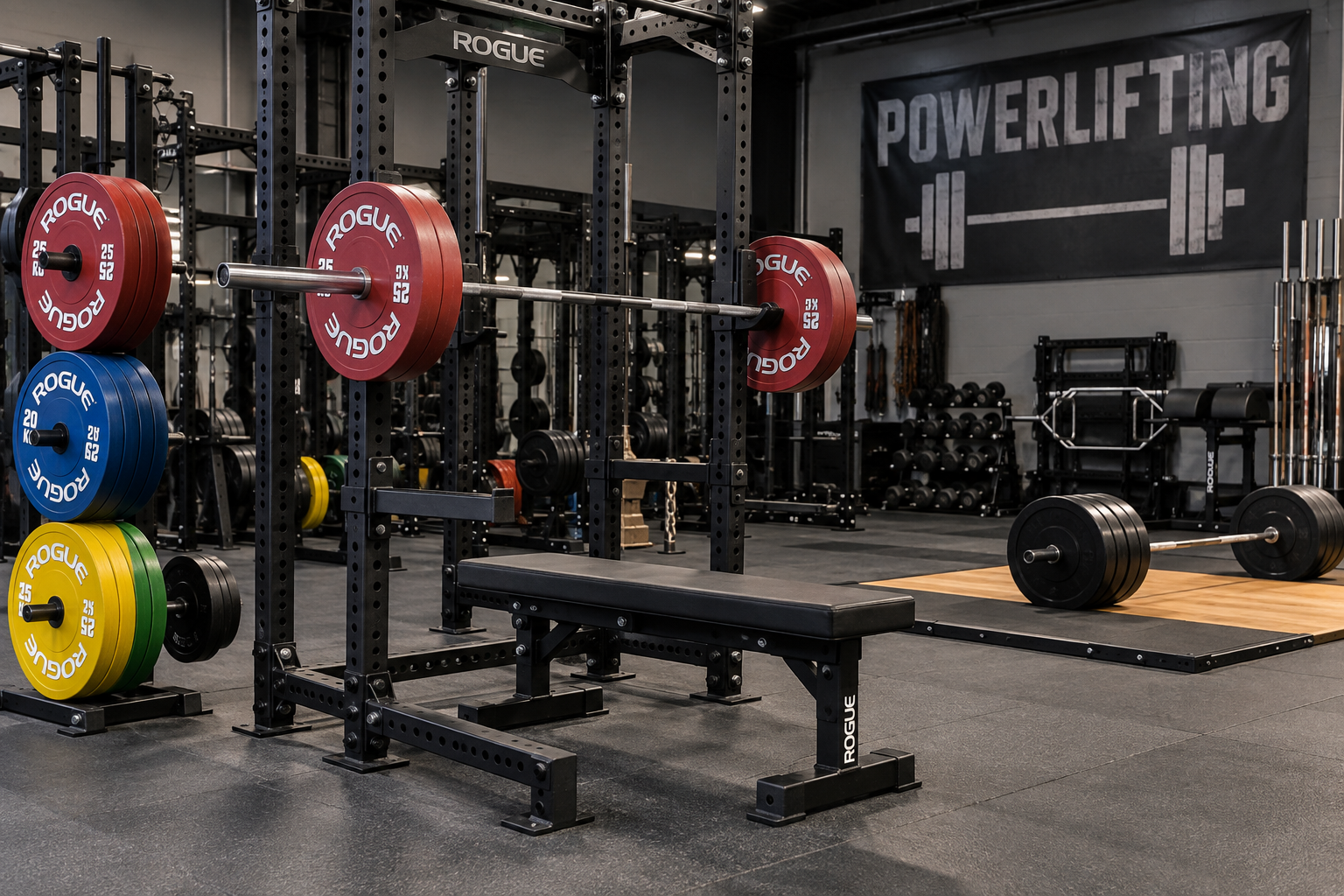
What equipment is needed for powerlifting: a complete selection guide
Anyone wishing to practice powerlifting or set up a dedicated gym must start with a specific question: what equipment is really needed? The answer depends on the athletes' level, the exercises intended to be performed, and the available space, but there are essential components that form the basis of any functional station.
For a complete workout, you need a structure for squats and bench press, an Olympic barbell compatible with the plates used, a stable bench, a technical platform, and accessories that improve safety and organization of the work area. The choice should always be based on the specifications stated by the manufacturer and the compatibility between the various elements.
Before purchasing, it is useful to check weight capacities, dimensions, adjustments, construction materials, and future expansion possibilities. Analyzing these aspects makes it possible to avoid purchases that are poorly suited to one's needs and to create an efficient station both in a home gym and in a professional gym.
- What equipment is essential
- What criteria to use in the selection
- Summary table
- Equipment for home gyms
- Equipment for professional gyms
- Compatibility between equipment
- Errors to avoid
- How to plan the investment
What equipment is essential for powerlifting?
Powerlifting is based on the squat, bench press, and deadlift. Consequently, the equipment must allow these exercises to be performed safely and with adjustments suited to the athlete's characteristics.
The basis of a station includes a rack, a bench, an Olympic barbell, plates, collar systems, and a sturdy platform. To these can be added accessories that improve practicality and space organization.
Sports facilities hosting intensive workouts should also consider the availability of spare parts, construction quality, and the possibility of integrating new components over time.
Is a rack always necessary?
For squats and bench press, a rack normally represents the benchmark solution. Depending on needs, it is possible to choose between a power rack, half rack, or combo rack, always checking weight capacity, adjustments, and operating dimensions.
Which barbell to use?
It is important to choose a barbell compatible with the plates used and the characteristics of the discipline practiced. The manufacturer's technical documentation must state materials, dimensions, and load capacity.
What criteria to use in the selection?
The evaluation should not focus exclusively on price. It is preferable to compare technical specifications, materials, quality of adjustments, and compatibility with the rest of the equipment.
It is also necessary to check the actual footprint of the structure and the space required to move safely during barbell loading and exercise execution.
A well-planned project makes it possible to avoid premature replacements and facilitates any future expansions of the weight room.
Why is weight capacity important?
The capacity declared by the manufacturer must be consistent with the level of users and the loads expected during workouts.
How much do adjustments matter?
Easily adjustable supports allow the station to be quickly adapted to athletes with different physical characteristics.
Summary table of equipment
The following table summarizes the main functions of each component.
| Equipment | Main function | What to check |
|---|---|---|
| Rack | Support for squats and bench | Capacity, adjustments, stability |
| Bench | Bench press | Rigidity, height, compatibility |
| Barbell | Execution of exercises | Dimensions, materials, capacity |
| Plates | Progressive loading | Compatibility with the barbell |
| Platform | Protection and stability | Dimensions and materials |
| Accessories | Safety and organization | Compatibility with the rack |
This overview allows essential elements to be quickly identified before purchase.
Definitively, specifications must still be checked directly in the product data sheets.
Which dimensions to check?
It is advisable to check the height, width, depth, and operating space required by the entire station.
Which materials to favor?
Structural steel, resistant finishes, and precise adjustment systems contribute to the durability of the equipment.
What equipment is needed for a home gym?
In a home gym, space often represents the main design constraint. For this reason, it is advisable to choose structures that allow multiple exercises to be performed while maintaining a compact footprint.
A configuration consisting of a rack, adjustable bench, barbell, plates, and platform allows most strength workouts to be tackled without occupying excessive surface areas.
The ability to add accessories at a later time makes the investment progressive and easier to manage.
How much space is needed?
The space must allow the barbell to be used safely, the plates to be loaded, and the athlete's movements without obstacles.
Why choose modular structures?
An expandable structure allows new accessories to be integrated without completely replacing the existing setup.
What equipment is needed in a professional gym?
Facilities dedicated to powerlifting must also consider the number of users, frequency of use, and speed of adjustments.
In these contexts, it can be useful to provide different stations dedicated to technical training, accessory work, and warm-up.
Proper organization improves flow management and reduces waiting times during busier sessions.
How to manage multiple athletes?
Sturdy and easily adjustable equipment makes it possible to quickly adapt the station to different users.
Is it useful to plan future expansions?
Yes. Evaluating the possibility of adding new stations right from the start facilitates the growth of the gym.
How to check compatibility between equipment?
Before purchasing, it is essential to check that the rack, bench, barbell, and plates can be used together without operational limitations.
The dimensions of the supports, the diameter of the sleeves, the adjustments, and the overall footprint must be consistent with the room's design.
Preventive verification avoids subsequent modifications and guarantees smoother use of the station.
Are accessories important?
Plate holders, safety systems, hooks, and supports improve the order, practicality, and safety of the training area.
How to choose the platform?
The platform must be compatible with the installed rack and the characteristics of the existing flooring.
What errors to avoid during purchase?
Purchasing equipment without checking available dimensions is one of the most frequent errors. A structure that is too large can compromise the usability of the room.
It is equally important not to neglect the technical documentation regarding capacity, materials, and installation instructions.
Finally, it is preferable to avoid mutually incompatible components that could limit future upgrades.
Is price the main criterion?
No. It is also appropriate to evaluate durability, construction quality, maintenance, and expansion possibilities.
Why read technical data sheets?
Manufacturer specifications allow products to be compared using verifiable data rather than subjective impressions.
How to plan the investment in powerlifting equipment?
An effective choice starts from the facility's goals and the users' profile. Anyone setting up a home gym can prioritize versatility and modularity, while a specialized gym might prefer stations dedicated to different exercises.
Overall evaluation of powerlifting equipment, rack and bench for powerlifting, technical flooring, equipment compatibility, and expansion possibilities makes it possible to build an efficient and long-lasting training area.
By carefully analyzing technical specifications, available space, and usage methods, it will be possible to create a complete station without purchasing unnecessary components and maintaining maximum consistency among all elements of the system.
Comments (0)