
Trolley
You have no items in your shopping cart

 Budgets
 Dumbers
 Discs
Discs
 Benches
 Racks and Rigs
 Weights Holders
 Isotonic machines
 Calisthenics
 Cardio
 Kettlebells
 Flooring
 Gym Set
 Accessories
 Combat
 ARTI MARZIALI
 CONTAINER GYM
 Tug-Of-War
 Used Gym Equipment
 PILATES MACCHINARI
 GINNASTICA ARTISTICA
 CAMPI DA PADEL
 Prodotti in Pronta Consegna
 Informazioni
 IRONMAN
 Gift Card
- Donatif
- General information
- 0 I like it
- 612 Views
- 0 comments
- gym flooring, safety flooring, gym safety, shock-absorbing materials
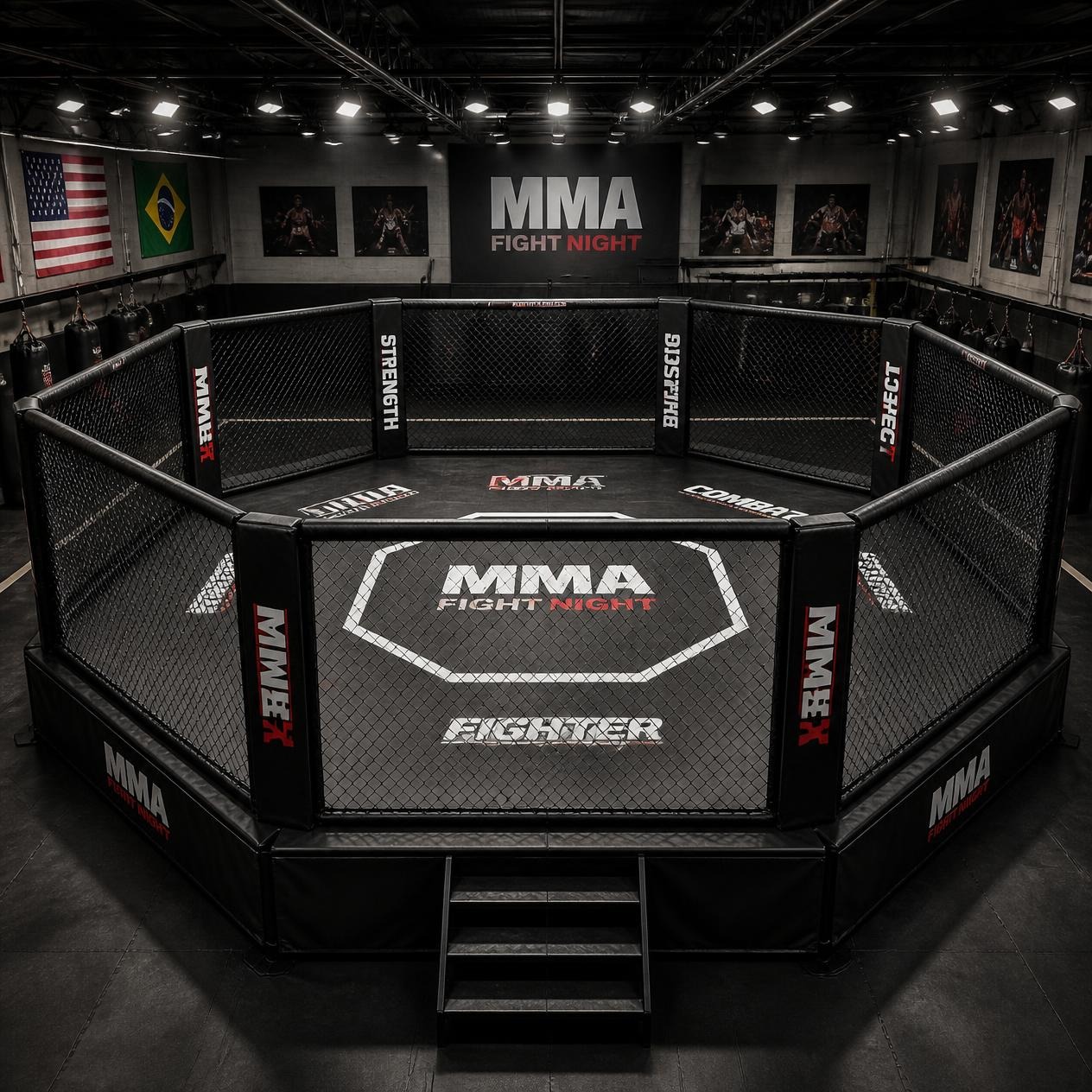
Boxing Ring vs MMA Cage: Which to Choose for Your Gym?
The choice between boxing ring vs mma cage represents one of the most important strategic decisions for those planning a gym dedicated to combat sports or looking to expand their offerings. It is not simply a matter of choosing between two different structures, but of defining the positioning of your business, the target audience, the courses that will be offered, and the return on investment in the medium and long term.
Rings and cages, in fact, meet completely different needs. The ring is created for boxing, kickboxing, Muay Thai, and other striking disciplines, while the octagonal cage is designed to host matches and training for Mixed Martial Arts, disciplines that combine striking, wrestling, and ground fighting. Each solution requires specific space, a different financial investment, and careful planning of the training area.
For gym and fitness center owners, the choice should never be driven exclusively by personal passion or current trends. It is essential to analyze the local market, the number of practitioners, commercial goals, and the growth prospects of the facility. In this guide, we will analyze all the technical and management aspects to consider before investing in a professional boxing ring or MMA cage.
- Differences between ring and MMA cage
- Which disciplines they can host
- Space required for installation
- Comparison of costs and investment
- Modularity and flexibility of use
- Safety and construction quality
- How to choose based on the business plan
- Which is the best solution for your gym
Differences between ring and MMA cage
The first evaluation concerns the function of the structure. The ring is designed to delimit a combat area using elastic ropes that allow athletes to use the bounces and movements typical of boxing. The MMA cage instead uses metal panels covered with padding that prevent athletes from exiting and become an integral part of the combat strategy.
From a technical point of view, the differences also influence the way of training. The ropes of the ring allow for continuous movement along the perimeter and are ideal for disciplines based mainly on striking. The cage, on the other hand, offers rigid surfaces on which techniques of clinch, control, and wrestling are performed, which are fundamental characteristics in mixed martial arts.
Understanding the difference between ring and octagon is essential to choose a structure that is truly consistent with the courses that will be offered and the expectations of the members.
Construction features
The ring uses ropes, padded corners, and a raised or floor-level platform, while the cage uses modular panels with protected wire mesh and fastening systems designed to ensure maximum safety during intensive training.
Training experience
The two structures change the behavior of the athletes. Those who practice boxing benefit from the ropes and lateral movements, while in MMA, the presence of the fence allows for training in realistic competition situations such as control against the cage and escapes from the clinch.
Which disciplines they can host
Before purchasing, it is essential to analyze which courses represent the heart of your sports center. A professional ring is the natural choice for Olympic boxing, professional boxing, kickboxing, Muay Thai, and technical preparation for striking.
The MMA cage, on the other hand, is created to host complete mixed martial arts training, including striking, grappling, wrestling, and ground fighting. It is the ideal solution for clubs that wish to organize courses dedicated to MMA or prepare athletes for official competitions.
Some multidisciplinary facilities manage to integrate both solutions, but this choice requires adequate space and a development plan that justifies the overall investment.
When to choose the ring
If most activities revolve around boxing, kickboxing, and Muay Thai, the ring represents the most consistent solution both from a technical and a commercial point of view.
When to choose the cage
Centers specialized in mixed martial arts, grappling, and competitive preparation benefit more from the installation of a professional cage that faithfully reproduces the competitive context.
Space required for installation
One of the most overlooked aspects concerns the design of the available area. The space required for a boxing ring does not coincide exclusively with the dimensions of the platform, but also includes the safety area intended for coaches, referees, athletes, and internal circulation.
Even a cage requires a free zone all around to allow for access, maintenance, and safe use. Furthermore, one must consider the height of the structure, lighting, and integration with other equipment present in the gym.
Careful planning avoids future operational problems and improves the usability of the spaces by members.
Space organization
Correctly positioning the structure allows for maintaining areas dedicated to warm-up, athletic preparation, and technical exercises without compromising user safety.
Thinking about future growth
Those who foresee an expansion of their offerings should evaluate solutions that allow for future layout changes without having to completely redesign the gym.
Comparison of costs and investment
The cost of an MMA cage vs ring varies significantly depending on dimensions, materials, certifications, and included accessories. However, the purchase price represents only a part of the total cost of the investment.
One must consider transport, installation, any room adaptation works, periodic maintenance, and the expected lifespan of the structure. A professional product, while requiring a higher initial investment, generally guarantees a longer useful life and lower management costs.
Evaluating only the price can lead to choosing cheap solutions that require frequent replacements or extraordinary maintenance interventions over time.
Initial cost
The price difference depends on construction quality, modularity, dimensions, and technical features. It is important to compare products with truly equivalent specifications.
Return on investment
A professional structure increases the attractiveness of the gym, improves the image of the center, and can contribute to attracting new members interested in combat sports.
Modularity and flexibility of use
Modern professional structures are often designed with modular components that facilitate assembly, disassembly, and reconfiguration of spaces. This represents an important advantage for multi-purpose gyms that host events, workshops, or different courses during the week.
Modularity also allows for easier intervention regarding maintenance and the replacement of individual components, reducing downtime and operating costs.
For those who wish to gradually develop their sports center, the possibility of integrating new modules or accessories represents a significant added value.
Use for events
An easily configurable structure allows for organizing sporting events, demonstrations, and competitions with greater flexibility.
Adaptability over time
Investing in modular products means being able to support the growth of the gym without having to completely replace existing equipment.
Safety and construction quality
Safety represents the most important criterion in the choice of any structure intended for combat sports. Certified materials, quality welds, high-density protections, and reliable fastening systems contribute to reducing the risk of accidents during training and competitions.
It is essential to verify the quality of the padding, the resistance of the ropes or cage panels, and the robustness of the entire load-bearing structure. Professional construction guarantees greater durability even in the presence of intensive use.
For fitness centers and sports clubs, construction quality also represents a distinctive element capable of conveying reliability and attention to the safety of members.
Importance of certifications
Products compliant with industry standards offer greater guarantees in terms of resistance, safety, and quality of the materials used.
Scheduled maintenance
Periodic checks on ropes, nets, padding, and fastening systems allow for maintaining high safety standards throughout the useful life of the structure.
How to choose based on the business plan
The choice between ring and cage should be guided primarily by the gym's business model. Analyzing the local market, the demand for different disciplines, the presence of competition, and the profile of potential clients allows for making more effective decisions.
A gym oriented primarily toward boxing and kickboxing will generally obtain better results by investing in a professional ring. Conversely, a center focused on MMA will be able to make better use of a cage, especially if it intends to develop competitive courses or organize dedicated events.
To compare the different combat sports equipment available and identify the most suitable solution for your project, it is advisable to rely on specialized suppliers capable of offering technical advice and support in space planning.
Knowing your target
Understanding the needs of members allows for investing in the equipment that generates the greatest value for the gym and improves the training experience.
Investment planning
Carefully evaluating budget, growth prospects, and expansion possibilities helps to build a competitive and sustainable structure in the long term.
Which is the best solution for your gym
There is no single answer that is valid for every situation. Rings and cages meet different needs and can both represent a winning investment if included within a strategy consistent with the gym's goals. The decision must stem from the analysis of the proposed disciplines, available space, budget, and target clientele.
A quality professional structure improves safety, enhances the center's image, and contributes to attracting new practitioners, offering athletes an environment that meets their expectations. Choosing certified materials, modular products, and solutions designed for intensive use means investing in the future growth of the business.
Relying on a specialized partner also allows you to receive support in space planning, choosing the most suitable configurations, and evaluating the best ratio between initial investment, performance, and long-term profitability.
Comments (0)