
Trolley
You have no items in your shopping cart

 Budgets
 Dumbers
 Discs
Discs
 Benches
 Racks and Rigs
 Weights Holders
 Isotonic machines
 Calisthenics
 Cardio
 Kettlebells
 Flooring
 Gym Set
 Accessories
 Combat
 ARTI MARZIALI
 CONTAINER GYM
 Tug-Of-War
 Used Gym Equipment
 PILATES MACCHINARI
 GINNASTICA ARTISTICA
 CAMPI DA PADEL
 Prodotti in Pronta Consegna
 Informazioni
 IRONMAN
 Gift Card
- Donatif
- General information
- 0 I like it
- 54 Views
- 0 comments
- gym flooring, safety flooring, gym safety, shock-absorbing materials
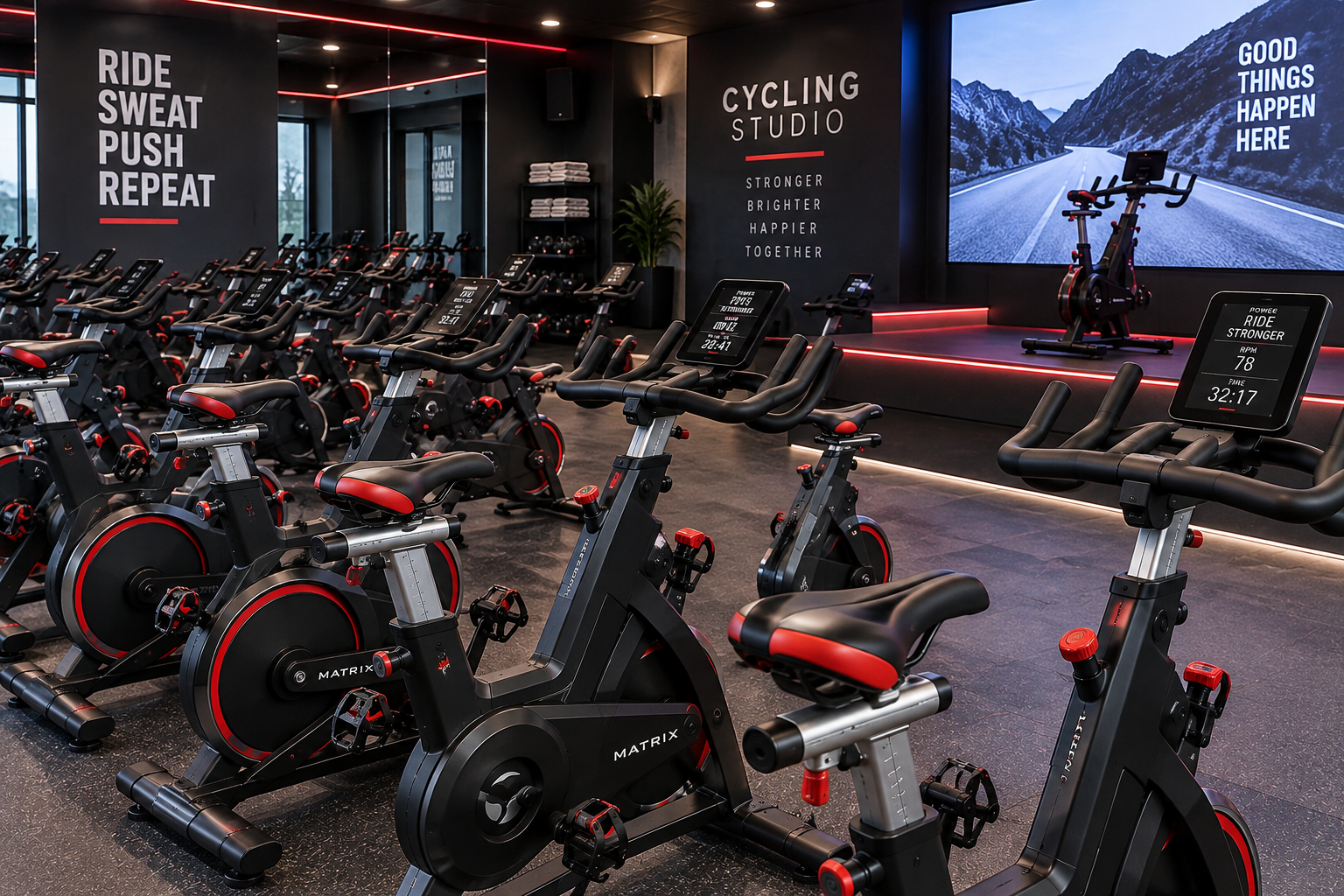
Spin bikes for a cycling studio: selection and setup criteria
Choosing a spin bike for a cycling studio requires planning that takes into account not only the characteristics of the bicycles but also the overall organization of the space, the type of classes, and daily operational management. A well-designed setup helps improve the participants' experience and facilitates the work of the instructors.
A professional cycling studio is used by users with different levels of preparation and must allow for quick adjustments, orderly access paths, and simple maintenance of the entire fleet of bicycles. For this reason, it is important to evaluate verifiable technical criteria before purchasing.
This guide analyzes the fundamental aspects for choosing a professional spin bike intended for a cycling studio, focusing on space requirements, workstation setup, safety, maintenance, and the most frequent design errors.
- Quick answer
- What requirements must a cycling studio have
- How to design space and layout
- How to configure spin bikes
- Safety and maintenance
- Design errors to avoid
- Comparison criteria
- How to evaluate the investment
How to choose a spin bike for a cycling studio?
The choice should start with the evaluation of the available space, the expected number of participants, and the usage methods of the room. A spin bike intended for a professional environment must offer simple adjustments, structural robustness, and ease of maintenance.
In addition to technical characteristics, it is advisable to check the availability of assistance, spare parts, and documentation provided by the manufacturer so as to correctly plan fleet management over time.
Consistent design makes it possible to improve comfort, operational continuity, and class organization without basing the choice exclusively on price.
What is the main criterion?
The intended use of the room represents the starting point for defining the number of workstations, configuration, and required characteristics of the bicycles.
Why design before purchasing?
Correct planning makes it possible to select equipment consistent with the layout and the operational needs of the facility.
What requirements must a professional cycling studio have?
A room dedicated to spinning classes should allow rapid adjustments of the bicycles and guarantee easy access to each workstation.
The adjustments of the saddle and handlebars must be simple to use so that each participant can quickly adapt their position before the start of the class. The resistance system should also allow for intuitive variations during training.
The design should also facilitate the instructor's work and allow good visibility from all the workstations present in the room.
Why is ergonomics important?
An easily adjustable position improves comfort, adaptability, and speed in lesson preparation.
How to facilitate access to bicycles?
An orderly arrangement makes the movement of participants easier before and after each session.
How to organize space and layout?
The arrangement of the bicycles should allow users to get on and off easily without interfering with neighboring workstations.
The layout should provide easy paths for instructors and maintain a good view of the entire group during the class.
The flooring also deserves attention because it contributes to the stability of the bicycles and the correct management of the room during continuous use.
How to distribute workstations?
A balanced configuration improves the circulation of people and facilitates the management of daily activities.
Why does the instructor's position matter?
An unobstructed view facilitates the conduction of the class and allows participants to follow instructions more easily.
How to correctly configure spin bikes?
Each bicycle should be easily identifiable and allow rapid adjustments even during the change between one class and the next.
It is useful to provide functional accessories such as a bottle cage or device holders, as long as they do not hinder the use of the bicycle.
To create a complete cardio area, it is possible to integrate the room with other professional cardio machines intended for different training modes.
Why evaluate the flywheel?
The characteristics of the flywheel affect the pedaling feel and should be compared using the manufacturer's technical documentation.
What role does the transmission play?
The transmission system influences the fluidity of movement and represents one of the elements to include in maintenance checks.
How to manage safety and maintenance?
Scheduled maintenance helps keep the fleet efficient and reduces the risk of bicycle unavailability during classes.
Verifications should include adjustments, transmission systems, wear-prone components, and the correct functioning of adjustment mechanisms according to the manufacturer's instructions.
It is also advisable to set up an intervention log to monitor the condition of the bicycles and plan any replacements.
Why schedule interventions?
Preventive planning allows checks to be distributed throughout the year, avoiding sudden service interruptions.
Why check spare parts and assistance?
Good availability of components facilitates maintenance and contributes to the operational continuity of the room.
Which design errors are best avoided?
One of the most frequent errors consists in designing a room without considering access paths and user movements from one workstation to another.
It is also advisable to avoid excessively dense configurations that can make the use of bicycles less comfortable and complicate maintenance interventions.
Even the choice based exclusively on the initial price risks neglecting important aspects such as assistance, spare parts, and long-term management.
Why avoid a layout that is too compact?
A balanced arrangement improves comfort, safety, and class organization.
Why evaluate technical support?
Assistance and availability of spare parts represent important elements in managing a professional cycling studio.
What criteria should be used to compare multiple models?
| Criterion | Why it is important |
|---|---|
| Flywheel | Affects the pedaling feel |
| Transmission | Contributes to the fluidity of movement |
| Adjustments | Facilitate adaptation to different users |
| Resistance system | Allows variations during training |
| Maintenance | Reduces the risk of machine downtime |
| Assistance and spare parts | Favor operational continuity |
| Compatible layout | Facilitates room design |
Is it useful to use a checklist?
A checklist makes it possible to compare multiple models using uniform and easily verifiable criteria.
What documents should be requested?
Technical data sheets, user manuals, warranty conditions, and maintenance instructions represent the basis for an objective evaluation.
How to evaluate the long-term investment?
The choice of a professional spin bike should consider construction quality, simplicity of adjustments, maintenance, assistance, and availability of spare parts in addition to the technical characteristics declared by the manufacturer.
A correctly designed cycling studio makes it possible to improve class organization, facilitate staff work, and keep the fleet efficient over time through scheduled maintenance.
Requesting official technical documentation and comparing the different solutions using measurable criteria represents the most reliable method to make a choice consistent with the facility's goals.
How to compare two professional spin bikes?
It is advisable to compare flywheel, transmission, adjustments, resistance system, assistance, spare parts availability, and technical documentation provided by the manufacturer.
What is the first step in designing a cycling studio?
Analyzing available space, the expected number of participants, and the usage methods of the room allows defining a consistent configuration before choosing the equipment.
Comments (0)