
Trolley
You have no items in your shopping cart

 Budgets
 Dumbers
 Discs
Discs
 Benches
 Racks and Rigs
 Weights Holders
 Isotonic machines
 Calisthenics
 Cardio
 Kettlebells
 Flooring
 Gym Set
 Accessories
 Combat
 ARTI MARZIALI
 CONTAINER GYM
 Tug-Of-War
 Used Gym Equipment
 PILATES MACCHINARI
 GINNASTICA ARTISTICA
 CAMPI DA PADEL
 Prodotti in Pronta Consegna
 Informazioni
 IRONMAN
 Gift Card
- Donatif
- General information
- 0 I like it
- 538 Views
- 0 comments
- gym flooring, safety flooring, gym safety, shock-absorbing materials
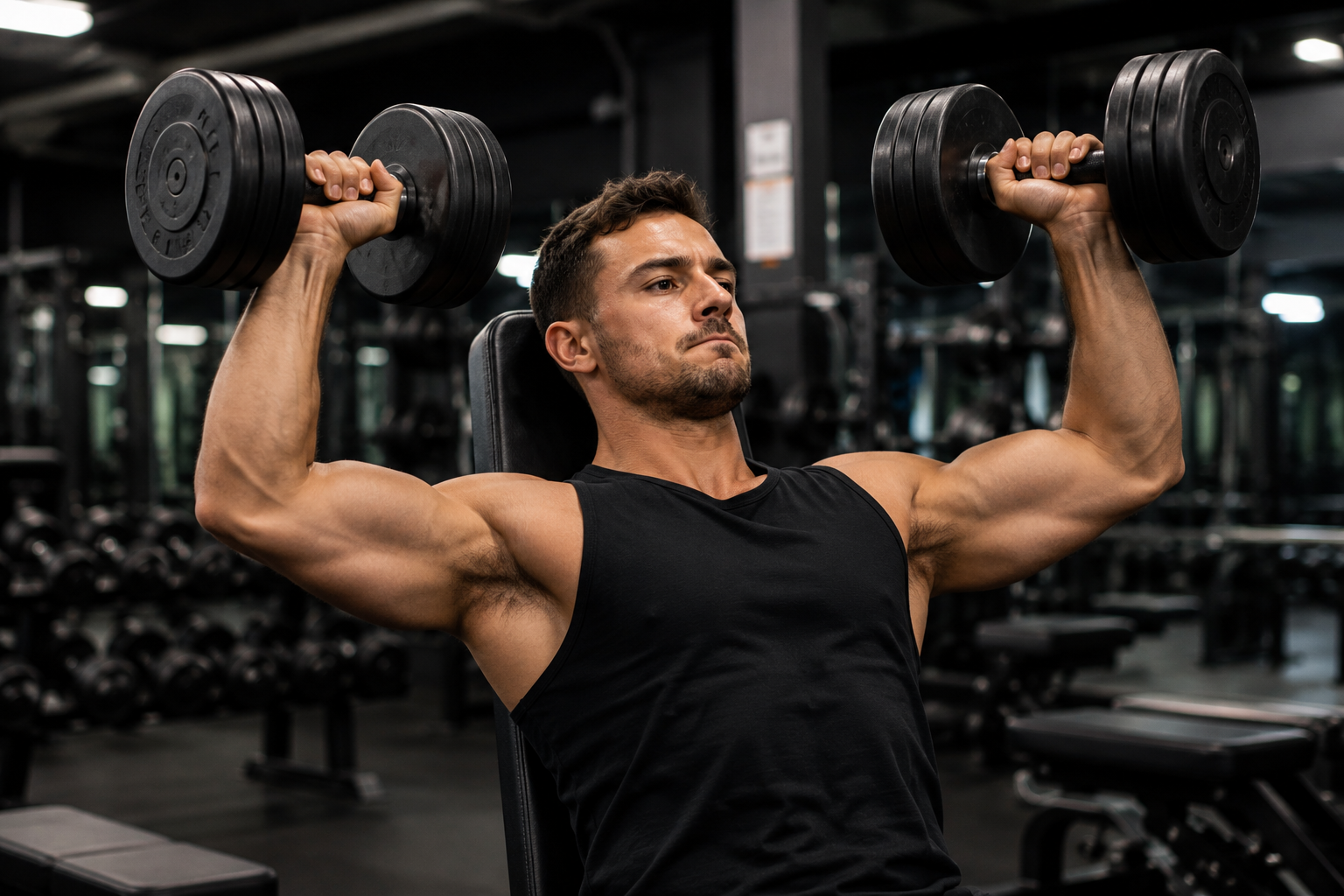
Dumbbell shoulder press: a guide to the military press for strong shoulders
Building wide, strong, and functional shoulders requires training based on effective movements and precise technique. Among the most used exercises for developing the deltoids are vertical dumbbell presses, a fundamental movement for increasing strength and muscle mass in the upper body. The dumbbell shoulder press represents an extremely versatile solution because it allows you to work with greater freedom compared to many guided machines.
Dumbbells offer the possibility of independently controlling the trajectory of the movement, adapting it to your physical structure and improving the engagement of stabilizer muscles. This feature can be particularly interesting for those seeking not only performance but also a more natural and controlled approach to shoulder training.
The dumbbell military press, in its standing or seated variations, is one of the most complete exercises for developing the deltoids. However, achieving results requires proper load management, good joint mobility, and attention to execution technique.
- Why dumbbell presses are fundamental for the shoulders
- Anatomy of the deltoids and muscles involved
- Correct technique for the dumbbell shoulder press
- Dumbbell military press standing or seated
- Advantages of dumbbells over the barbell
- Common mistakes in vertical dumbbell presses
- Programming dumbbell deltoid exercises
- Building strong shoulders with the correct technique
Why dumbbell presses are fundamental for the shoulders
The shoulders play a central role in many upper body movements. Every pushing, throwing, or lifting gesture involves the shoulder complex, making it essential to develop strength and stability through appropriate exercises.
Dumbbell presses are considered a basic movement because they allow you to work primarily on vertical pushing, an important motor pattern for general strength development. Unlike more isolated exercises, they involve several muscle groups simultaneously.
This makes the dumbbell military press a useful exercise both for those seeking aesthetic improvement and for those who want to increase their physical capabilities.
Developing strength and muscle mass
Overhead presses allow you to apply progressive loads to the deltoids, creating an important stimulus for increasing muscle mass. The ability to use separate dumbbells also allows you to distribute the work more evenly between the two sides.
A gradual progression allows you to improve your pushing capacity while maintaining correct technique.
Improving stability and control
During a dumbbell press, each arm must independently manage its own weight. This increases the work of the stabilizer muscles of the shoulder and torso.
The increased demand for control can help develop a more coordinated push.
Anatomy of the deltoids and muscles involved
The deltoid is the main muscle involved in vertical presses and is composed of three portions: anterior, lateral, and posterior. Each part contributes to different arm movements and must be trained within a balanced program.
Dumbbell presses primarily involve the anterior and lateral deltoid, but also require the contribution of the triceps, trapezius, and scapular stabilizer muscles.
Understanding the role of the different muscles helps you choose complementary exercises and build more complete shoulders.
Role of the anterior deltoid
The anterior deltoid participates mainly in shoulder flexion movements and upward presses. During the military press, it plays an important role in producing the force necessary to overcome the initial point of the movement.
Proper development contributes to overall pushing capacity.
Role of the lateral deltoid and stabilizers
The lateral deltoid contributes to the visual width of the shoulders, while the stabilizer muscles help maintain a safe trajectory.
Training the shoulder completely means considering both strength and the quality of the movement.
Correct technique for the dumbbell shoulder press
The dumbbell shoulder press requires technical precision because it involves a complex joint like the shoulder. Correct execution allows you to maximize the stimulus on the deltoids and reduce compensatory movements.
Controlling the weight throughout the entire trajectory is more important than simply using heavy loads.
Before increasing the weight, it is fundamental to consolidate your position, breathing, and stability.
Initial pushing position
The starting position involves the dumbbells at shoulder height, with elbows controlled and the torso stable. The spine must maintain a natural position without excessive compensation.
Good initial preparation facilitates a more efficient movement.
Pushing and lowering phase
In the concentric phase, the dumbbells are pushed upward while maintaining control of the trajectory. In the negative phase, it is important to avoid descending too quickly.
The eccentric phase contributes to the muscle stimulus and must be managed with care.
Dumbbell military press standing or seated
The dumbbell military press can be performed in different variations, mainly standing or seated. Both solutions have specific characteristics and can be included in different programs.
The choice depends on the training goal, the athlete's level, and the ability to maintain a correct position during the movement.
Understanding the differences allows you to use both variations strategically.
Standing dumbbell presses
The standing variation requires greater body stabilization because the torso must control the movement without external support. This increases the engagement of the core and stabilizer muscles.
It is an interesting solution for those who want to train the ability to produce force while maintaining balance and control.
Seated dumbbell presses
The seated version offers greater stability because it eliminates part of the work required by the body to maintain the position. This can allow you to focus more on the push of the deltoids.
It is often used when the main goal is to increase the volume of work on the shoulders.
Advantages of dumbbells over the barbell
Dumbbells represent an interesting alternative to the barbell in overhead presses because they allow for greater freedom of movement. The hands are not bound to the same bar, which allows you to better adapt the trajectory to individual characteristics.
This possibility can be useful for those seeking a more natural movement and greater joint control.
The main difference is not about which tool is always superior, but which solution is better suited to the specific goal.
Greater joint freedom
With dumbbells, each arm can follow a slightly personalized trajectory. This allows you to find a more comfortable position for the shoulder.
The freedom of movement is one of the main reasons why many athletes prefer this solution.
Reduction of asymmetries
By using two separate dumbbells, each side must produce its own force. This can help identify differences in capacity between the two shoulders.
Balanced work contributes to more harmonious development.
Common mistakes in vertical dumbbell presses
Overhead presses can become ineffective when performed without attention to technique. Mistakes such as using too much weight, arching the back excessively, or losing control of the descent can reduce the benefits of the exercise.
Correcting these aspects allows you to train more productively and safely.
The quality of the movement must always precede increasing the load.
Using loads that are too heavy
Excessive weight can lead to torso compensation and a loss of the correct trajectory. This reduces the specific work on the deltoids.
An appropriate load allows you to maintain control during every repetition.
Neglecting shoulder mobility
Good mobility allows you to perform the movement with greater freedom and safety. Joint limitations can influence technique and require adjustments.
Properly preparing the shoulder improves the quality of the training.
Programming dumbbell deltoid exercises
Dumbbell deltoid exercises must be organized considering volume, frequency, and goals. Presses represent a fundamental movement, but they can be integrated with complementary exercises to stimulate all portions of the deltoid.
A complete program combines pushing and isolation movements to develop strength and proportion.
Progression must be planned to continue improving over time.
Combining presses and raises
Presses mainly develop general strength, while exercises like lateral raises allow you to focus more on the lateral deltoid.
Combining the two approaches creates a more complete stimulus.
Managing volume and recovery
The shoulders participate in many upper body movements, so recovery must be considered in the programming.
A well-distributed volume allows you to improve without accumulating excessive fatigue.
Building strong shoulders with the correct technique
Dumbbell presses represent one of the most effective tools for developing strong, stable, and proportionate shoulders. Their ability to combine strength, control, and freedom of movement makes them a very interesting choice both for those who train in the gym and for those building a home gym.
The difference in results does not depend only on the weight used, but on the quality of execution, progression, and the ability to maintain correct technique during every phase of the movement.
Choosing reliable equipment like adjustable dumbbells allows you to create a versatile training environment ready to support strength development in the long term.
Comments (0)