
Trolley
You have no items in your shopping cart

 Budgets
 Dumbers
 Discs
Discs
 Benches
 Racks and Rigs
 Weights Holders
 Isotonic machines
 Calisthenics
 Cardio
 Kettlebells
 Flooring
 Gym Set
 Accessories
 Combat
 ARTI MARZIALI
 CONTAINER GYM
 Tug-Of-War
 Used Gym Equipment
 PILATES MACCHINARI
 GINNASTICA ARTISTICA
 CAMPI DA PADEL
 Prodotti in Pronta Consegna
 Informazioni
 IRONMAN
 Gift Card
- Donatif
- General information
- 0 I like it
- 2278 Views
- 0 comments
READING TIME: 7 MINUTES ➤➤
Standing Desk and Posture: How to Use a Standing Workstation Without Destroying Your Legs and Back
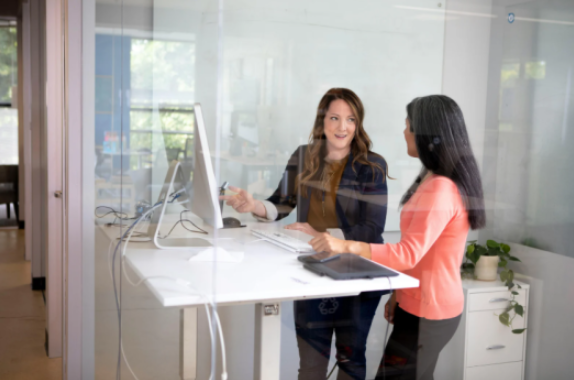
The idea of working while standing is often presented as a simple solution to all the problems associated with a sedentary lifestyle. Less rounded back, more energy, greater productivity. In reality, as is often the case when discussing ergonomics, the truth is less exciting but far more useful. Using a standing desk does not automatically improve posture, nor does it guarantee that you will feel better at the end of the day.
The real issue is not whether standing while working is right or wrong, but how, for how long, and with what precautions a standing workstation is used. Without awareness, a standing desk can become just another way of being uncomfortable, shifting the problem from the chair to the feet and lower back.
- Why standing while working is not enough
- The real benefits of a standing workstation
- Risks for your back and legs
- Proper adaptation times
- Alternating between sitting and standing
- Essential posture tips
- Useful supports and accessories
Standing While Working Is Not Enough: Why a Standing Desk Is Not a Magic Solution
One of the most common mistakes is believing that simply standing up can “compensate” for hours of sedentary work. In reality, standing still for many hours is not very different from sitting still for many hours. The human body is designed to move, not to maintain any static posture for extended periods.
A standing desk is effective only when it is part of a broader strategy of movement and postural variation. Without this approach, there is a risk of accumulating tension in the feet, calves, and lower back, while creating the false impression of doing something healthy simply because you are no longer sitting.
The Real Benefits of a Standing Workstation, Without Myths or Exaggerated Claims
When used correctly, a standing workstation can offer tangible benefits. The main advantage is not necessarily “standing up straight,” but rather reducing the total amount of time spent sitting. This can improve circulation, maintain mild muscular activation, and break the postural monotony of the workday.
Another genuine benefit is increased body awareness. Working while standing makes it easier to notice when a position becomes uncomfortable, encouraging posture changes and micro-movements. However, these benefits only emerge when the standing desk is used as a tool rather than as a fixed alternative to sitting.
When Standing While Working Becomes a Problem for Your Back and Legs
The less discussed side of standing desks involves the risk of overload. Standing for too long can increase pressure on the lower back, especially if the pelvis is pushed forward or the lower back is excessively arched. The knees and ankles may also suffer, particularly when standing on hard surfaces.
Leg fatigue is another warning sign that is often ignored. Tight calves, sore feet, and a feeling of heaviness indicate that standing time is excessive or poorly managed. In these situations, persisting with the belief that “you’ll get used to it” can lead only to poor compensatory patterns and chronic discomfort.
Adaptation Time and Self-Regulation: How to Help the Body Adjust Without Stressing It
The transition to a standing desk should be gradual. A common mistake is starting with sessions that are too long, believing that more standing time automatically means more benefits. In reality, the body needs time to adapt, especially after years of predominantly seated work.
An effective approach is to begin with short standing intervals, even just 15–20 minutes at a time, alternating them with seated work. Listening to your body’s signals is essential: pain and stiffness are not obstacles to overcome, but useful information that can help you regulate both duration and frequency.
Alternating Between Sitting and Standing: The Strategy That Truly Makes a Difference
The real ergonomic key is not choosing between sitting and standing, but consciously alternating between the two positions. Postural rotation reduces repetitive stress and allows different muscle groups to recover.
Integrating a standing desk into a dynamic routine that includes position changes, small movements, and active breaks is far more effective than any “perfect” posture. The goal is not to find the ideal position, but to avoid staying in the same one for too long.
Proper Standing Desk Posture: Essential Tips to Avoid Overloading the Lower Back
Proper standing posture begins with the correct workstation setup. The monitor should be at eye level, the arms relaxed, and the elbows bent at approximately 90 degrees. Arching the lower back or pushing the pelvis forward unnecessarily increases the load on the lumbar region.
Weight distribution is equally important. Gently shifting weight from one leg to the other, without becoming rigid, helps prevent prolonged tension. The ideal posture is not stiff but adaptable, with constant micro-movements.
Supports, Anti-Fatigue Mats, and Footrests: What You Really Need—and What You Don’t
Supportive accessories can help, but they do not solve postural issues on their own. An anti-fatigue mat can reduce pressure on the feet, while a low footrest encourages weight shifting and positional changes. However, no accessory can compensate for incorrect or excessive standing desk use.
It is important to avoid the illusion that simply adding a support tool allows you to stand longer without consequences. Accessories are effective only when combined with a conscious approach to timing and a healthy balance between sitting and standing throughout the day.
Comments (0)