
Trolley
You have no items in your shopping cart

 Budgets
 Dumbers
 Discs
Discs
 Benches
 Racks and Rigs
 Weights Holders
 Isotonic machines
 Calisthenics
 Cardio
 Kettlebells
 Flooring
 Gym Set
 Accessories
 Combat
 ARTI MARZIALI
 CONTAINER GYM
 Tug-Of-War
 Used Gym Equipment
 PILATES MACCHINARI
 GINNASTICA ARTISTICA
 CAMPI DA PADEL
 Prodotti in Pronta Consegna
 Informazioni
 IRONMAN
 Gift Card
- Donatif
- General information
- 0 I like it
- 29 Views
- 0 comments
- gym flooring, safety flooring, gym safety, shock-absorbing materials
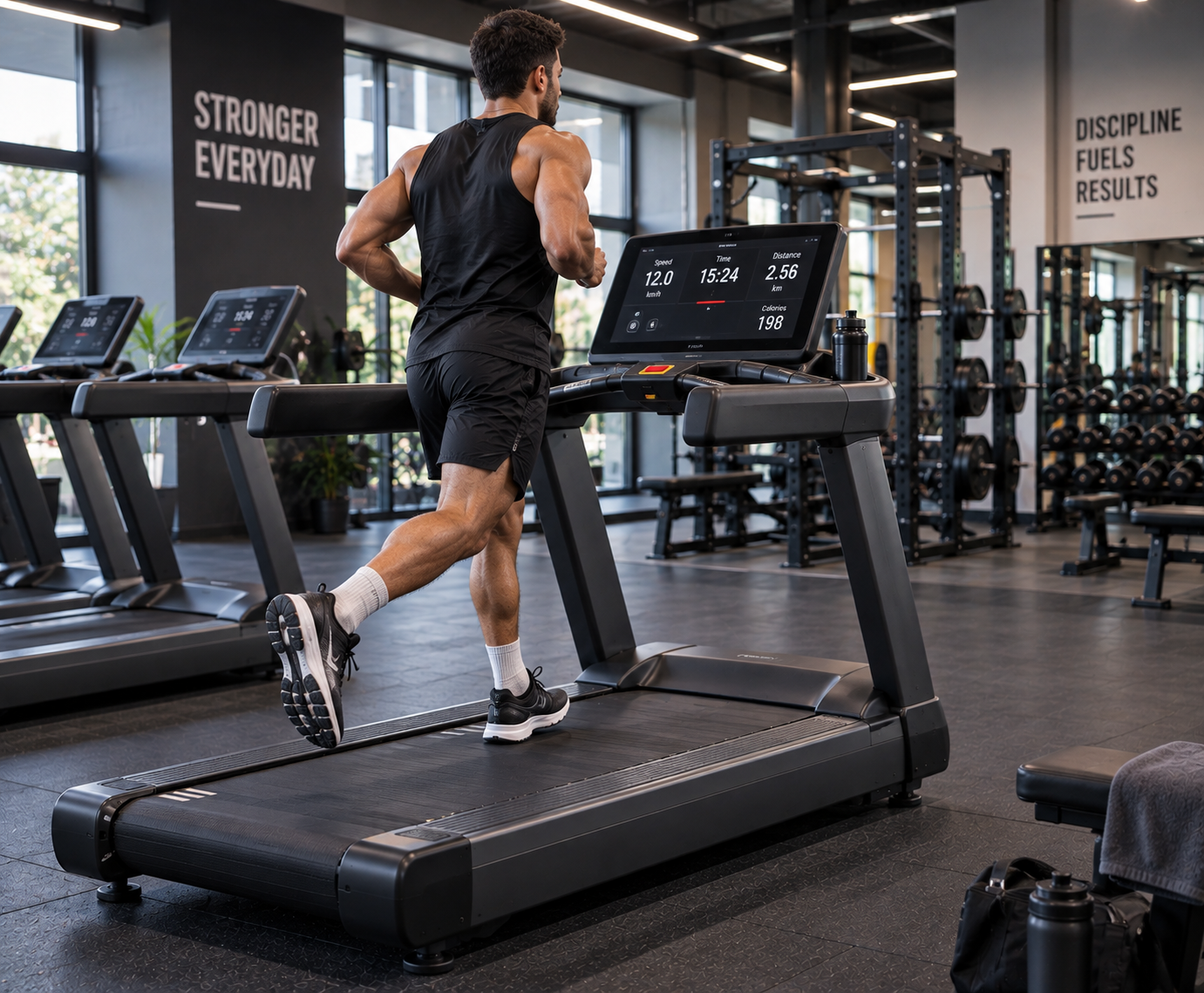
Curved vs motorized treadmill: differences and selection criteria
Choosing between a curved treadmill and a motorized model means evaluating the expected type of training, the context of use, and the technical features actually required. Although both solutions are intended for running and walking, the operating principle and application scenarios can differ.
A curved treadmill uses the user's movement to rotate the belt, whereas a motorized treadmill uses a motor to control its speed. This difference influences the modes of use, machine design, maintenance, and the type of training that can be performed.
This guide compares the two categories through verifiable technical criteria, analyzing differences in operation, usage contexts, maintenance aspects, and elements to evaluate before purchase.
- Quick answer
- What are the main differences
- How to choose between curved and motorized
- When to choose a curved treadmill
- When to choose a motorized treadmill
- Errors to avoid
- Comparison table
- How to evaluate the investment
Curved or motorized treadmill: which one to choose?
The choice depends on training objectives, the operational context, and the characteristics required of the machine. A curved treadmill is operated directly by the user, while a motorized model uses a motor to move the belt. Both solutions may be appropriate depending on specific needs.
Before purchasing, it is advisable to compare manufacturing quality, technical documentation, scheduled maintenance, spare parts availability, and assistance offered by the manufacturer.
Evaluating the total cost of ownership allows for a more comprehensive choice compared to just the initial price.
What is the first criterion to consider?
The intended type of use represents the starting point for identifying the solution most consistent with your needs.
Is there an absolute best choice?
No. Each type responds to different needs and should be evaluated in relation to the context of use.
What are the main differences?
The fundamental difference concerns the operating principle. The curved treadmill harnesses the user's movement to drive the belt, while the motorized one uses an electrical system that controls its speed.
The characteristics of the curvature, the running surface, and the resistance system represent elements to be compared using the technical specifications provided by the manufacturer.
The two categories may also differ in terms of usage modes, maintenance, and operational destination.
How does operation change?
In the curved model, belt movement depends directly on the user's action, whereas in the motorized model, it is regulated by the machine's motor.
Why compare the structure as well?
Manufacturing quality and design affect the durability and management of the equipment over time.
How to choose between the two solutions?
A comprehensive evaluation should include modes of use, training frequency, scheduled maintenance, spare parts availability, and technical assistance.
It is advisable to request technical datasheets, manuals, and official documentation to compare the characteristics of different models using verifiable data.
Available space and compatibility with the training area layout also deserve particular attention during planning.
Why evaluate maintenance?
Proper planning of interventions contributes to the operational continuity of the machine over time.
How much do spare parts and assistance matter?
Good availability of spare parts facilitates equipment management throughout its lifecycle.
When might a curved treadmill be suitable?
A curved treadmill can be considered when its characteristics are consistent with the training program and the facility's goals.
Activities such as sprints and technical running should be evaluated by verifying the model's compatibility with the manufacturer's instructions.
To design an area dedicated to conditioning, the treadmill can be integrated with other professional cardio machines depending on operational needs.
In what contexts is it used?
It can be used in different sports environments provided the model is designed for the intended use.
What workouts can it support?
Compatibility depends on the machine's technical characteristics and the program defined by the facility.
When might a motorized treadmill be suitable?
A motorized model can represent an appropriate solution when its characteristics are consistent with the user's goals and the operational context.
Here too, it is advisable to compare manufacturing quality, scheduled maintenance, assistance, and technical documentation before making a choice.
The evaluation should consider the entire machine design and not exclusively the belt drive system.
How to evaluate continuous use?
It is advisable to check the intended use indicated by the manufacturer and the expected operating modes for the model.
Why compare comfort as well?
Ergonomic and manufacturing characteristics can influence the overall user experience.
What mistakes are best avoided?
One of the most frequent mistakes is choosing exclusively based on the initial price without considering maintenance, spare parts, assistance, and intended use.
It is also advisable to avoid comparisons based on a single technical characteristic while neglecting manufacturing quality and official manufacturer documentation.
A complete evaluation should always consider the operational context and the user's objectives.
Why is price not enough?
The total cost also includes maintenance, spare parts availability, and operational continuity over time.
Why verify the intended use?
Each machine is designed for specific operational scenarios that should be respected during selection.
Comparison between curved and motorized treadmills
| Criterion | Curved treadmill | Motorized treadmill |
|---|---|---|
| Belt movement | Driven by the user | Driven by a motor |
| Operating principle | Based on the athlete's movement | Based on the motorized system |
| Intended use | To be verified according to the model | To be verified according to the model |
| Maintenance | Follow manufacturer instructions | Follow manufacturer instructions |
| Spare parts | Check availability | Check availability |
| Assistance | Element to be compared | Element to be compared |
Why use a checklist?
A checklist allows you to compare different models using the same technical and organizational criteria.
What documents should be requested?
Datasheets, manuals, warranty conditions, and maintenance information constitute an objective basis for evaluation.
How to evaluate long-term investment?
The choice of a curved treadmill or a motorized model should be based on manufacturing quality, technical documentation, maintenance, assistance, and compatibility with the planned training program.
Comparing the two solutions means analyzing different technologies that can both be appropriate depending on the goals of the facility or the user.
Requesting official documentation and comparing verifiable technical data represents the most reliable method for making an informed choice.
What is the most important criterion?
The match between intended use, expected training modalities, and the technical characteristics declared by the manufacturer represents the starting point for an informed choice.
How to compare two models?
It is advisable to use a checklist that includes structural characteristics, maintenance, spare parts, assistance, and technical documentation provided by the manufacturer.
Comments (0)