
Trolley
You have no items in your shopping cart

 Budgets
 Dumbers
 Discs
Discs
 Benches
 Racks and Rigs
 Weights Holders
 Isotonic machines
 Calisthenics
 Cardio
 Kettlebells
 Flooring
 Gym Set
 Accessories
 Combat
 ARTI MARZIALI
 CONTAINER GYM
 Tug-Of-War
 Used Gym Equipment
 PILATES MACCHINARI
 GINNASTICA ARTISTICA
 CAMPI DA PADEL
 Prodotti in Pronta Consegna
 Informazioni
 IRONMAN
 Gift Card
- Donatif
- General information
- 0 I like it
- 495 Views
- 0 comments
- gym flooring, safety flooring, gym safety, shock-absorbing materials
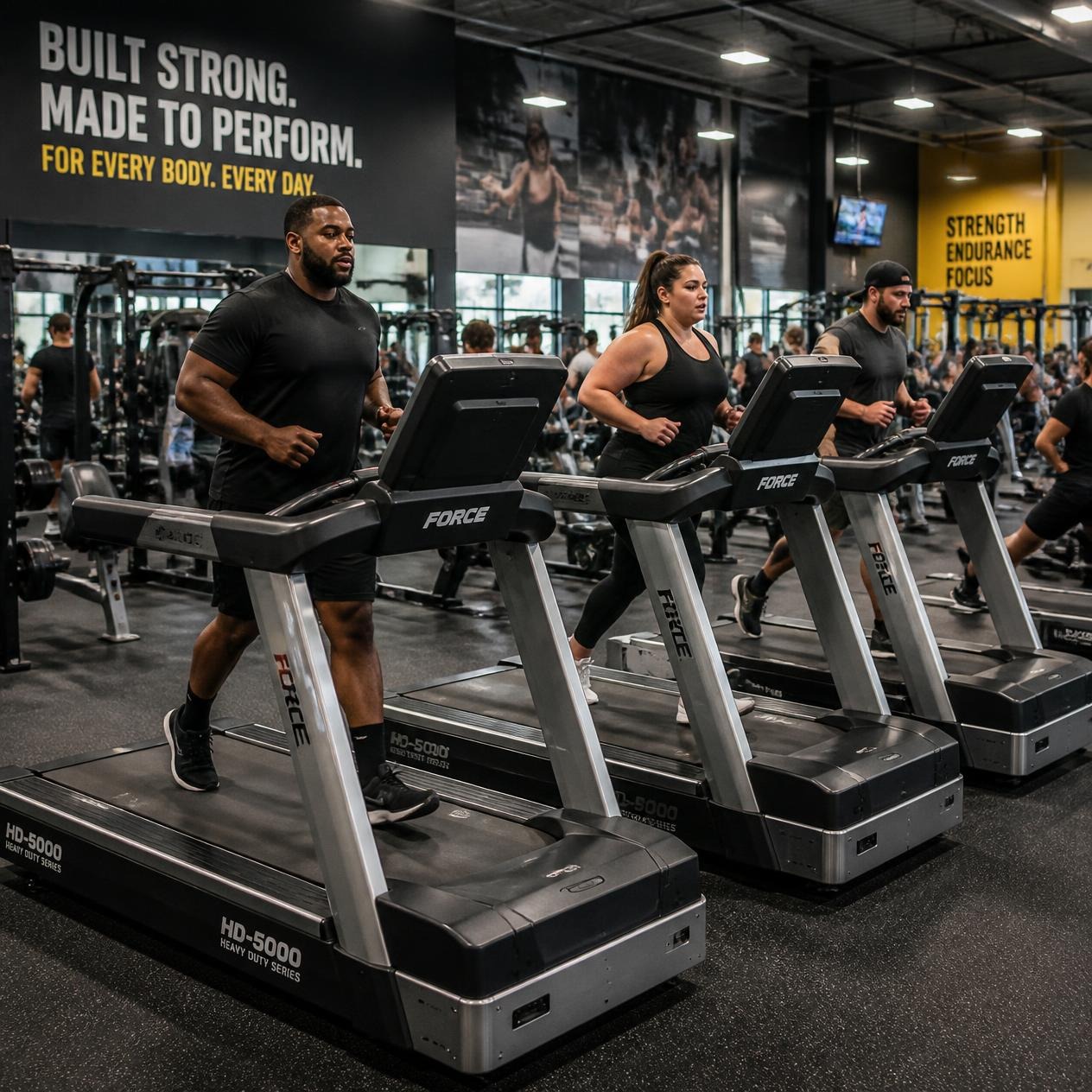
Treadmills for Heavy Users: A Guide to Models with a 150-180kg Capacity
Choosing a 150 kg capacity treadmill does not simply mean buying a machine with a high load capacity. For those with a robust build or who wish to train in total safety, it is essential to carefully evaluate the build quality of the equipment, the motor power, the sturdiness of the frame, and the effectiveness of the cushioning system. A treadmill designed to support users up to 150, 160, or 180 kg must, in fact, guarantee stability, smooth operation, and long-term durability even during intense workouts.
Many budget models found in large retail stores claim high capacities, but these values often represent the static limit of the structure and not the dynamic limit during running. When the body generates an impact on the running deck, the forces involved increase significantly, and an undersized machine can lose stability, wear out quickly, or offer a feeling of insecurity that compromises the entire training experience.
Investing in a treadmill actually designed for heavy users means training with peace of mind, protecting your joints, and having equipment destined to last for years. In this guide, we will analyze in detail all the technical elements to evaluate before purchasing, explaining why not all treadmills are the same and which features distinguish a professional heavy-duty model from a simple home machine.
- Why maximum capacity is so important
- Frame and materials: the heart of stability
- Motor power and the role of 4 HP
- Cushioning system and joint protection
- Running surface and comfort
- Certifications, tests, and safety
- Maintenance and long-term durability
- Why choose a professional heavy-duty model
Why maximum capacity is so important
The capacity indicated by the manufacturer is one of the first parameters to check, but it is important to understand its meaning. A machine with a capacity of 150 or 180 kg is designed to work with heavy loads while maintaining constant performance, stability, and safety even during frequent use.
During walking and especially running, the weight that bears down on the running deck does not simply correspond to body weight. With every step, the body generates dynamic forces that can far exceed the static value. For this reason, choosing a treadmill with a higher safety margin than your own weight is a smart decision.
A model designed with adequate structural reserves also offers a better feeling of solidity, reduces vibrations and oscillations, and maintains constant performance over time even after thousands of hours of use.
Static weight and dynamic load
The difference between static weight and dynamic load is fundamental. During running, the forces generated by impacts can significantly increase the stress on the structure, which is why a high capacity represents a real guarantee of reliability.
Why a safety margin is needed
Purchasing a machine with a capacity higher than your own weight allows the motor and frame to work without being constantly close to design limits, improving comfort and durability.
Frame and materials: the heart of stability
One of the aspects that distinguishes a professional treadmill from a budget model is the quality of the frame. Heavy-duty machines normally use high-thickness steel structures, designed to reduce flexing and twisting even during intensive use.
When comparing materials like steel and aluminum, it is important to consider that steel generally offers superior rigidity, a feature particularly useful in treadmills intended to support heavy users. A rigid structure improves load distribution and helps maintain constant stability throughout the movement.
Beyond the material, the overall design of the machine also counts. Reinforced sections, quality welds, and well-distributed support points allow for a stable platform that inspires confidence from the very first use.
Steel versus aluminum
Steel, thanks to its greater structural rigidity, is the preferred choice for professional treadmills intended for heavy and continuous use.
Why a heavy-duty frame makes the difference
A reinforced structure reduces vibrations, increases comfort, and ensures a feeling of safety even during brisk walking and sustained running.
Motor power and the role of 4 HP
The motor is the heart of any treadmill. When the user's weight increases, so does the work required to keep the belt moving smoothly. For this reason, the choice of motorization takes on even greater importance.
A 4HP motor treadmill offers a power reserve that allows you to maintain a constant speed without overheating and without performance drops. This does not mean that a less powerful motor is always inadequate, but a greater availability of torque allows the system to work with less mechanical stress, improving reliability and durability over time.
The quality of the motor does not depend only on the value expressed in HP. The cooling system, the quality of electronic components, and power management also directly influence the user experience. A motor designed for professional use maintains smoother operation even during long and repeated sessions, offering a feeling of fluidity that improves training comfort.
Why HP is important
Greater power allows the motor to easily handle load variations, maintaining the set speed constant and reducing wear on internal components.
Power does not just mean speed
The availability of mechanical reserve improves the fluidity of the walk, reduces the strain on the transmission system, and makes the treadmill more reliable in the long term.
Cushioning system and joint protection
Those with a robust build inevitably exert greater forces on the running deck. An effective cushioning system therefore becomes essential to limit impacts on the knees, hips, and spine.
The best treadmills use combinations of elastomers, cushioned supports, and flexible platforms designed to evenly distribute the energy generated during each step. This improves comfort and reduces the feeling of fatigue even during prolonged workouts.
Good cushioning protects not only the user's body but also the machine's structure, decreasing the stress transmitted to the frame and mechanical components.
Joint protection
Reducing impacts allows you to train with greater consistency and comfort, especially when the goal is to lose weight through frequent walking.
Stability and fluidity
A well-designed platform offers a more natural run and an even distribution of forces throughout the gait cycle.
Running surface and comfort
The width and length of the running deck directly affect perceived safety. Those with a larger build benefit from a wider surface that allows them to maintain a natural stride without the feeling of having to constantly check foot placement.
A longer belt also encourages a full stride, improving ergonomics and comfort both in brisk walking and running. This aspect becomes even more relevant for tall users or those with a long gait.
Professional machines combine generous running surfaces with stable frames, offering a feeling of safety that is difficult to replicate with compact models intended for occasional use.
Belt width
A wide surface reduces the risk of imprecise foot placement and increases safety during workouts.
Stride length
An extended running deck allows for more natural and comfortable movements, especially during sustained walking.
Certifications, tests, and safety
Capacity claims take on real value when supported by reliable production processes and load tests performed according to rigorous standards. A specialized manufacturer normally subjects its machines to structural checks and functional tests that simulate real-world usage conditions.
Demonstration videos, load certifications, and technical documentation are useful elements for evaluating the manufacturer's seriousness. It is not just about marketing, but information that helps the buyer understand how the machine was designed and verified.
To learn more about the features of professional solutions dedicated to indoor training, you can consult 150 kg capacity treadmills, where information on heavy-duty models and their relative technical specifications is available.
The value of certifications
A credible certification proves that the product has been designed and verified following objective criteria of safety and quality.
Why observe practical tests
Stability tests allow you to concretely evaluate the machine's behavior during use and represent a useful complement to technical data.
Maintenance and long-term durability
A treadmill designed for heavy loads still requires periodic maintenance. Lubricating the running deck, checking the correct belt tension, and keeping the motor and electronic components clean helps preserve performance and reliability.
The quality of materials also influences maintenance interventions. Professional components and robust transmission systems tend to require fewer adjustments and maintain constant performance for longer.
Regularly performed maintenance protects the investment and allows the machine to offer comfort and safety for many years of use.
Periodic checks
Small scheduled checks allow you to identify any anomalies in a timely manner, avoiding more complex interventions in the future.
A machine built to last
Quality materials, constant maintenance, and correct use allow heavy-duty treadmills to maintain high performance even after thousands of hours of training.
Why choose a professional heavy-duty model
A sturdy treadmill represents much more than just a fitness machine. It is a tool designed to offer stability, safety, and continuity in training to users with specific needs, eliminating the fear that the structure might be insufficient during walking or running.
Even those looking for a treadmill for obese users should not limit themselves to evaluating the declared capacity, but consider the frame, motor, cushioning system, build quality, and after-sales support as a whole. These elements truly determine the reliability and comfort of the machine in the long term.
Choosing a professional heavy-duty model means investing in peace of mind. A structure designed to support significant loads allows you to focus exclusively on your goals of well-being, physical fitness improvement, and weight loss, transforming every workout into a stable, safe, and motivating experience.
Comments (0)