
Trolley
You have no items in your shopping cart

 Budgets
 Dumbers
 Discs
Discs
 Benches
 Racks and Rigs
 Weights Holders
 Isotonic machines
 Calisthenics
 Cardio
 Kettlebells
 Flooring
 Gym Set
 Accessories
 Combat
 ARTI MARZIALI
 CONTAINER GYM
 Tug-Of-War
 Used Gym Equipment
 PILATES MACCHINARI
 GINNASTICA ARTISTICA
 CAMPI DA PADEL
 Prodotti in Pronta Consegna
 Informazioni
 IRONMAN
 Gift Card
- Donatif
- General information
- 0 I like it
- 803 Views
- 0 comments
- gym flooring, safety flooring, gym safety, shock-absorbing materials
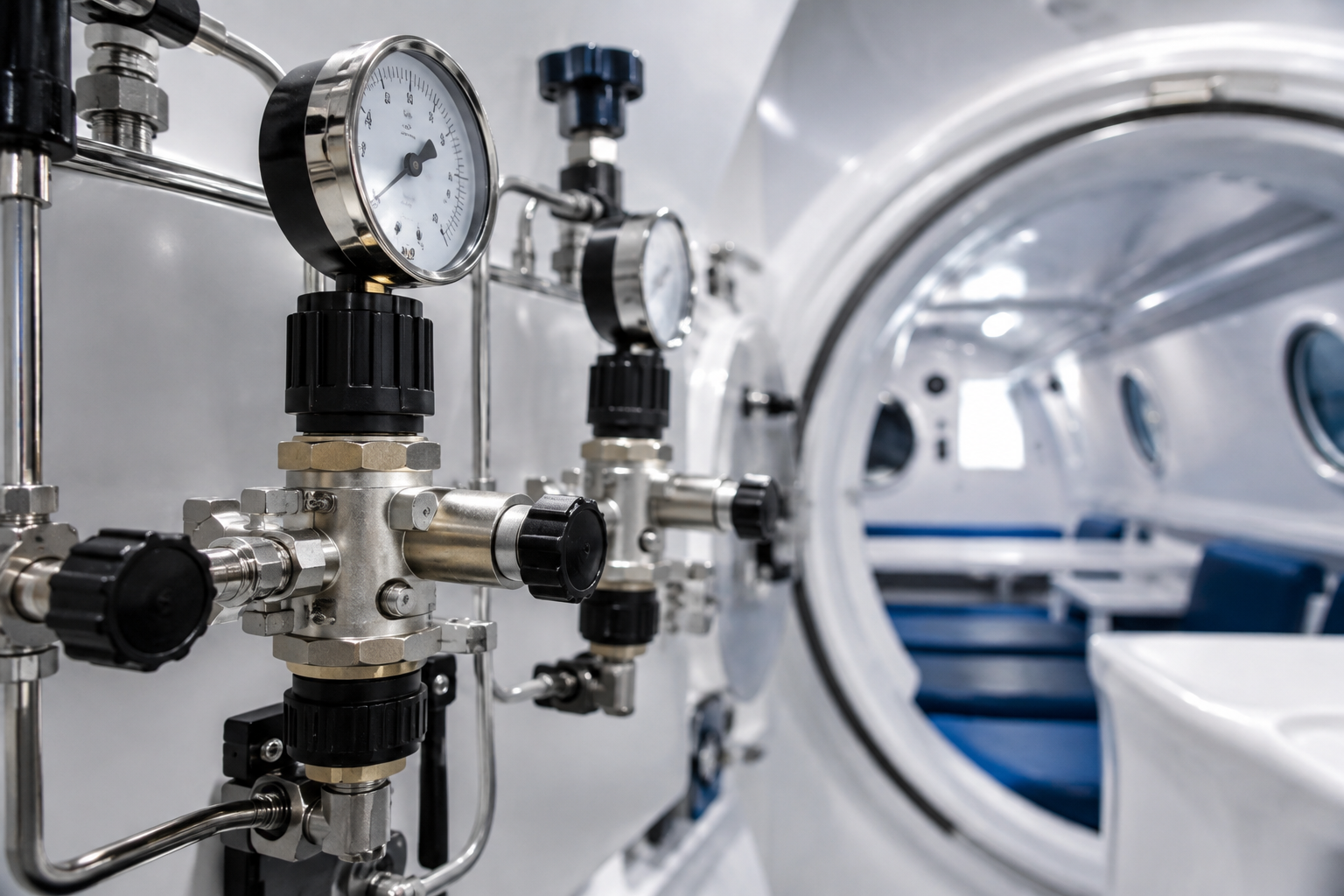
Regulation Valves and Sensors: the mechanics of controlled altitude
A professional hypoxic chamber is not simply a closed space in which the oxygen concentration is reduced. Behind every simulated altitude training session exists a complex technological system composed of generators, sensors, valves, fittings, and control devices that work together to create a stable and safe environment.
When talking about controlled hypoxia, attention is often focused on the most visible elements, such as the chamber itself or the generator. However, it is precisely the less obvious components that determine the precision of the system. A valve that correctly regulates flow, a reliable sensor, or a fitting designed with professional criteria can make the difference between a truly controlled environment and a simple closed structure.
The quality of oxygen sensors for hypoxic chambers and mechanical components directly influences safety, the repeatability of training sessions, and the system's ability to maintain consistent conditions over time. For this reason, in the design of a professional facility, every detail must be evaluated with rigorous technical criteria.
- The role of technical components in the hypoxic chamber
- Operation of regulation valves
- Sensors and control of environmental parameters
- Mechanical precision and system safety
- Technical components for professional hypoxic facilities
- Criteria for choosing hypoxia components
- Investment in the quality of the hypoxic facility
The role of technical components in the hypoxic chamber
Every professional hypoxic chamber functions thanks to the collaboration between numerous technical elements. The generator produces air with the desired composition, while valves and sensors allow for the continuous distribution, control, and verification of the internal conditions of the environment.
This integration is fundamental because hypoxia does not consist solely of reaching a specific oxygen value, but of maintaining it stable throughout the duration of the session. Variations due to the entry of people, internal movements, or changes in flow must be compensated for quickly by the system.
Mechanical components therefore represent the link between theoretical design and real operation. The build quality determines the system's ability to work reliably even after numerous hours of use.
Visible and hidden components
When an athlete enters a hypoxic chamber, they primarily perceive the external environment, but much of the work happens through components that remain hidden from view. Valves, fittings, and sensors operate continuously to maintain the programmed conditions.
The professionalism of a system is often measured precisely by the quality of these less evident elements, because they are responsible for daily operational stability.
Importance of integrated design
An excellent component inserted into a poorly designed system cannot guarantee optimal results. For this reason, valves, sensors, and generators must be selected as parts of a single technical project.
Correct integration allows for greater precision, reduced operational problems, and increased overall longevity of the facility.
Operation of regulation valves
Regulation valves play a fundamental role in managing airflow within a hypoxic system. Through their operation, it is possible to control air movement, balance pressures, and maintain consistent conditions within the environment.
A valve designed for professional applications must guarantee precision and reliability even during prolonged use. Small variations in regulation can, in fact, influence the general behavior of the system.
The quality of the valves directly affects the facility's ability to adapt to different operating conditions while keeping the set protocol stable.
Airflow regulation
Flow control is one of the most important aspects for the correct functioning of a hypoxic chamber. An inadequate amount of air can compromise oxygen distribution and create differences between the set value and the one actually present.
Valves allow for the management of this balance, contributing to the stability of the environment and the precision of the training.
Valves and pressure control
In addition to flow, some configurations require accurate management of internal pressure. Valves help maintain correct operating conditions and prevent unwanted variations.
Fitness pressure regulation valves must therefore be selected considering reliability, precision, and compatibility with the overall system.
Sensors and control of environmental parameters
Sensors represent the nervous system of the hypoxic chamber. Through continuous measurement of environmental parameters, they allow the technology to know the real conditions present within the controlled space.
A system lacking reliable sensors cannot guarantee precise control because it works without a correct perception of the environment. Measurement is therefore the starting point for any automatic regulation.
The quality of the collected data influences every subsequent phase, from generator management to user safety.
Oxygen measurement
Oxygen concentration represents the main parameter in managing hypoxia. Dedicated sensors must provide precise and stable information to allow the system to maintain the desired level.
An inaccurate reading can create differences between the programmed value and the one actually present, reducing the effectiveness of the protocol.
Continuous parameter monitoring
Continuous monitoring allows for the rapid identification of any variations and intervention through control systems. This approach improves safety and makes the environment more predictable.
For professional athletes and specialized facilities, the availability of reliable data represents an essential element of service quality.
Mechanical precision and system safety
The safety of a hypoxic chamber depends on the ability to maintain controlled and verifiable conditions. Every component must contribute to the overall precision of the facility, avoiding situations where the system operates far from the intended parameters.
Mechanical precision does not only concern the construction of individual elements, but also how they interact with each other. A professional system must be designed to reduce margins of error and guarantee continuity.
This approach allows for offering users a reliable environment and operators greater control in daily management.
Reduction of operational errors
Quality components reduce the probability of malfunctions and simplify control operations. Accurate design makes it easier to identify any anomalies.
Prevention represents a fundamental element in the management of any professional facility.
Solidity and reliability over time
The longevity of a hypoxic system also depends on the ability of the components to maintain constant performance over the years. Resistant materials and precise workmanship contribute to preserving the efficiency of the facility.
The choice of quality components therefore represents an investment in operational continuity.
Technical components for professional hypoxic facilities
A professional hypoxic facility includes numerous elements that must be chosen with technical criteria. In addition to main generators and sensors, fittings, connection systems, and control components also influence general operation.
Hypoxia technical components must guarantee compatibility, precision, and resistance to continuous use. Every part of the system contributes to the final result.
For this reason, it is important to rely on specialized manufacturers and suppliers capable of understanding the specific needs of controlled environments.
Material quality and production
The choice of materials influences the durability, reliability, and behavior of components over time. Solutions designed according to high standards offer greater operational safety.
Production quality represents a distinctive element, especially in facilities intended for frequent use.
Made in Italy approach and quality control
A production process oriented toward quality allows for obtaining more reliable components that are easily integrated into professional systems.
Attention to construction details contributes to the perceived solidity of the entire facility.
Criteria for choosing hypoxia components
Choosing the correct components requires an evaluation that goes beyond the simple purchase price. Performance, compatibility, support, and reliability over time are fundamental elements for a professional investment.
A hypoxic system must be considered as a coordinated whole in which each part influences the behavior of the others.
The choice of adequate components allows for building a more stable solution ready to support intensive use.
Supplier reliability
Collaborating with specialized suppliers allows for receiving support in the selection, installation, and management of components. Technical experience reduces the risk of non-optimal configurations.
A qualified partner represents added value in the life of the facility.
Compatibility between components
Every element must be compatible with the rest of the system. Sensors, valves, and generators must communicate correctly to guarantee the expected result.
Coordinated design improves overall efficiency and reliability.
Investment in the quality of the hypoxic facility
The difference between a professional hypoxic chamber and a simple closed structure lies in the system's ability to truly control what happens inside it. Precise sensors, reliable valves, and quality technical components transform a physical environment into a technologically advanced solution.
Investing in the mechanics of altitude means choosing precision, safety, and operational continuity. Every component contributes to creating more stable conditions and ensuring that training is carried out according to controlled parameters.
For professional athletes, sports centers, and operators seeking high quality standards, the selection of technical components represents a strategic element. The solidity of the system is born from the less visible details, precisely those that allow hypoxic technology to function correctly.
Technology at the service of safety
A facility designed with reliable components allows for managing hypoxia with greater awareness. Technology becomes a tool to control the process and reduce uncertainty.
Safety derives from the combination of design, build quality, and continuous monitoring.
Precision as a distinctive element
In a sector where even small variations can influence the result, precision represents the true added value. Correctly designed components allow for obtaining more constant performance.
The quality of the internal mechanics therefore determines the quality of the athlete's final experience.
Comments (0)