To buy outdoor fitness equipment for a municipality in a way that stands up to scrutiny, you need to request documents that refer to the specific product and to the place where it will be installed, not generic descriptions. In practice, four blocks are required: product identification, technical and safety documentation, installation and installation area, and use and maintenance.
This guide is designed for project managers (RUP), procurement offices, municipal technicians and designers who must prepare a tender specification or evaluate offers and want to avoid gaps discovered only after installation. It is not legal advice: tender rules and procedures remain those of your contracting authority and current legislation, to be verified on official sources.
We do not repeat here the general framework already covered in documents to request and checks for informed purchases of outdoor equipment: this article is an operational tool, to be used as a control list.
In this article
Why do you need a checklist rather than a general rule?
Two offers for “an outdoor fitness area” can describe very different things: number of units, safety zones, flooring included or excluded, installation, documents delivered. If the specification does not define what must be attached, you receive offers that cannot be compared and gaps that only surface at acceptance testing or delivery.
The checklist turns “we want a reliable supplier” into verifiable requests. It also lets you justify your choice: every point has an outcome (present, missing, to be completed) and a source.
A general rule is not enough because conditions change: park, school, sports area or the garden of a facility; presence of children or adults only; proximity to the sea; installation on grass, concrete or rubber surfacing. Each condition can change which documents matter most.
Block 1: how do you identify the product exactly?
Ask for a datasheet that makes it possible to uniquely recognise what will be supplied. Without this, any other document is useless, because you do not know what it refers to.
- Commercial name and model code, identical in the offer, technical datasheet and delivery note.
- Dimensions, weight and footprint of each unit.
- Main materials (frame, coating or treatment, moving parts) in the outdoor version.
- Quantity and composition of the area: equipment, surfacing, any information panels.
- Any options or variants included or excluded from the offer.
For example, in the outdoor fitness equipment category you will find models for different types of exercise: always check the datasheet of the exact model, not that of a similar product.
Block 2: which technical and safety documents should you request?
Ask what the supplier declares and on what basis. For fixed fitness equipment installed outdoors, there is a reference technical standard, UNI EN 16630 (the 2015 edition, as indicated by the standards body): ask the supplier whether and how the model refers to it, and verify the edition currently in force on the UNI website.
Be careful about what you cannot infer from a commercial label. A generic statement such as “compliant” is not a document: you need to know which standard, which edition, which model and which document supports it.
- Request in writing which standards or technical specifications the model refers to.
- Ask for the document supporting the declaration (declaration of conformity, test report or other attestation, if it exists) and check that it bears the model name.
- Check the date, issuer and any expiry or edition of the cited standard.
- If the document does not exist or refers to another product, record it as a gap and request clarification before awarding the contract.
If you need a specific approval or certification, state it in the tender specification: we cannot take it for granted or attribute it to a product without seeing the document.
Block 3: what should you ask about installation and the installation area?
Even the best-documented product can be installed incorrectly. Ask therefore for assembly instructions, the planned fixing method (anchor bolts, footings, ballast) and the substrate requirements. If installation is carried out by the supplier or a third-party company, state it in the offer.
Also ask for the free space around each unit, and compare it with the designer's layout. Verify that the distances specified by the manufacturer are respected in the site plan before placing the order.
The surface under and around the equipment is part of the choice. If you plan a surfacing system, consider outdoor rubber flooring and request the technical datasheet with thickness and format, bearing in mind that the choice of thickness depends on use and on the manufacturer's and designer's recommendations.
Practical example: area with several units
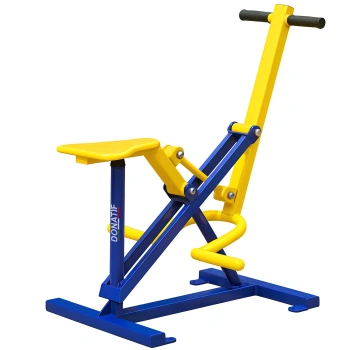
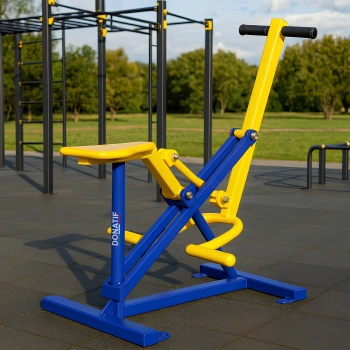
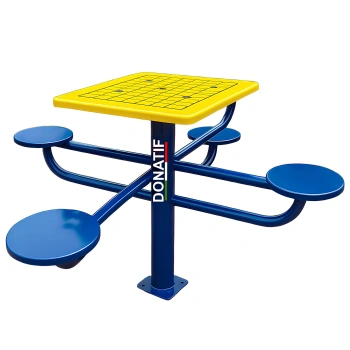
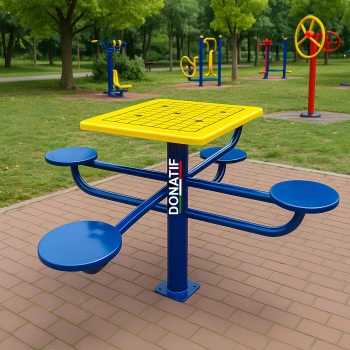
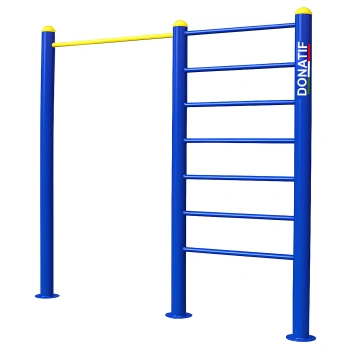
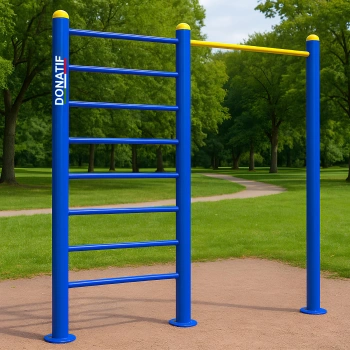
Imagine an area with an outdoor pull-up bar and wall bars, an outdoor fitness rider machine and an outdoor fitness area table. For each model, request the datasheet, the assembly instructions and the planned fixing, then complete one row of the table in the next section. Availability and conditions must be verified on each product's page.
Block 4: which documents are needed for use, maintenance and records?
Public equipment must be checked over time, so request the user and maintenance manual, guidance on periodic inspections, a list of spare parts and information on how to obtain assistance. Also ask for the instructions to be reproduced on any signage.
Decide from the start how to archive everything: one folder for each unit, with datasheet, documents and an inspection log. To organise it you can use a maintenance log with QR code and set up a maintenance plan from the outset.
Do not take the warranty for granted: ask that its duration and conditions are written in the offer or in the product datasheet.
How do you make offers comparable?
Use the same grid for all suppliers and complete one row for each unit. If an offer does not address a column, write “not provided” without interpreting it.
| Item | What to verify | Outcome |
|---|
| Identification | Model and code consistent across all documents | Present / to be completed |
| Reference standards | Standard, edition and supporting document | Present / missing |
| Assembly | Instructions, fixing method, who carries out installation | Present / to be completed |
| Installation area | Clearances and surface compatible with the layout | Verified / to be clarified |
| Maintenance | Manual, periodic inspections, spare parts | Present / missing |
| Warranty | Duration and written conditions | Present / missing |
If you want to explore how to assess the references of suppliers proposing the equipment, you will find a method in supplier references for fitness equipment.
Frequently asked questions
Can I use the same checklist for every municipality?
As a base, yes, but it must be adapted: regulations, type of area and procurement procedure vary. Always check the rules of your contracting authority.
Is a supplier’s “compliant” declaration sufficient?
No, on its own it is not a verifiable document. Request the reference standard, its edition and a supporting document referring to the specific model.
If I buy through MEPA (the Italian public e-procurement marketplace), is the documentation already complete?
You cannot assume so. Check the catalogue listing and the official portal’s rules to see what is declared for that product, and request whatever is missing.
Should the surfacing be included in the same purchase as the equipment?
It depends on the project. What matters is that the tender specification clearly states whether it is included or not, so that you do not compare different offers.
Conclusion: from checklist to documented decision
Start with the product block, move on to safety, installation and maintenance, then compare offers using the same table and keep every answer on file. This way you can justify your choice and identify what is missing in advance.
If you are preparing a tender specification or an outdoor area and want to see the model datasheets, browse the outdoor fitness equipment category or contact Donatif for consultancy or a quote: we will tell you which documents are available for the model you are interested in.


 Budgets
 Dumbers
 Discs
 Benches
 Racks and Rigs
 Weights Holders
 Isotonic machines
 Calisthenics
 Cardio
 Kettlebells
 Flooring
 Gym Set
 Accessories
 Combat
 ARTI MARZIALI
 CONTAINER GYM
 Tug-Of-War
 Used Gym Equipment
 PILATES MACCHINARI
 GINNASTICA ARTISTICA
 CAMPI DA PADEL
 Prodotti in Pronta Consegna
 Informazioni
 IRONMAN
 Gift Card