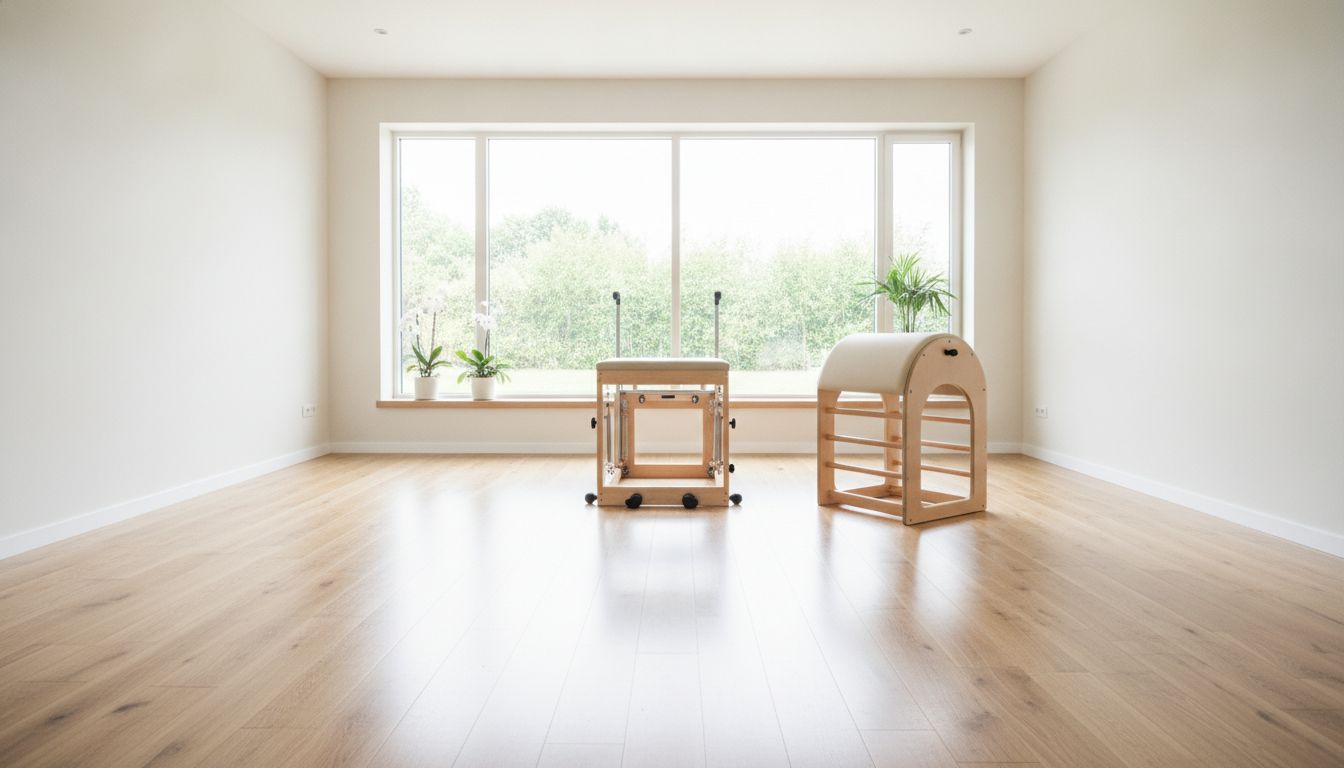
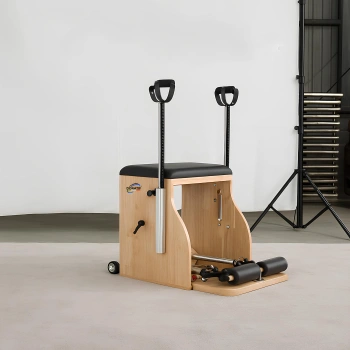
To choose between a Pilates chair or barrel for a small studio, comparing the floor footprint of each apparatus is not enough. What matters is the free space the instructor needs to assist, the paths clients use to reach their station, and how easily students can rotate between stations. If your studio is compact, start from here and only then look at the product specifications.
Many small studios assume that more apparatus means a better offer. In reality, one extra machine often shrinks the instructor's working area and creates crossing paths between clients. This guide gives you a method to compare the two apparatus in the same room, using criteria you can document.
You won't find invented measurements or performance claims here. Dimensions and load ratings are the ones published by the manufacturer in the model's specifications. We show you how to use them to make the decision. If you first need to understand who really needs each apparatus, read the guide on Chair and Barrel for small studios; this article focuses on comparing operational spaces.
In this article
Why isn't the floor footprint enough?
The dimensions listed in the specifications describe the apparatus at rest. During a class you also need space to get on and off, to move legs and arms, to make adjustments, and for the instructor to move around. The operating area is therefore always much larger than the apparatus outline.
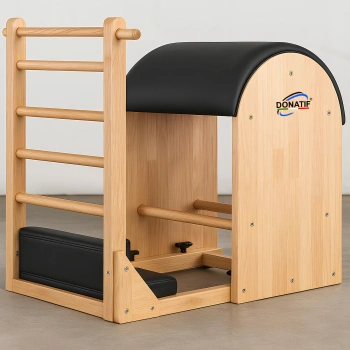
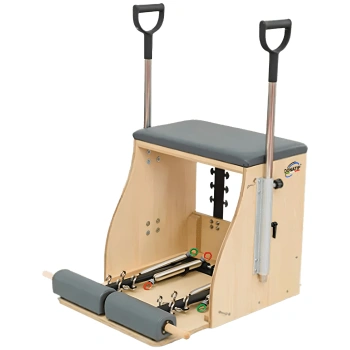
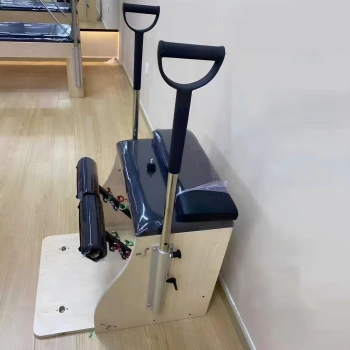
A Chair is usually a more compact station with one main working side. A Ladder Barrel, by contrast, develops the exercise across several planes and directions, so it tends to need free space all around the structure. These are general guidelines: always confirm with the measurements and instructions of the specific model you choose.
Three areas to distinguish
- Physical footprint: the overall dimensions declared by the manufacturer.
- Use area: the space the client occupies during exercises, including adjustments.
- Assistance area: where the instructor moves to correct, guide and protect the client.
How much space does the instructor need?
There is no single value that works for everyone: it depends on the type of class, the number of clients and how you assist them. A practical rule is to draw on your floor plan, for each apparatus, the sides from which the instructor must be able to intervene. If a side sits against a wall or another machine, that station is worth less than it appears.
Try simulating a typical class with masking tape on the floor. Mark the footprint, then the use area, then the points where you would stand to assist. If two areas overlap, the apparatus is too close to another piece or to the wall.
Traffic paths and access: where small studios get stuck
In a compact studio the problem is rarely a single machine. It's the passageways: entrance, changing room, storage, emergency exit. Apparatus that forces clients to pass behind another while a class is running slows down the whole session.
Also check the group changeover flows: people leaving and people arriving should not cross inside the use areas. To learn how to avoid overlaps in a small studio, see this guide on footprint and overlapping flows, written for personal training studios but applicable to path planning.
- Always keep the routes to the exits clear.
- Avoid making clients pass through the use area of another station.
- Check that doors, lockers and windows open without hitting the equipment.
- Plan where to store props and mats during the class.
Chair and Barrel comparison matrix
This table is a reasoning model, not a list of technical data. Fill in the columns with the measurements and instructions of the model you are evaluating.
| Criterion | Chair | Ladder Barrel |
|---|
| Floor footprint | Generally more compact: check the specifications | Depends on the model: check the specifications |
| Use area | More contained around the station | Often requires more free space around it |
| Assistance sides | One main side, depending on the model | More sides usable by the instructor |
| Mobility | To be verified per model | To be verified per model |
| Rotation | Suited to small groups with fast rotation | Needs more attention if shared between clients |
| Repertoire | Depends on the model and the instructor's training | Depends on the model and the instructor's training |
If you can't fill in a criterion, that's information to request from the supplier before buying. To see how the apparatus fits into the overall studio plan, you may also find useful how to choose Pilates equipment based on your studio's goals.
Three typical studio scenarios
Scenario 1: single room, one-to-one sessions
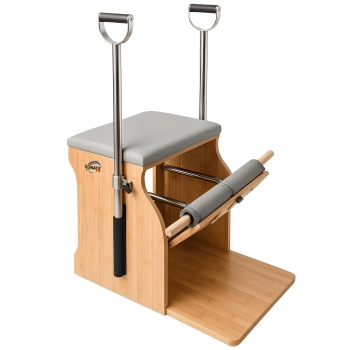
If you work almost always one-to-one, the key factor is the instructor's freedom of movement around the client. A compact station such as the PM19 Wooden Pilates Chair usually leaves more room for individual work, but always verify the model's dimensions and the area you need.
Scenario 2: small groups with rotation
Here the criterion is rotation: how many people must move between stations and along which paths. A bulky apparatus in the centre of the room can slow down changeovers. Draw the rotation path on your floor plan before deciding how many pieces to install.
Scenario 3: shared space with other activities
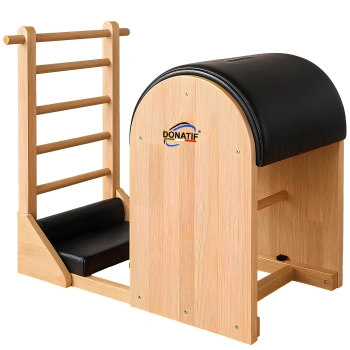
If the room also hosts mat classes or other disciplines, the question becomes whether the apparatus can be moved or stored in a corner without getting in the way. A model such as the Ladder Barrel PM2 should be assessed exactly on this point: footprint, weight and handling described in the specifications.
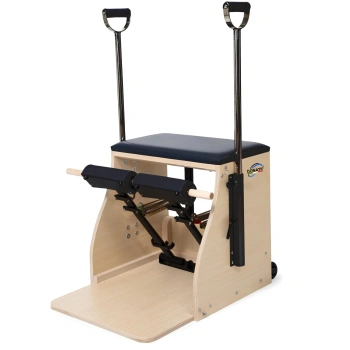
If you want a station that combines several functions in one frame, you can also look at the PM1 Combo Chair: compare the declared repertoire with what your instructor would actually use.
The Reformer belongs to a different family of apparatus, with different footprints and usage logic. In a small studio the question is not "Chair or Barrel or Reformer", but which sequence of purchases makes sense for the repertoire you offer and the space you have. For a comparison between apparatus families, read the difference between the Reformer and other Pilates apparatus.
If you already own a Reformer and are wondering whether to add a second piece, calculate what you lose in space and traffic flow. The reasoning on the opportunity cost of a rarely used machine is developed in this article on the cost of an underused machine.
How to check before you buy
- Measure the room and draw a scaled plan with doors, windows and fixed points.
- Collect the measurements of the candidate apparatus from the product specifications in the Pilates equipment catalogue.
- Draw the three areas (footprint, use, assistance) for each apparatus.
- Simulate a typical class with tape on the floor or scaled cardboard cut-outs.
- Check the paths for entry, exit and rotation between stations.
- Confirm instructions, use and assembly with the supplier and, if needed, with a technician or the facility manager.
Remember to plan for accessories too: mats, balls and small props take up space. You'll find some options in the functional accessories category.
Frequently asked questions
Chair or Barrel: which takes up less space?
It depends on the model. In general the Chair has a more compact use area, but you should compare the specifications and the area the instructor needs.
Can I have both in a small studio?
It depends on the floor plan and the paths. If the use and assistance areas don't overlap and the exit routes stay clear, it may be possible. Run the floor simulation before deciding.
Is it worth buying more apparatus to look more complete?
Not necessarily. A rarely used piece takes up space and limits traffic paths. It's better to start from the repertoire you actually offer.
Who checks safety standards and minimum space requirements?
The manufacturer's instructions define the model's conditions of use; for building and premises requirements, contact the facility manager or a qualified technician.
The next step
Before choosing, bring use areas, assistance areas and traffic paths onto your floor plan: the decision between Chair and Barrel becomes much clearer. Then compare the specifications in the Pilates equipment category.
If you'd like an opinion on your layout, contact Donatif for a consultation or a quote: with your room plan and the type of classes you run, we can help you evaluate which models make sense in your space.


 Budgets
 Dumbers
 Discs
 Benches
 Racks and Rigs
 Weights Holders
 Isotonic machines
 Calisthenics
 Cardio
 Kettlebells
 Flooring
 Gym Set
 Accessories
 Combat
 ARTI MARZIALI
 CONTAINER GYM
 Tug-Of-War
 Used Gym Equipment
 PILATES MACCHINARI
 GINNASTICA ARTISTICA
 CAMPI DA PADEL
 Prodotti in Pronta Consegna
 Informazioni
 IRONMAN
 Gift Card