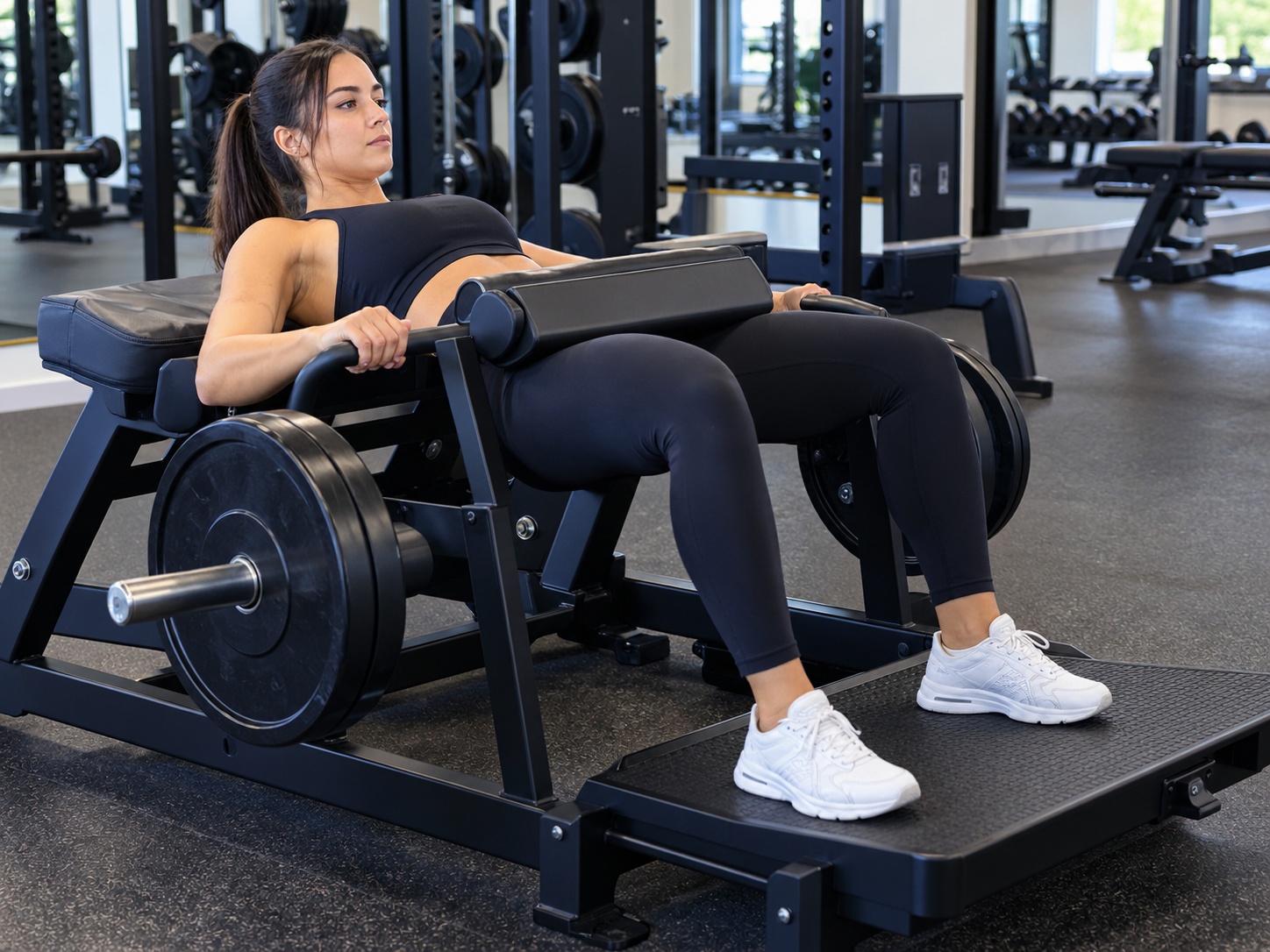
Choosing a hip thrust machine should start with an analysis of training needs, available space, and frequency of use. The most important criteria are the type of load, the quality of adjustments, the stability of the structure, user compatibility, and ease of maintenance. Evaluating these aspects allows you to purchase a machine that is truly suitable without relying solely on price.
Compared to other equipment dedicated to the glutes, a hip thrust machine allows for a guided movement designed to emphasize hip extension while maintaining high technical repeatability. However, not all models offer the same construction and functional features.
This guide outlines verifiable criteria that help compare the different solutions available, highlighting the differences between plate-loaded and weight stack options, the importance of adjustments, space-related aspects, and the most common mistakes to avoid during purchase.
Which criteria really matter in the choice?
Before comparing models, it is helpful to define the context of use. A commercial gym requires robustness, quick adjustments, and components designed for intensive use, while a home gym may prioritize compactness and simplicity.
The main elements to verify are frame quality, movement fluidity, stability during exercise, load capacity declared by the manufacturer, pad ergonomics, and ease of access.
It is also important to verify the availability of spare parts and the user manual, in addition to the maintenance instructions provided by the manufacturer.
Why is the frame crucial?
A rigid frame reduces unwanted oscillations and improves the sense of safety during movement.
How much does ergonomics matter?
A well-designed support better distributes pressure on the pelvis and facilitates correct positioning during execution.
Is a plate-loaded or weight stack machine better?
The choice between a plate-loaded and a weight stack machine depends mainly on the type of user and the facility's goals.
Plate-loaded versions allow greater flexibility in weight selection through Olympic plates and are often appreciated by experienced users. For those looking for dedicated equipment, it is also possible to evaluate the isotonic machines category.
Models with weight stacks allow rapid load changes via a selector and facilitate management in gyms with many users.
Advantages of plate-loaded systems
Greater load customization, mechanical simplicity, and the ability to use plates already present in the gym.
Advantages of weight stacks
Rapid weight changes, operational order, and reduced time between sets.
What adjustments should be present?
The adjustments of the hip thrust machine directly affect the ability to adapt the machine to users of different heights.
The presence of adjustments for the backrest, starting point, footplate, or supports depends on the manufacturer's design but represents an important element in the evaluation.
The locking system should also be intuitive and easily identifiable by the user.
Is the belt important?
A stable belt helps maintain correct contact during the exercise and must be easily adjustable.
Does the position of the footplate matter?
Yes, because it influences foot placement and the ability to adapt the exercise to different body proportions.
How to verify compatibility with users?
A machine intended for a diverse audience should adapt to different statures without requiring complex adjustments.
Access to the machine must be simple even for those using the equipment for the first time.
The movement path should allow for natural execution without structural limitations.
Is it suitable for beginners?
A guided machine can facilitate the learning of the technical movement as long as clear instructions and intuitive adjustments are present.
Is it suitable for advanced users?
Experienced users primarily evaluate stability, load progression, and biomechanical quality.
How much space is needed?
The available space concerns not only the machine's footprint but also the areas required for access, plate loading, and user traffic.
Before purchasing, it is advisable to compare the dimensions declared by the manufacturer with the floor plan of the room.
The flooring should be suitable for the installation of the equipment according to the manufacturer's instructions.
How to integrate it into the layout?
It is preferable to maintain adequate safety spaces and clear pathways around the machine.
Are dedicated accessories needed?
It depends on the model. Some versions require Olympic plates while others fully integrate the loading system.
What maintenance does it require?
Routine maintenance includes visual checks, checking bolt tightness, surface cleaning, and inspection of wear parts as outlined in the manufacturer's manual.
In models with guides and weight stacks, it is useful to follow the maintenance schedule indicated by the manufacturer.
Regular maintenance helps preserve the machine's functionality over time.
Why check spare parts?
The availability of replacement components can reduce downtime in case of repairs.
Why read the manual?
The manual contains instructions on installation, use, periodic checks, and safety.
Comparison table
| Criterion |
What to verify |
| Load |
Plate-loaded or weight stack |
| Adjustments |
Backrest, belt, initial position |
| Frame |
Rigidity and stability |
| Ergonomics |
Support comfort and ease of use |
| Space |
Operational footprint |
| Maintenance |
Spare parts and inspection schedule |
This table allows for a quick comparison between different models using easily verifiable parameters.
It is advisable to gather technical specifications directly from the manufacturer's official documentation without relying solely on promotional material.
Which sources to consult?
User manuals, technical documentation, installation instructions, and manufacturer statements represent the primary and most useful sources for comparing machine features.
What mistakes to avoid?
Buying based only on price, ignoring available space, neglecting adjustments, and failing to verify scheduled maintenance are among the most frequent mistakes.
How to make the final decision
The choice of the hip thrust machine should stem from an objective evaluation of technical and operational requirements. A machine with adequate adjustments, a stable structure, a loading system consistent with the context of use, and simple maintenance generally represents a more sustainable long-term solution.
Before purchasing, it is useful to prepare a checklist including dimensions, load capacity, type of resistance system, build quality, availability of spare parts, technical documentation, and warranty conditions. This approach allows different models to be compared using homogeneous and verifiable criteria.
FAQ
Hip thrust machine or barbell? It depends on the goals, the level of the users, and the context of use. The machine offers a guided movement while the barbell requires different technical management.
Is the weight stack always better? No. It is a practical solution in high-traffic gyms, but plate-loaded systems can be more flexible in other contexts.
Which adjustments are indispensable? Those that allow the machine to be correctly adapted to users with different anthropometric characteristics.
How much does maintenance matter? A lot, because it helps maintain safety, functionality, and continuity of use according to the manufacturer's instructions.
The content of this guide follows an approach oriented toward decision-making criteria and does not replace the instructions provided in the technical manuals of individual manufacturers. For dimensional data, load capacity, installation requirements, and maintenance schedules, it is always appropriate to refer to the official documentation provided with the equipment. :contentReference[oaicite:0]{index=0}


 Budgets
 Dumbers
 Discs
 Benches
 Racks and Rigs
 Weights Holders
 Isotonic machines
 Calisthenics
 Cardio
 Kettlebells
 Flooring
 Gym Set
 Accessories
 Combat
 ARTI MARZIALI
 CONTAINER GYM
 Tug-Of-War
 Used Gym Equipment
 PILATES MACCHINARI
 GINNASTICA ARTISTICA
 CAMPI DA PADEL
 Prodotti in Pronta Consegna
 Informazioni
 IRONMAN
 Gift Card