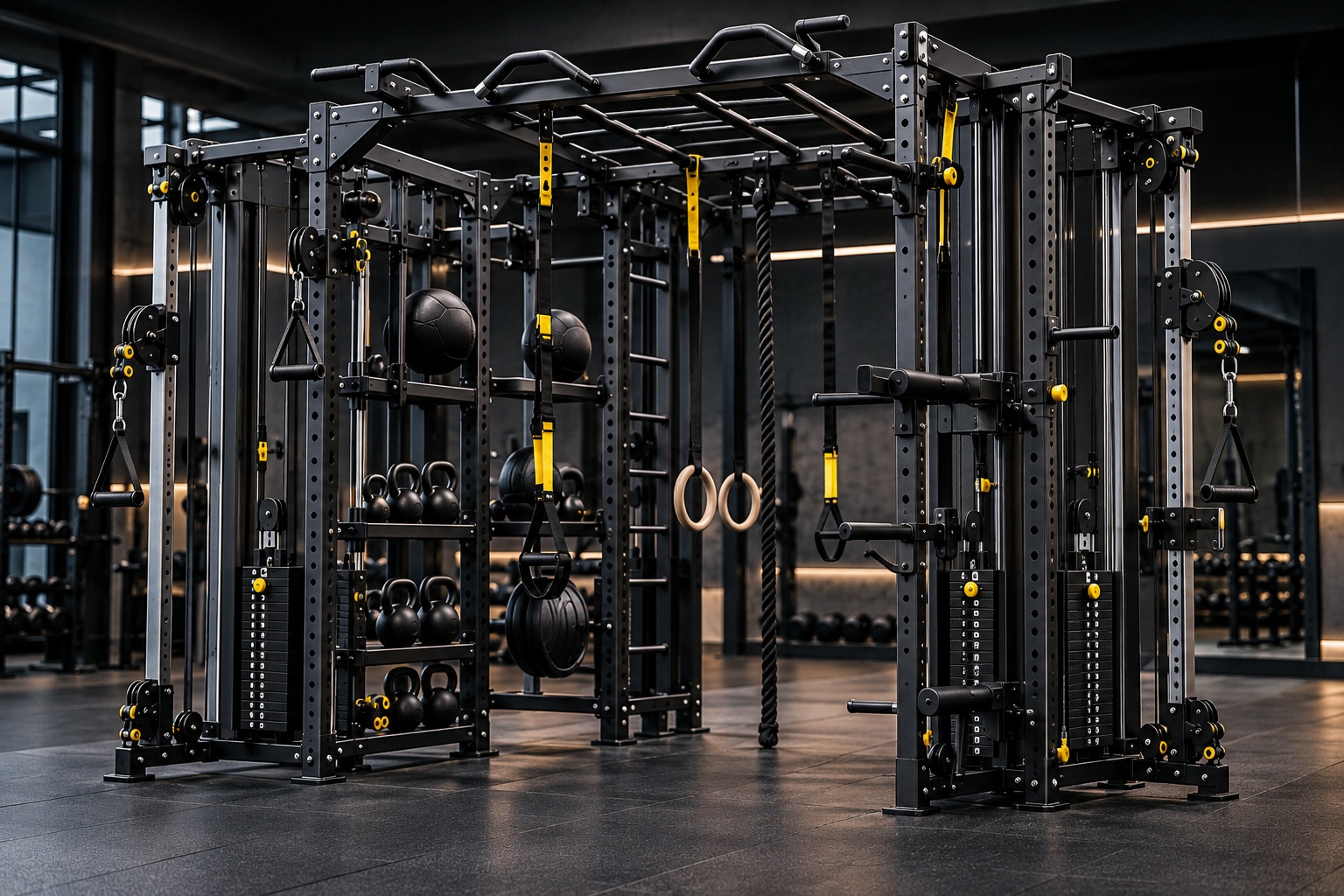
The comparison between a functional trainer and a jungle machine involves two types of equipment that use cable and pulley systems but respond to different design requirements. Both allow for numerous exercises to be performed, yet they differ in structure, number of available stations, mode of use, and intended application.
The choice should not be based solely on the machine's dimensions or the number of exercises claimed by the manufacturer. It is more useful to evaluate the type of users, available space, expected training volume, and the overall organization of the gym or studio.
Analyzing technical characteristics using verifiable criteria makes it possible to identify the solution most consistent with the facility's project, avoiding investments that are disproportionate to actual operational needs.
Functional trainer or jungle machine: which one to choose
The choice between a functional trainer and a jungle machine depends on the number of users, space configuration, activity goals, and the variety of exercises required. The functional trainer is generally designed for one or two people at the same time, while a jungle machine integrates multiple workstation units allowing simultaneous use by multiple users.
Before purchasing, it is advisable to analyze the average user flow, available surface area, and the type of training that will be performed daily.
An initial technical assessment makes it possible to choose the most consistent solution without oversizing the investment.
Decision criteria
The main criteria concern the number of pulleys, workstation configuration, transmission ratios, weight stack capacity, accessory modularity, operational footprint, and maintenance simplicity.
Technical references
For installation, use, and maintenance, it is appropriate to follow the manufacturer's manual. For fitness equipment, EN ISO 20957 series standards may also represent a reference when applicable.
What are the main differences
The functional trainer normally consists of two columns with adjustable pulleys that allow for a wide variety of individual exercises. The jungle machine, on the other hand, integrates multiple interconnected modules, offering various dedicated stations that can be used simultaneously.
This difference influences space planning, the number of manageable users at the same time, and the flexibility of the training area.
Both solutions can be used for full body programs, but they respond to different organizational needs.
Functional trainer characteristics
The machine favors versatility, quick adjustments, and the ability to perform numerous exercises using a single station.
Jungle machine characteristics
The jungle machine is designed to offer multiple integrated stations, allowing simultaneous use by different users.
How to choose between functional trainer and jungle machine
For a personal training studio or a gym with limited space, the functional trainer often represents a solution that optimizes available surface area while maintaining high versatility.
A jungle machine may be more suitable in facilities with high foot traffic, where multiple people need to train simultaneously on different stations without excessive waiting times.
The choice should also consider the availability of accessories, ease of adjustment, scheduled maintenance, and the possibility of expanding the training area in the future.
Evaluating space
Before installation, it is important to verify not only the machine's footprint but also the operational area needed to use all stations safely.
Evaluating users
Number of clients, session frequency, and usage methods represent fundamental elements in choosing the configuration.
In which scenarios to choose one solution or the other
A PT studio oriented toward individual sessions can benefit from the flexibility of the functional trainer, which allows for quick exercise changes and simple space management.
A commercial gym with numerous members might instead prefer a jungle machine to distribute users across multiple stations and improve the room's operational capacity.
In centers dedicated to athletic preparation, the choice depends on the adopted working method and the type of planned sessions.
Personal training studio
The compactness and speed of adjustments make the functional trainer particularly suitable for individual workouts.
Commercial gym
The jungle machine allows an increase in the number of users who can train simultaneously using dedicated stations.
Comparison table
| Feature |
Functional trainer |
Jungle machine |
| Stations |
One or two |
Multiple integrated |
| Simultaneous users |
Generally one or two |
Multiple users at the same time |
| Footprint |
More compact |
Larger |
| Versatility |
High with dedicated accessories |
High thanks to various stations |
| Configuration |
Quick and simple |
More articulated |
| Typical destination |
PT studios and small gyms |
Fitness centers with high foot traffic |
How to interpret the comparison
The table allows comparing the two types using technical criteria without attributing an absolute advantage to either configuration.
Defining priorities
Each facility should identify the most important features according to its business model.
Errors to avoid
One of the most common mistakes is choosing a jungle machine in environments with limited space or installing a functional trainer when the number of users requires numerous simultaneous stations.
It is also advisable to avoid evaluating exclusively the number of available exercises without considering space organization, maintenance, and ease of use.
The quality of the installation surface also contributes to equipment stability. An impact-absorbing flooring protects the floor and machines during daily use. To learn more about available solutions, you can consult gym impact-absorbing flooring.
Underestimated space
Considering exclusively the external dimensions of the machine without evaluating the operational area can compromise the functionality of the gym.
Inconsistent configuration
A choice not aligned with the number of users or the working method can reduce investment efficiency.
How to evaluate the investment
The decision between a functional trainer and a jungle machine should be included within an overall fitness room design, considering the future growth of the facility, space availability, and client characteristics.
For many professional entities, the best solution is the one that offers the best balance between expected use, management simplicity, maintenance, and the possibility of adapting the training area to new needs.
Analyzing manufacturers' technical specifications, carefully designing the layout, and verifying the machine's compatibility with the facility's goals allows making an informed and sustainable choice over time.


 Budgets
 Dumbers
 Discs
 Benches
 Racks and Rigs
 Weights Holders
 Isotonic machines
 Calisthenics
 Cardio
 Kettlebells
 Flooring
 Gym Set
 Accessories
 Combat
 ARTI MARZIALI
 CONTAINER GYM
 Tug-Of-War
 Used Gym Equipment
 PILATES MACCHINARI
 GINNASTICA ARTISTICA
 CAMPI DA PADEL
 Prodotti in Pronta Consegna
 Informazioni
 IRONMAN
 Gift Card