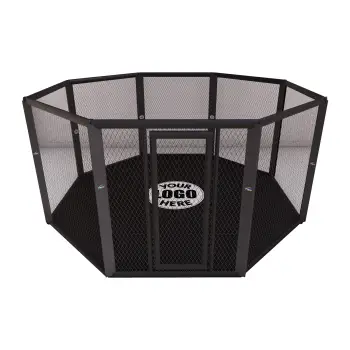
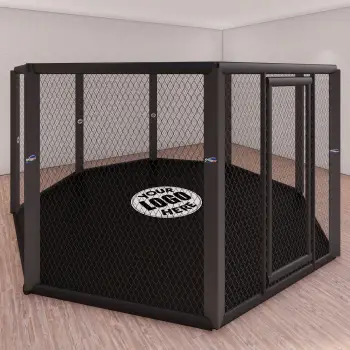
The choice between a complete MMA cage and a wall panel system mainly depends on the facility's goals, available space, and intended usage methods. The two solutions are not absolute alternatives, but rather address different operational needs and must be evaluated by considering verifiable technical criteria rather than generic preferences.
A complete cage recreates a delimited area intended for specific mixed martial arts training, whereas wall panels represent a solution to protect the environment's surfaces and expand the room's usage possibilities. Understanding the differences allows you to properly plan your investment without purchasing equipment that is inconsistent with the gym's actual activity.
Before making a choice, it is advisable to analyze the room layout, the number of practitioners, the frequency of classes, the presence of other disciplines, and the manufacturer's technical instructions regarding installation, maintenance, and space requirements.
What is the difference between a complete MMA cage and wall panels?
A complete MMA cage creates a delimited training area using a supporting structure and mesh, while wall panels are protective elements fixed to the vertical surfaces of the room. The choice depends on available space, training type, gym configuration, and the facility's operational goals.
Both solutions can be integrated into the same facility when the project requires it.
Before purchasing, it is appropriate to compare the characteristics reported in the manufacturer's technical documentation.
Define the Goal
It is useful to establish whether the priority is to create an area dedicated to matches or to increase wall protection during training.
Analyze Usage
The number of athletes, class types, and frequency of use affect the choice of configuration.
What are the main differences?
The most obvious difference concerns the function of the structure. The complete cage delimits a specific space for MMA training, while the panels protect the walls without creating a closed area.
Installation, layout, and usage methods are also different and must be evaluated together with the room's characteristics.
To design a room dedicated to combat sports, you can consult the range of combat sports equipment.
Characteristics of the Complete Cage
The structure includes the frame, mesh, fastening systems, panels, and protections provided by the chosen model, creating a defined area for training and sparring.
Characteristics of Wall Panels
The panels are installed on vertical surfaces with a protective function and allow greater freedom in configuring the training area.
What criteria help in the choice?
Available space represents one of the first elements to evaluate. A complete cage actually requires a dedicated area that also includes the space needed for access, maintenance, and circulation.
It is also necessary to consider the activity schedule, the number of users, and the possibility of reconfiguring the rooms in the future.
The choice should always be compared with the manufacturer's technical specifications.
Gym Layout
A room used exclusively for martial arts may require a different configuration compared to a multi-purpose space.
Future Flexibility
Evaluating any changes to internal organization helps choose a solution that is more consistent with the facility's evolution.
Comparison Table
To facilitate evaluation, it is useful to compare some fundamental aspects.
| Criterion |
Complete MMA Cage |
Wall Panels |
| Dedicated Area |
Yes |
No |
| Space Flexibility |
Lower |
Higher |
| Wall Protection |
Limited to the structure |
Specific for vertical surfaces |
| Installation |
Requires complete assembly |
Requires fixing to walls |
| Main Usage |
Training and sparring |
Environment protection |
Evaluating Space
The available dimensions directly influence the feasibility of the chosen solution.
Evaluating Usage
Intensive scheduling of MMA activities may require different needs compared to occasional use.
In which cases should you choose one solution or the other?
A complete cage may be indicated when the gym has a dedicated area and wishes to organize specific activities within a delimited space.
Wall panels can represent an appropriate solution when the main goal is to protect the environment while keeping the room more open.
In some projects, the two configurations can be combined to meet different needs.
When to Prefer the Cage
This is a solution to evaluate when the layout allows for a permanent installation and the main activity is dedicated to MMA.
When to Prefer the Panels
They can be suitable in multi-functional environments where it is important to preserve space flexibility.
What errors are best to avoid?
One of the most frequent errors consists of choosing exclusively based on price without considering the gym's configuration and intended use.
Another critical issue concerns failing to check the actual room dimensions and the pathways required for assembly.
It is also advisable to avoid structural modifications not foreseen by the manufacturer.
Neglecting the Layout
Incomplete planning can limit the functionality of the entire room.
Ignoring Technical Documentation
Manuals and manufacturer instructions constitute the main reference for installation and maintenance.
Manuals and Technical Documentation
Before installation, it is advisable to consult the manufacturer's manual to verify assembly methods, space requirements, flooring characteristics, and the maintenance plan.
Each model may present different assembly methods and technical specifications.
Keeping the documentation facilitates checks, maintenance, and spare parts management throughout the structure's life cycle.
Installation Manual
Contains official indications regarding assembly, checks, and use of the structure.
Maintenance Log
Documenting checks and interventions helps keep equipment management organized.
FAQ
Is it possible to use both solutions?
Yes. Depending on the gym's project, it is possible to integrate an MMA cage with wall panels, provided the layout and available space allow it.
Which solution takes up less space?
Wall panels generally do not delimit a dedicated area like a complete cage, but the evaluation must be carried out on the overall room project.
Does maintenance change?
Yes. Procedures depend on the type of structure and must follow the manufacturer's indications.
How to evaluate the most suitable solution
The choice between a complete MMA cage and wall panels should be based on verifiable criteria such as available space, intended use, required flexibility, installation methods, and the manufacturer's technical documentation. By analyzing these elements, it is possible to design a combat sports area consistent with the gym's operational needs and the future developments of the facility.


 Budgets
 Dumbers
 Discs
 Benches
 Racks and Rigs
 Weights Holders
 Isotonic machines
 Calisthenics
 Cardio
 Kettlebells
 Flooring
 Gym Set
 Accessories
 Combat
 ARTI MARZIALI
 CONTAINER GYM
 Tug-Of-War
 Used Gym Equipment
 PILATES MACCHINARI
 GINNASTICA ARTISTICA
 CAMPI DA PADEL
 Prodotti in Pronta Consegna
 Informazioni
 IRONMAN
 Gift Card