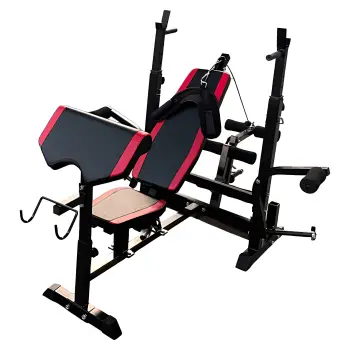
Black Friday represents an interesting opportunity for those who want to purchase fitness equipment, complete a home gym, or upgrade the tools used during workouts. Promotions can make products that require a significant investment more accessible, but a high discount percentage does not automatically guarantee a cost-effective purchase. Real savings depend on the actual price charged, the technical features of the product, and its usefulness compared to training needs.
When looking for Black Friday gym equipment deals, it is easy to focus attention on the crossed-out price or the stated reduction percentage. However, two seemingly similar pieces of equipment can have important differences in terms of materials, dimensions, weight capacity, compatibility, and durability. Furthermore, shipping costs, necessary accessories, and return conditions can significantly alter the overall convenience of the purchase.
For those building a home gym, for a personal trainer who needs to optimize their budget, or for those wishing to replace already used equipment, the most reliable criterion consists of comparing the total cost with the expected use value. This guide proposes a practical method to verify promotions, correctly interpret discounts, and recognize when it is preferable to buy or wait, without being conditioned by promotional urgency.
What truly makes a fitness offer cost-effective
The convenience of sports equipment cannot be determined exclusively by the difference between the original price and the promotional price. A product may be offered with a significant discount and still turn out to be poorly suited to the buyer's needs. Conversely, an item with a modest reduction can represent a sensible economic choice when it responds to a concrete need, presents adequate characteristics, and is used regularly.
The first element to consider is the function of the tool within your training program. A barbell, a pair of dumbbells, or a protective surface must solve an identifiable need. Buying a product simply because it costs less than the advertised price means giving more importance to the promotion than to its actual usefulness.
An effective method consists of defining three criteria before viewing offers: necessity, compatibility, and maximum budget. These parameters allow you to quickly exclude irrelevant products and focus the comparison on alternatives that can concretely improve the training experience.
The difference between stated discount and effective savings
A 40% discount indicates a reduction compared to a reference price, but it does not prove by itself that the product is more advantageous than equivalent alternatives. To understand the actual savings, it is necessary to verify the previous price, compare products with comparable characteristics, and include any additional costs. The result must be evaluated against the value that the equipment offers to the user.
How much frequency of use matters
A tool used multiple times a week can justify a higher investment compared to an accessory destined to remain unused for long periods. The expected frequency does not automatically determine the quality of the product, but it helps to mentally distribute the cost over its lifecycle. Before purchasing, it is useful to ask yourself which exercises will be performed, with what regularity, and whether the equipment responds to already existing needs.
How to check previous prices and stated discounts
One of the most delicate aspects of promotions concerns the interpretation of the crossed-out price. Consumers often tend to use the first amount displayed as a reference to judge the final price. This phenomenon, known as the anchoring effect, can lead to overestimating the convenience of an offer when the initial value is not analyzed carefully.
To understand how to evaluate fitness equipment discounts, it is necessary to distinguish the list price, the previously applied price, and the one actually requested during the promotion. These are not necessarily equivalent values. When a price reduction is announced, Italian regulations provide specific rules on the indication of the previous price, governed by Article 17-bis of the Consumer Code, with exceptions and application methods to be considered according to the specific case.
In general terms, for price reduction announcements subject to such discipline, the previous price corresponds to the lowest price applied by the professional to the general public of consumers in the thirty days preceding the reduction, barring expected exceptions. Before publishing claims relating to the compliance of a specific promotion, it is advisable to check the updated regulatory text and applicable conditions with a competent contact person. The presence of a Black Friday label does not constitute, by itself, proof of a special discount compared to price history.
Check price history
When available, previous surveys, saved screenshots, and monitoring tools can help reconstruct the price trend of an item. It is important to compare the exact same model, in the same configuration, and under equivalent commercial conditions. A price observed on another site can offer a useful reference, but it does not necessarily replace the relevant previous price for the purposes of price reduction rules.
Correctly interpret promotional percentages
Suppose a piece of equipment has a reference price of 200 euros and is offered at 150 euros. The mathematical reduction is 25%. This calculation is correct only with respect to the reference used and does not prove that 150 euros is the best available price. For a complete evaluation, it is necessary to verify the nature of the initial price, product characteristics, and any services included in the offer.
Calculate the total cost of gym equipment
The price displayed on the product page represents only a part of the investment. Fitness equipment may require special shipping, complementary accessories, protective materials, or assembly work. For this reason, the total cost of gym equipment constitutes a more useful indicator than the simple promotional price.
The calculation should include the final price of the item, transportation costs, any surcharges for special deliveries, and indispensable accessories for the intended use. For complex equipment, installation, maintenance, and replacement of wear-prone components can also become relevant. Not all these costs are present in every purchase, but they must be verified before comparing alternatives.
Let us consider two hypothetical products. The first costs 180 euros, requires 25 euros for shipping, and needs an additional 30-euro accessory. The second costs 215 euros, includes shipping, and requires no further components. The total immediate cost of the first reaches 235 euros, while that of the second remains at 215 euros. In this scenario, the seemingly cheaper product entails a higher expense of 20 euros.
Shipping and essential accessories
The physical characteristics of sports equipment often affect logistics. Long barbells, heavy plates, and bulky structures can have different delivery conditions compared to small accessories. It is necessary to check if transportation is included, if delivery is to the curb, and if there are limitations for certain destinations. It is equally important to distinguish truly necessary accessories from simply recommended ones.
Maintenance and costs over time
The cost of ownership also includes foreseeable expenses during use. Replaceable components, cleaning, surface protection, and availability of spare parts can influence the economic value of the investment. A more expensive product at purchase can be interesting if it offers useful features for frequent use, but this evaluation must be based on verifiable data and not on the presumption that a higher price automatically guarantees a longer lifespan.
Evaluate quality, technical specifications, and compatibility
Gym equipment must be compared through technical parameters relevant to its function. Materials, dimensions, stated capacity, geometry, and compatibility with other components directly affect the training experience. Two items belonging to the same category can satisfy very different needs and should not be considered equivalent simply because they have a similar appearance.
The technical datasheet therefore represents a fundamental tool to distinguish an interesting offer from an ill-suited purchase. For barbells, length, grip diameter, loading sleeve diameter, rotation characteristics, and stated load can be relevant. For dumbbells, type, weight intervals, ergonomics, and bulk matter instead. For protective surfaces, thickness, material, intended use, and laying methods become important.
Quality must be interpreted in relation to the intended use. An occasional user may have different needs compared to an advanced athlete or a personal trainer who uses equipment with different clients. The correct choice does not necessarily coincide with the most sophisticated product, but with the one that presents adequate characteristics for the real conditions of use.
Dimensions and available space
Before purchasing, it is advisable to measure the area destined for training, considering not only the bulk of the equipment but also the space necessary to move safely. A barbell requires lateral margins for loading, while a bench needs sufficient space for access and execution of exercises. Even ceiling height, door openings, and the transport path to the installation area can influence the choice.
Compatibility with already owned equipment
A convenient purchase loses part of its value when it requires the replacement of other components. It is necessary to verify, for example, the compatibility between barbells and plates, between structures and accessories, or between flooring and training methods. Nominal measurements must be compared with the actual specifications indicated by the manufacturer, avoiding the assumption that all products belonging to the same category are interchangeable.
Checklist to recognize truly useful deals
A checklist makes it possible to always apply the same evaluation criteria, reducing the weight of initial impressions. Its objective is not to automatically identify the least expensive product, but to verify whether a promotion satisfies sufficient economic, technical, and practical conditions to proceed with the purchase. The method can be used both for single accessories and for more articulated investments.
The first check concerns the need. It is useful to identify the exercises to be performed, the expected frequency, and the maximum spending limit. Subsequently, it is necessary to check the indicated previous price, the final price, the product configuration, and the stated characteristics. Only after these verifications does it make sense to examine logistical and contractual conditions.
The operational checklist includes eight checks: actual need for the product, reliability of the price reference, total cost, technical specifications, compatibility, quantity and availability, delivery times, and return conditions. If one of the determining elements is not verifiable, it is reasonable to request additional information before purchasing. The lack of data should not be compensated by the presence of a high discount.
Questions to ask yourself before the cart
Before confirming the order, ask yourself if you would have considered the same product even in the absence of the promotion, if you know its total cost, and if you possess the space and necessary accessories to use it. Also check if equivalent alternatives exist and what characteristics justify any price differences. These questions help distinguish a real need from a desire generated by promotional communication.
When to immediately exclude an offer
An offer should be set aside when it exceeds the available budget, presents dimensions incompatible with the space, does not provide essential technical information, or requires accessories that make the final cost excessive. Even delivery times incompatible with your needs can represent a sufficient reason to give up. Not buying constitutes an economically valid decision when it avoids an expense devoid of concrete utility.
Practical examples of comparison between fitness equipment
Applying the method to concrete products allows you to better understand how to evaluate Black Friday gym offers. The following examples use purely illustrative technical criteria and amounts, not referring to promotions currently available. Prices, availability, and real commercial conditions can change and must be verified directly on product pages at the time of purchase.
For a correct comparison, it is necessary to start from equipment that performs the same function and presents sufficiently similar characteristics. Comparing products belonging to different technical ranges can be useful to understand available alternatives, but it does not allow establishing convenience on the sole basis of price. The choice must remain connected to the training program and the context of use.
In the Donatif catalog, it is possible to consult various categories of equipment, including gym dumbbells, barbells, and solutions for surface protection. Consulting the datasheets can help gather the parameters necessary for comparison, without assuming that a specific promotional label automatically demonstrates an extraordinary price reduction.
Comparing two dumbbell solutions
Let's imagine a pair of fixed-weight dumbbells and an adjustable solution. The first can offer immediate ease of use, while the second can allow varying the load while occupying less space, depending on the model. To compare them, one must consider the actually available weight, load increments, adjustment practicality, and the cost of the entire configuration. An economical solution that does not allow reaching the necessary loads might require a further purchase after a few months.
Evaluating a barbell on promotion
For a barbell, the price must be analyzed together with the stated specifications and expected exercises. A user interested primarily in squats and presses may have different priorities compared to someone practicing dynamic lifts. It is necessary to verify dimensions, compatibility with owned plates, construction characteristics, and conditions of use indicated by the manufacturer. A discounted model incompatible with existing equipment could entail additional expenses superior to the initial savings.
Calculating the cost of protective flooring
For flooring and tatami mats, it is advisable to compare the cost per actually covered square meter, thickness, intended use, and material characteristics. A surface of twelve square meters requires a quantity calculated on the environment's geometry and the dimensions of individual elements. Any cuts, scrap, borders, and transportation costs must be considered. The product with the lower unit price is not necessarily the one that allows completing the installation with the most contained expense.
The most common mistakes during Black Friday
Promotional campaigns can create a sense of urgency that makes it harder to compare alternatives. Messages relating to the duration of offers, limited availability, or discount percentages naturally attract attention, but must be interpreted as information to be verified and not as sufficient reasons to buy. The main risk consists in modifying one's priorities to adapt them to the available promotion.
One of the most frequent mistakes is increasing the initial budget because a seemingly superior product is presented with a high discount. This behavior can lead to purchasing features that will not be used. A second mistake consists of comparing only stated percentages, neglecting the final price and technical differences between models.
A further risk concerns the early purchase of equipment destined for not-yet-defined projects. If the home gym has not been measured or the training program is still uncertain, the product might turn out to be poorly suited. The possibility of saving today does not eliminate the costs deriving from a wrong choice.
The effect of the crossed-out price
The crossed-out price can influence judgment because it becomes an immediate point of reference. To reduce this effect, try evaluating the final price before observing the discount percentage. Ask yourself how much you would be willing to pay for those specific characteristics and subsequently compare the result with other options. In this way, the value attributed to the product derives more from its utility than from commercial communication.
Recognizing the fear of missing out
The fear of letting a promotion slip away can push one to decide before having gathered sufficient information. To counter this, it is useful to establish a budget in advance, prepare a list of necessary products, and define the minimum acceptable characteristics. If an item does not respect these criteria, its temporary availability does not automatically make it more suitable. A postponed purchase may be preferable to an expense that subsequently generates regret.
Availability, delivery, warranty, and return conditions
The convenience of a product also depends on the conditions accompanying the sale. Actual availability, purchasable quantity, shipping methods, estimated delivery times, and return procedures can influence the final decision. This information assumes particular importance for heavy or bulky equipment, for which logistics can be more complex than for small products.
Before purchasing, it is advisable to check if the item is available in the desired configuration, if separate deliveries are planned, and what services transportation includes. For a personal trainer who needs to equip a studio by a certain date, a lower price may prove of little use if delivery times are not compatible with the start of business.
Warranty and return conditions must be read carefully, distinguishing rights provided by law from any additional commercial guarantees. In online purchases by a consumer, specific protections may apply, including the right of withdrawal in provided cases, with exceptions and conditions established by regulations. Purchases made within the scope of a professional activity may instead be subject to a different regime.
Verifying delivery times and methods
The estimated delivery date should be compared with your operational needs. It is important to understand if the product ships immediately, if it requires preparation, or if it is subject to specific procurement times. For bulky items, it is also necessary to verify unloading methods and the accessibility of the address. Clear communication on these aspects allows avoiding unexpected expenses and organizational problems.
### Resets and guarantees
Before ordering, you must check the procedures established for any returns, the costs that can be legitimately charged to the buyer, and the management methods for defective or non-compliant products. The legal guarantee of conformity and the right of withdrawal are distinct institutions and must not be confused. Knowing these differences helps evaluate the risk of purchase, especially when it is not possible to physically examine the equipment before delivery.
How to decide whether to buy or postpone the investment
The final evaluation should bring together all gathered elements: actual need, previous price, total cost, technical characteristics, compatibility, and sale conditions. A purchase can be considered coherent when the product responds to a concrete necessity, falls within the budget, and presents a satisfactory ratio between cost and expected utility. The promotional percentage remains useful information, but must not replace this evaluation process.
For those wishing to build a home gym, it can be advantageous to schedule purchases in order of priority. Equipment necessary for exercises performed most frequently generally deserves greater attention compared to accessories destined for occasional uses. A personal trainer can adopt a similar criterion, also considering the versatility of tools, available space, and the possibility of using them with clients with different needs.
A practical modality consists of assigning each product a rating from one to five for necessity, compatibility, quality of available information, and sustainability of the total cost. The score must not be interpreted as a scientific measure of convenience, but as a support to compare alternatives according to constant criteria. Indispensable conditions, such as safety and compatibility, must still be respected regardless of the total score.
If an offer satisfies all essential requirements and the final price is adequate compared to comparable alternatives, proceeding can be reasonable. If instead important information is missing, the product exceeds the budget, or future use is uncertain, waiting allows preserving economic resources for more pertinent investments. The decision should not depend on the sensation of missing an opportunity, but on the ability of the equipment to generate value over time.
Black Friday can therefore be used as a moment to verify your purchasing plan, rather than as a reason to modify it. Preparing a list of needs, comparing available data, and checking conditions before payment allows evaluating future promotions with greater autonomy as well. For those investing in fitness equipment, the most important result is not obtaining the highest discount percentage, but allocating the budget to tools truly compatible with objectives, spaces, and training modalities.


 Budgets
 Dumbers
 Discs
 Benches
 Racks and Rigs
 Weights Holders
 Isotonic machines
 Calisthenics
 Cardio
 Kettlebells
 Flooring
 Gym Set
 Accessories
 Combat
 ARTI MARZIALI
 CONTAINER GYM
 Tug-Of-War
 Used Gym Equipment
 PILATES MACCHINARI
 GINNASTICA ARTISTICA
 CAMPI DA PADEL
 Prodotti in Pronta Consegna
 Informazioni
 IRONMAN
 Gift Card