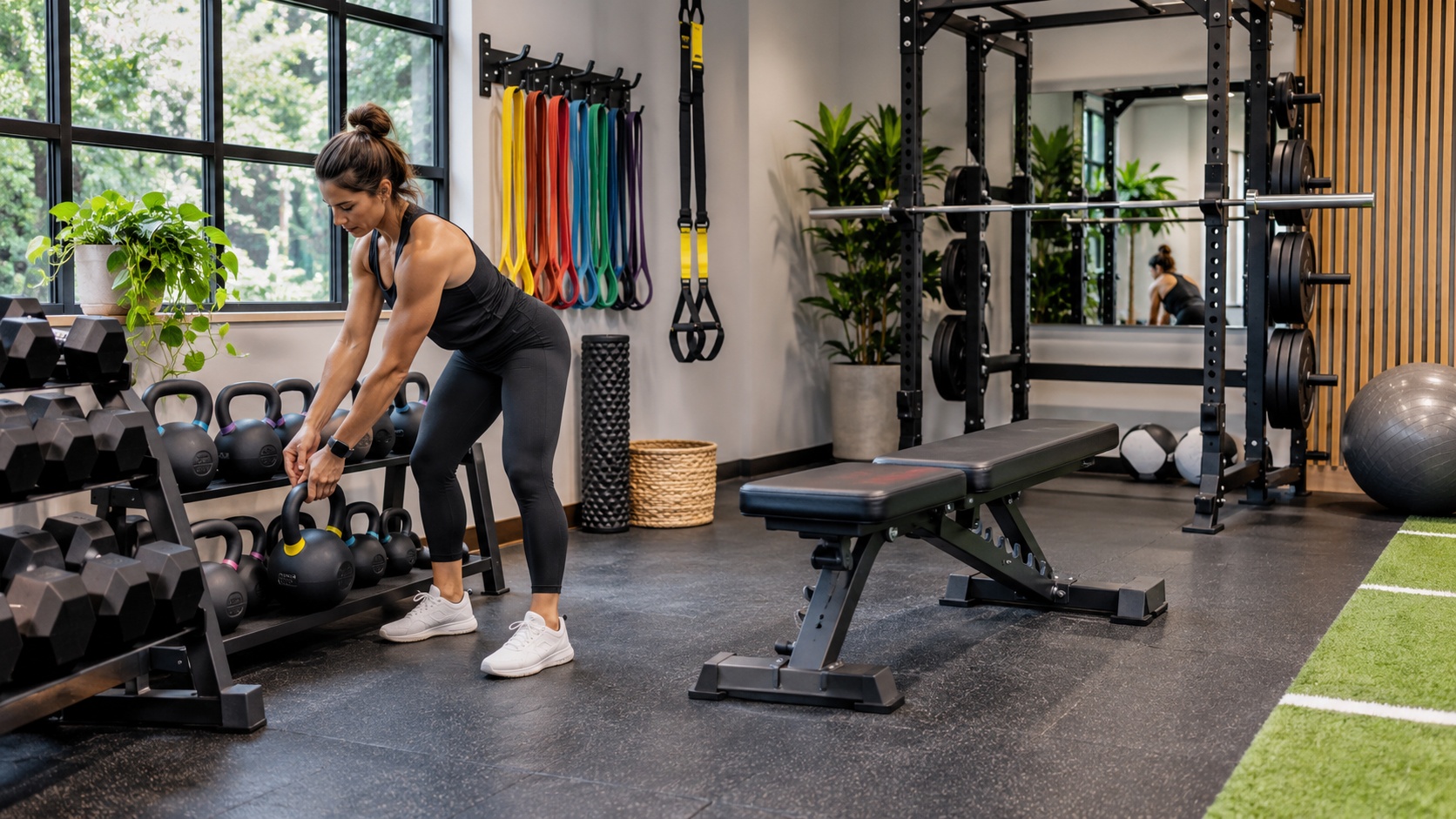
Black Friday represents an interesting opportunity for personal trainers who want to improve their studio's equipment without facing disproportionate investments. However, when available space is limited and every purchase must meet precise operational needs, taking advantage of a discount does not necessarily mean making a good investment. The most effective choice consists of identifying equipment capable of supporting different programs, adapting to diverse clients, and integrating into the daily organization of sessions.
For those managing an individual studio or a micro gym, the search for black friday personal trainer equipment should start with a concrete question: which tools allow the workouts already proposed to be performed better without unnecessarily occupying the available surface area? Dumbbells, benches, barbells, flooring, and storage systems can offer different advantages, but their value depends on the frequency of use and compatibility with the services actually provided.
A professional studio does not necessarily have to replicate the equipment of a large gym. Rather, it must guarantee safe movement paths, equipment adequate to the characteristics of the users, and smooth session management. This guide proposes selection criteria, illustrative scenarios, and a priority matrix to transform seasonal offers into reasoned purchases, avoiding duplications and clutter that could compromise the environment's functionality.
How to evaluate Black Friday for a personal training studio
Seasonal promotions can allow you to purchase equipment already planned in the studio's development plan under more favorable economic conditions. The risk arises when the temporary availability of an offer alters the professional's priorities, pushing them toward products that do not solve any concrete need. In a contained space, even a technically valid tool can become inconvenient if it requires a large surface area compared to the occasions of use.
The starting point should be an evaluation of the existing activity. Which exercises are proposed most frequently? Which tools must be shared among clients with different levels of preparation? Which steps of the session require movements or reconfigurations that slow down work? Answering these questions makes it possible to distinguish a useful purchase from a simple inventory expansion.
A professional approach also considers the total cost of the equipment. In addition to the promotional price, transport, assembly, any compatible accessories, maintenance, and the need to modify the room layout can have an impact. The initial savings must therefore be compared with the actual possibility of integrating the product into daily activities.
Value depends on real usage
Equipment used regularly in strength, mobility, and physical preparation programs may be more interesting than a machine dedicated to a single movement. This does not mean that specialized tools are always less valid, but that their priority must depend on the service model. For a generalist studio, versatility often represents a decisive criterion because it allows exercises to be adapted without multiplying stations.
Why it is not advisable to imitate a large gym
Large-scale facilities must manage numerous users simultaneously and can distribute equipment across specialized areas. A PT studio generally works with different modalities, often through individual sessions or small groups. Professionalism does not depend on the number of visible machines, but on the consistency between programming, available tools, and the quality of organization. An orderly environment, in which each product has a precise function, can effectively support a personalized service.
Start with clients and services actually offered
Before choosing the new personal training studio equipment, it is useful to analyze the composition of the clientele. A studio frequented mostly by beginners might require easily adjustable tools, progressive loads, and free surfaces for bodyweight exercises. An environment dedicated to athletic preparation, on the other hand, might attach greater importance to barbells, plates, and structures capable of supporting exercises with heavy loads.
The evaluation should also consider the characteristics of the sessions. A professional who follows one client at a time can organize a multifunctional station and modify it during the workout. Those who work with two or three people simultaneously must instead provide sufficient tools to prevent waiting and interference between exercises. The same equipment can therefore have a different operational value depending on the number of users present.
A practical method consists of collecting the exercises used in recent weeks and associating them with the necessary tools. This analysis makes it possible to recognize the most requested categories and identify any shortcomings. It is important to distinguish recurring needs from occasional requests, because a single infrequent exercise does not automatically justify the purchase of a dedicated machine.
Classify client profiles
Clientele can be divided into operational groups, such as beginners, people interested in general strength improvement, users who want functional workouts, and athletes engaged in physical preparation. These categories must not become rigid schemes, but they help to understand which movements and progressions are most frequent. If many programs share pushing, pulling, squatting, and stabilization exercises, tools adaptable to such movements deserve particular attention.
Measure exercise frequency
A simple session log can become a decision-making tool. For each equipment category, the personal trainer can note how many times it is used, with which clients, and for what objectives. Complex systems are not needed: a periodically updated table makes it possible to distinguish indispensable tools from marginal ones. The most useful data is not only how many people use a product, but how many exercises and progressions it allows to be managed effectively.
Three practical scenarios for organizing a PT studio
To understand how purchasing priorities change, it is useful to observe some illustrative configurations. The situations described do not represent executive projects and do not establish universal minimum square footage. Rather, they serve to show how the choice of equipment depends on the activity performed, the room layout, and client characteristics.
In every scenario, it is necessary to consider the actually usable surface area, excluding spaces occupied by accesses, furnishings, and passageways. A seemingly large room may offer less freedom of movement than its overall square footage suggests. For this reason, before purchasing a product, it is necessary to check dimensions, operational clearance, and required distances for exercise execution.
The ideal configuration is not the one containing the largest possible number of tools, but the one that allows the professional to move from one exercise to another without compromising safety, order, and supervision quality. The following examples highlight three service models with different requirements.
Scenario 1: Individual studio oriented towards general strength
Let's imagine a room dedicated primarily to individual sessions with clients who have different levels of experience. A setup consisting of dumbbells with adequate loads, an adjustable bench, and a free surface for bodyweight exercises can support numerous progressions. In this context, the priority might be to improve load availability and tool organization, rather than adding a bulky machine used only occasionally.
Scenario 2: Micro studio for functional training
Consider a space used for individual circuits and small groups. The main need is to guarantee fluid movements between stations, preventing tools and accessories from occupying passageways. Dumbbells, kettlebells, compact accessories, and adequate flooring may be more consistent than numerous fixed structures. In this case, orderly storage and quick reconfiguration become purchase criteria as important as exercise variety.
Scenario 3: Studio dedicated to athletic preparation
A personal trainer who works predominantly with athletes might frequently use barbells, plates, and equipment for strength exercises. A structure compatible with the training program may have a higher priority than an extensive collection of small accessories. However, it must be verified that the room allows barbell loading, plate handling, and user work without interference. The suitability of the floor and the technical characteristics of the structure must be evaluated before purchase.
Priority matrix between usage, space, and investment
A decision-making matrix helps compare different products without being influenced exclusively by the discount. The three fundamental criteria are frequency of use, operational footprint, and versatility relative to the services offered. Price enters the evaluation after verifying that the product meets a real need. In this way, the purchase is linked to the studio's operation and not to the perception of convenience generated by the promotion.
To build the matrix, it is possible to assign a qualitative judgment to each equipment piece: high, medium, or low usage; contained, medium, or high footprint; broad, specific, or limited versatility. Evaluations must be personalized, because a barbell can be central for a strength studio and rarely used in an environment dedicated primarily to mobility.
The following matrix presents an example referring to a generalist PT studio with predominantly individual sessions. The classifications are indicative and do not replace the verification of dimensions, loads, and conditions of use reported in the technical sheets of individual products.
| Equipment |
Potential frequency |
Footprint |
Versatility |
Indicative priority |
| Dumbbells |
High |
Contained or medium |
High |
High |
| Adjustable bench |
High |
Medium |
High |
High |
| Adequate flooring |
Transversal |
Dedicated surface |
High |
To be checked immediately |
| Barbell and plates |
Medium or high |
Medium or high |
High |
Linked to services |
| Rack |
Daily for storage |
Variable |
Organizational |
Linked to equipment |
| Specialized machine |
Variable |
Often high |
Specifically targeted |
To be justified |
How to correctly interpret the matrix
A product with frequent use, high versatility, and manageable footprint generally represents an interesting candidate. However, the matrix must not turn into a universal ranking. If a studio already owns sufficient dumbbells, purchasing additional pairs could generate duplications. Conversely, a rack might become a priority when existing equipment occupies surfaces necessary for exercise execution.
Establish a threshold before purchasing
Before Black Friday, the professional can define a simple rule: purchase only products that solve a documented shortage, are compatible with available space, and fall within the established budget. If one of these conditions is missing, the purchase should be postponed. This criterion helps maintain decision-making independence even in front of particularly evident promotions or commercial packages rich in accessories.
What equipment to buy during Black Friday
After analyzing services, observing scenarios, and building the priority matrix, product categories can be evaluated. Micro gym equipment should be selected considering the variety of allowed exercises, load progression, and ease of use during consecutive sessions. The choice must not focus solely on the characteristics of the single tool, but also on its integration with existing equipment.
Dumbbells, benches, and barbells can support numerous exercises, but have different requirements in terms of storage and operational surface. Flooring and racks, while not training tools in the strict sense, affect environment organization. For this reason, it is useful to consider exercise products and room management components together.
An effective purchase should also allow progressions consistent with client characteristics. The availability of appropriate loads, surface stability, and equipment compatibility are aspects to be verified through manufacturer specifications. Promotional offers become truly interesting when they concern products already identified as necessary.
Adjustable or hexagonal dumbbells: which solution to choose
Personal trainer dumbbells represent a particularly versatile category because they allow exercises for upper limbs, lower limbs, and core stabilization. Adjustable models can reduce the number of items to store, but require an evaluation of adjustment mechanisms, available loads, and intended use modes. Fixed-weight hexagonal dumbbells facilitate immediate load selection and can be practical in sessions with frequent changes, while requiring more space when numerous pairs are available. To compare available solutions, you can consult the gym dumbbells category, checking dimensions and model characteristics in relation to studio organization.
Benches, barbells, and plates to expand possibilities
An adjustable bench can support pushing, rowing, and numerous dumbbell-based variants, provided it is used according to manufacturer instructions. Barbells and plates allow load progressions and specific movements, but require sufficient space for preparation, execution, and storage. Before purchasing, it is necessary to check diameter compatibility, declared weight capacities, overall dimensions, and characteristics of any supports. It is not appropriate to choose a set just because it includes many components: each element should find a concrete function in programming.
Floor and racks as organizational tools
PT studio flooring must be evaluated in relation to planned activities, subfloor characteristics, and technical material instructions. Thickness, density, behavior under load, and installation methods are parameters to compare without assuming that every rubberized surface is suitable for any use. Racks help keep dumbbells and plates orderly, but must be sized according to products to contain and permitted weight capacities. Correct arrangement can free up operational surfaces and make session preparation simpler.
Optimizing space, safety, and session management
In a small studio, available space represents an operational resource. It is not enough to verify that equipment physically fits in the room: client movement, the personal trainer's position, and activities required to prepare or put away tools must also be considered. A bench, for example, occupies a larger surface during the execution of certain exercises than when simply parked against a wall.
Design should start from the most frequent movements. Squats, lunges, pushes, pulls, and floor activities require different configurations. It is useful to simulate training sequences and observe where interference occurs between equipment, furnishings, and pathways. This check may reveal that a seemingly compact product requires operational space that is not available.
Safety depends on several elements, including floor conditions, equipment stability, compliance with load limits, and pathway adequacy. Manufacturer technical instructions must be respected and, when necessary, integrated with professional checks related to the environment. No configuration should be based exclusively on indicative dimensions or commercial photographs.
Measure operational footprint and not just static footprint
Before ordering new equipment, it is advisable to plot its dimensions on the room layout and add the space necessary for its use. For a barbell, for example, overall length, plate loading, and planned movements must be considered. For a bench, accessibility, adjustments, and the professional's positioning during assistance must be evaluated. These checks make it possible to identify any critical issues before delivery.
Reduce unnecessary transitions during sessions
A well-organized studio allows transitioning from one exercise to another without constantly moving heavy equipment or searching for accessories scattered around the room. It is useful to place the most used tools in easily accessible positions, keeping pathways clear and providing storage points consistent with workflow. Transition speed must not prevail over safety, but can help make the management of consecutive appointments more orderly.
How to compare offers without buying superfluous products
Black Friday may present discounts on single products, complete sets, and equipment combinations. For a personal trainer, comparison should start from the already defined list of needs, not from the breadth of the promotion. A seemingly convenient bundle might include components that are rarely used or incompatible with those already present in the studio. The value of the offer therefore depends on the share of actually necessary products.
To compare similar alternatives, it is important to examine technical characteristics, materials, use limits, warranty conditions, and availability information. Actual dimensions and declared capacities must be verified in product sheets, avoiding attributing equivalent performance to equipment that shares only a commercial denomination. The possibility of purchasing additional components in the future can also affect the choice.
The promotional price must be read together with overall purchase conditions. Shipping costs, any assembly costs, delivery times, and conditions applicable to returns can alter the comparison between offers. When a product requires special installations or preliminary checks, these aspects must be clarified before ordering.
Compare products through verifiable data
A comparative sheet can include dimensions, equipment weight, declared maximum capacity, materials, available adjustments, and compatibility with other components. For products requiring assembly or fastening, it is important to examine the provided instructions. Comparison must concern specific models and not generic categories, because two benches or two racks can have very different characteristics. When data is not available, it is preferable to request clarification rather than formulate hypotheses.
A set can be interesting when all components respond to already identified needs and are compatible with each other. If instead it includes numerous accessories destined to remain unused, nominal savings risk losing meaning. A practical check consists of comparing the cost of the package with that of only the necessary products, also considering the space required to store them. The goal is not to obtain the largest number of pieces, but to complete functional equipment.
Limited promotions can induce rapid decisions, especially when presented as hard-to-repeat opportunities. To maintain a professional criterion, it is useful to prepare in advance a list of products, indispensable specifications, and maximum budget. During the promotional period, the personal trainer will only need to check whether available offers respect such conditions. This procedure reduces the weight of social comparison and the appeal exercised by particularly flashy equipment.
Planning an investment consistent with studio development
Equipment selection during Black Friday should fit into a broader plan. For a personal training studio, the best investment does not necessarily coincide with the most expensive product or the highest percentage discount. It is the one that allows overcoming an identified operational limit while maintaining compatibility with offered services and available space. This approach allows using promotions as purchasing opportunities without turning them into the primary decision criterion.
An effective sequence involves three checks. The first concerns frequency of use: the product must respond to exercises or activities actually present in programming. The second concerns space: dimensions and operational footprints must be compatible with the room and planned movements. The third concerns investment sustainability: the total cost must fall within available resources without subtracting budget from more urgent needs, such as maintenance, surface adaptation, or replacement of no longer suitable equipment.
It is useful to distinguish immediate purchases from postponable ones. A product needed to complete frequently programmed exercises may deserve priority attention, while specialized equipment destined for a service not yet developed could be introduced in a later phase. Progressive planning allows observing how room usage changes and updating priorities based on concrete experience rather than unverified commercial forecasts.
For those opening a new studio, the same logic suggests building an essential initial setup, first checking compatibility between tools, expected client characteristics, and room layout. For those managing an already established micro gym, however, it may be more useful to intervene on a specific shortage: an incomplete load range, a bench unsuited to proposed programs, or a storage system limiting available surface area. Priorities may change, but the evaluation method remains applicable to both contexts.
Allocate budget according to operational priorities
The budget can be organized into three categories: indispensable equipment for current activity, improvements making session management more efficient, and products destined for any future services. This distinction does not require pre-established percentages, because needs change from one studio to another. Instead, it serves to prevent an interesting but non-urgent purchase from absorbing resources needed for tools used daily. Each item should be accompanied by an operational justification and a check of required technical characteristics.
The final check before confirming the order
Before purchasing, the personal trainer should check that the product is actually necessary, that dimensions are compatible with available space, and that specifications respond to intended uses. Delivery conditions, any assembly requirements, assistance availability, and compatibility with existing equipment should also be verified. If some aspects remain uncertain, requesting technical information before ordering allows making a more conscious decision. A professional studio is built through coherent and progressive choices, in which each equipment piece contributes to supporting daily work without introducing unnecessary clutter or complexity.


 Budgets
 Dumbers
 Discs
 Benches
 Racks and Rigs
 Weights Holders
 Isotonic machines
 Calisthenics
 Cardio
 Kettlebells
 Flooring
 Gym Set
 Accessories
 Combat
 ARTI MARZIALI
 CONTAINER GYM
 Tug-Of-War
 Used Gym Equipment
 PILATES MACCHINARI
 GINNASTICA ARTISTICA
 CAMPI DA PADEL
 Prodotti in Pronta Consegna
 Informazioni
 IRONMAN
 Gift Card