When purchasing new dumbbells for a gym, personal training studio, or equipped home gym, the weight and type of the product are not the only elements to evaluate. Dumbbell handles have dimensional characteristics that can influence the grip style, equipment handling, and compatibility with any accessories. Knowing these measurements allows you to compare different products using verifiable criteria rather than relying solely on photographs or commercial descriptions.
The grip diameter is often the first piece of information to check, but it is not always sufficient to make a choice. The length of the gripping area, surface shape, presence of coatings, and dimensions of adjacent parts can also change the way a dumbbell is used. Furthermore, a measurement stated by the manufacturer must be interpreted correctly: the nominal diameter of a bar does not necessarily coincide with the actual diameter of the coated surface.
For gym managers and personal trainers, well-organized dimensional verification makes it possible to justify purchases, compare alternatives, and document the characteristics of available equipment. This guide proposes an operative method for reading grip dimensions, identifying missing data, and verifying compatibility in the specific context, without assuming that one configuration is suitable for all users or every type of training.
Why check handle measurements
Handle dimensions represent a part of a dumbbell's technical characteristics. Two products with the same nominal weight can have different grips in terms of diameter, length, surface, and arrangement of lateral elements. These differences do not automatically indicate that one model is better than the other, but they make a consistent comparison with planned exercises and the facility's operating conditions necessary.
In a professional gym, dumbbells are often used by different people throughout the day. Equipment consisting of models with very different geometries may require greater attention in selecting tools and communicating characteristics to users. Before standardizing a product line, it is therefore advisable to know the actual dimensions and check whether the differences are relevant for the programmed uses.
Grip measurement also becomes important when the dumbbell must be placed on a support, used with specific accessories, or integrated into existing equipment. In these cases, the handle diameter is only part of the check; the external dimensions of the equipment and the points of contact with the support system can also be decisive.
Why dumbbells of the same weight can have different grips
Manufacturers can adopt different manufacturing solutions for hexagonal, round, adjustable, or modular dumbbells. The geometry of the handle depends on the product design and cannot be reliably deduced from the commercial category alone. For this reason, when comparing models from different brands or series, it is advisable to request the specific measurements of each version.
The context of use changes the necessary checks
A personal training studio that uses a few selected dumbbells may have different organizational requirements compared to a weight room with numerous stations. In the first case, it can be useful to carefully evaluate each tool in relation to the proposed exercises; in the second, dimensional consistency of the equipment and compatibility with storage spaces also become important. Neither scenario alone determines an ideal diameter.
How to read the grip diameter
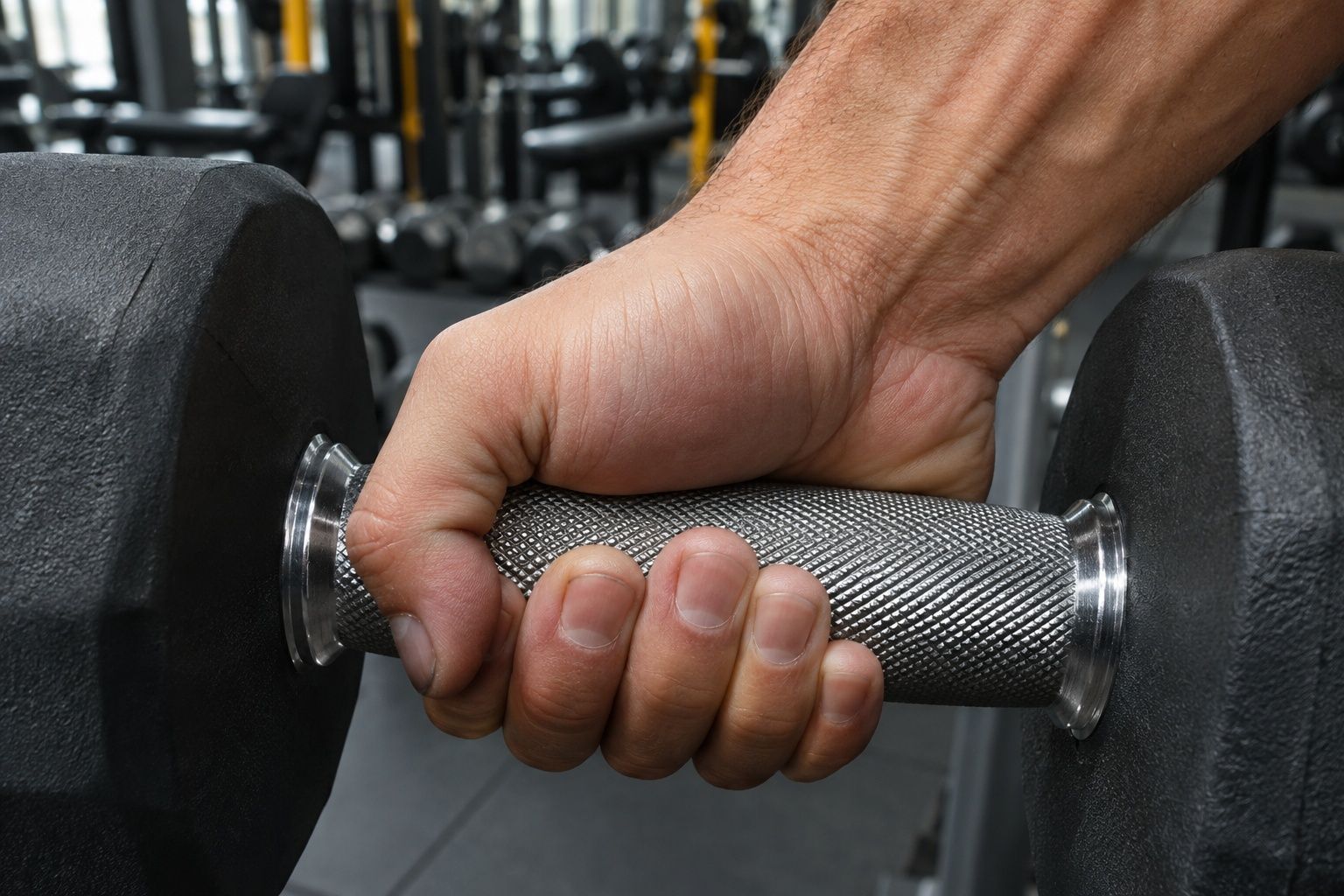
The diameter is the distance between two opposite points of a circular section, measured passing through the center. In the case of a cylindrical handle, this value describes the thickness of the area being gripped. Technical data sheets may report this in millimeters, but you need to check which element it refers to: finished external surface, underlying metal component, or another part of the dumbbell.
When the grip has a non-perfectly circular section, a single value might not completely describe its geometry. Some handles have contoured profiles or variations along their length. In these situations, it is more useful to ask the manufacturer for a dimensioned drawing or take multiple measurements, clearly indicating the points where they were measured.
Diameter should be interpreted as a dimensional characteristic, not as a guarantee of comfort or performance. The relationship between grip size and use also depends on the user's hand, exercise, technique, and surface characteristics. Therefore, there is no universally correct value to apply indiscriminately to all contexts.
Nominal and effective diameter
The nominal diameter is the value used to identify a declared dimension, while the effective diameter comes from measuring the real component. The difference may depend on manufacturing tolerances, the coating, or the measurement point. Before comparing two technical data sheets, it is necessary to ensure that both describe the same surface and use the same unit of measurement.
Where to measure the handle diameter
For a uniform cylindrical grip, measurement can be carried out in the accessible central area, avoiding rounded ends or protruding elements. If the diameter varies along the grip, it is preferable to record at least the dimensions in the various functional areas. Each reading should report the exact position so that it can be repeated or compared with the manufacturer's technical drawing.
Length and other dimensions to check
The useful handle length indicates the space actually available for positioning the hand. It should not be confused with the overall length of the dumbbell, which also includes heads, plates, collars, or other structural elements. A data sheet that only reports the total footprint does not necessarily provide sufficient information to evaluate the gripping area.
The useful length can be bounded by shoulders, fillets, or fastening elements. Furthermore, in modular dumbbells, the configuration of plates and locking systems can modify the spaces available near the hand. It is therefore important to distinguish permanent handle measurements from those that depend on the actual assembly of the tool.
Another element to check is the distance between the gripping area and the lateral parts of the dumbbell. This data can be relevant when performing movements where the heads of the tool approach the body or when accessories that take up space near the grip are present. Evaluation must always refer to the exercise and concrete configuration.
How to identify the space actually available
To determine the usable length, you need to identify the starting and ending points of the surface intended for the grip. Any rounded fillets or changes in diameter must be noted separately. If the manufacturer declares a length without specifying references, it is advisable to request an additional dimension before using the data to compare different models.
External dimensions and equipment footprints
In addition to the grip, it is advisable to record the total length, head width, and geometry of the support surfaces. This information allows you to evaluate the arrangement of dumbbells on racks, shelves, or dedicated stations. A product may have a handle dimensionally suited for the intended use but require further checks to be placed correctly in the available space.
Materials, coatings, and grip geometry
The surface of the handle helps define the contact between the hand and the tool. Grips can feature machined metal, specific coatings, or finishes with different surface characteristics. The choice should not be based solely on visual appearance, because photographs and generic descriptions do not always make it possible to distinguish the actual geometry of the workmanship.
The presence of knurling, for example, introduces a surface structure that can vary in depth, distribution, and design. Two handles both described as knurled are not necessarily equivalent. A reliable comparison requires technical instructions from the manufacturer and, when possible, direct verification of the product.
Coatings also require dimensional attention. If a surface is covered with additional material, the outer diameter may differ from that of the inner component. It is incorrect to automatically deduce the thickness of the coating from the final diameter without knowing the construction characteristics. The useful measurement for the grip is the one referring to the surface actually used.
Knurling and finish characteristics
When comparing knurled handles, it is useful to record the extent of the workmanship and check whether it affects the entire grip or only certain areas. The manufacturer can provide information on the type of finish, while a physical sample allows you to observe the actual characteristics. Subjective impressions must remain distinct from measurable dimensional data.
A cylindrical grip can be described through diameter and length, provided the section is uniform. For a contoured handle, width, height, local diameters, and the position of geometric variations may be needed. The fundamental criterion consists of using a sufficient number of measurements to represent the real surface, without reducing different geometries to a single, uninformative value.
Compatibility with accessories and supports
The compatibility between dumbbells and supports must be verified by considering the parts that actually come into contact. A rack can support dumbbells through the heads, special housings, or other surfaces provided for in the design. Consequently, knowing the handle diameter is not enough to establish whether a given model can be placed on a specific support.
To evaluate a combination, it is necessary to identify the exact model of the dumbbell and that of the support, consulting their respective instructions. Information to compare can include housing dimensions, geometry of support points, center-to-center distances, and declared load limits. Furthermore, dimensional compatibility does not replace the manufacturer's instructions on permitted configurations.
The same attention applies to any accessories applied directly to the handle. An element designed for a cylindrical surface might not be usable on a contoured grip or a special coating. Before considering two components compatible, you must check permitted diameters, fastening methods, conditions of use, and any exclusions reported in the technical documentation.
How to check an existing rack
The procedure begins by identifying the code and model of the support, and then measuring the dimensions of the surfaces intended for support. Subsequently, this data is compared with the dumbbell dimensions. If the documentation does not clarify a specific combination, it is preferable to request confirmation from the manufacturer rather than considering the fact that the tool seems to fit into the housing sufficient.
Accessories applied to the grip
For sleeves, adapters, or other accessories intended for the handle, you must distinguish between the inner diameter of the accessory and the outer diameter of the dumbbell. It is also necessary to check available length, surface characteristics, and installation methods. A numerical correspondence between two diameters alone does not prove that the coupling is appropriate during exercise.
How to compare dumbbells with different measurements
Comparison between products becomes more effective when information is organized into a common sheet. For each model, it is useful to report the outer diameter of the grip, usable length, section shape, surface finish, and overall dimensions. Unavailable information must be explicitly indicated, avoiding replacing it with values estimated from photographs.
Before attaching importance to a dimensional difference, you must define the goal of the comparison. If the priority concerns grip during exercises, diameter and useful length will be central. If instead the purchase serves to complete existing equipment, it may also be necessary to check the continuity of characteristics between products of the same series and compatibility with existing racks.
A transparent comparison does not necessarily require identifying an absolute winner. It can lead to choosing a product for a specific use, requesting further data, or temporarily excluding an undocumented solution. This approach makes it possible to distinguish operational preferences from verifiable technical characteristics.
Preparing a comparative technical sheet
A simple sheet can contain these columns: product code, dumbbell type, grip diameter in millimeters, useful length in millimeters, finish, total footprint, expected accessories, and data source. Adding the date of consultation of the documentation helps reconstruct the comparison if the manufacturer updates the specifications.
Illustrative example with two alternatives
Consider two hypothetical dumbbells: model A features a cylindrical grip with a declared diameter of 28 mm and a useful length of 125 mm; model B features a declared diameter of 32 mm and a useful length of 115 mm. These values are purely illustrative and do not describe Donatif products. The comparison shows that model B has a thicker grip but a shorter gripping area. To choose, it is not enough to observe which measurement is larger: you must verify operational requirements, actual geometry, and any compatibility constraints.
Practical procedure for measuring handles
When the technical sheet does not contain all the necessary information, direct measurement can help clarify the characteristics of the available tool. To measure an accessible outer diameter, you can use a suitable caliper, first checking the condition of the instrument and the selected unit of measurement. The dumbbell must be placed in a stable position, preventing it from moving during the check.
Measurement should be repeated at defined and noted points. On a uniform cylindrical surface, readings in different positions can help identify any variations. In the case of pronounced knurling, deformable coatings, or particular geometries, the result may depend on the method used. It is therefore advisable to describe the instrument and the detection method without attributing a precision to the value higher than what is actually obtainable.
For useful length, instead, the limits of the area intended for the hand are identified, and the distance between these references is measured. If the ends are rounded, a coherent criterion must be established and documented. Readings taken in the gym can be useful for internal comparisons, but they do not automatically replace the manufacturer's official tolerances and specifications.
Instruments and control preparation
A caliper can be used for accessible diameters and distances, while a ruler or rigid tape measure may be suitable for some longitudinal measurements. Before measuring, it is best to clean the surface, identify the model, and check that there are no removable accessories capable of altering the result. Any signs of wear or deformation must be recorded as conditions of the individual specimen.
How to document a reproducible measurement
Useful recording includes the dumbbell code, date, instrument used, measurement position, recorded value, and photographs with visible references. If multiple readings are taken, it is preferable to keep them separate rather than reporting only an average. In this way, it is possible to recognize local variations and subsequently compare the results with official documentation.
Technical checklist before purchasing
Before purchasing new equipment, the gym manager should define which dimensional characteristics are actually necessary. The checklist does not serve to impose a standard measurement, but to prevent a comparison from being concluded based on incomplete data. Each check must have a precise reference: a technical sheet, a dimensioned drawing, a documented measurement, or manufacturer confirmation.
The first group of checks concerns the grip: outer diameter, any section variations, useful length, and surface characteristics. The second concerns the complete product: dimensions, head shape, and presence of elements that limit available space. The third considers integration into the gym, including existing supports, accessories, and planned storage methods.
To concretely apply the method, you can consult the gym dumbbells category and select models to explore further. The information reported in individual data sheets must be verified for each product: presence in a common category does not imply identical dimensions, universal compatibility, or characteristics not explicitly documented.
Checks to perform on product data sheets
The documentary checklist includes exact model identification, availability of grip dimensions, units of measurement, finish description, overall dimensions, and indications on compatible accessories. It is important to distinguish declared data, internally measured dimensions, and information still to be confirmed. If a decisive characteristic is missing, the comparison should remain open until clarification.
Practical check and management of missing information
When a sample is available, accessible dimensions can be checked and compared with declared data, taking applicable tolerances into account. For combinations with supports or accessories, verification must comply with the instructions of the respective manufacturers. If doubts remain about a configuration, it is advisable to request specific technical confirmation and keep it together with the purchase documentation.
How to use dimensional data in investment decisions
The choice of handles should not be treated as an evaluation isolated from the rest of the equipment. For a gym manager, purchasing new dumbbells also means considering continuity with tools already present, station organization, and expected conditions of use. Grip dimensions therefore constitute a set of data useful for the decision, but they do not replace the overall evaluation of the product.
An effective method consists of dividing requirements into three categories: essential characteristics, preferable characteristics, and aspects to be verified. Essential requirements may include measurements necessary for a pre-selected accessory or dimensional constraints of an existing support. Grip-related preferences can instead be evaluated through tests consistent with planned exercises, without transforming individual impressions into general rules.
Technical documentation also makes it possible to avoid incomplete economic comparisons. Two products with different prices might have different geometries, finishes, and compatibility conditions. Before attributing an economic advantage to a solution, it is necessary to check whether both meet the defined requirements. It is not possible to deduce future savings or longer durability from the handle measurement alone.
For a facility intending to progressively expand its equipment, it can be useful to keep an archive of the characteristics of purchased dumbbells. Product codes, photographs, main dimensions, manufacturer documents, and information on supports make it possible to set up subsequent comparisons on a more solid basis. The archive should be updated when models change or new accessories are introduced.
The final decision can be formalized through a short approval sheet reporting the usage scenario, required measurements, considered alternatives, consulted sources, and checks still necessary. This document makes it easier to explain why a certain dumbbell was selected for a specific gym or station. If available information does not allow confirming an important compatibility, the most prudent choice is to complete verification before proceeding with the order.
Investing in coherent equipment primarily means knowing product characteristics and connecting them to the real needs of the facility. A correctly identified diameter, a documented useful length, and punctual control of dimensions offer concrete criteria for comparing alternatives. The value of this approach does not depend on finding a universally better measurement, but on the possibility of making motivated, verifiable decisions referred to the actual context of use.


 Budgets
 Dumbers
 Discs
 Benches
 Racks and Rigs
 Weights Holders
 Isotonic machines
 Calisthenics
 Cardio
 Kettlebells
 Flooring
 Gym Set
 Accessories
 Combat
 ARTI MARZIALI
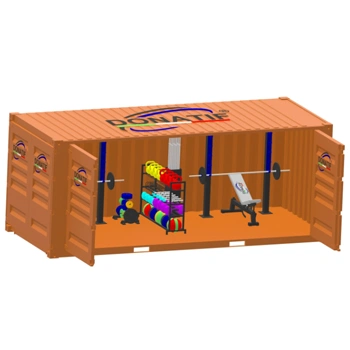 CONTAINER GYM
 Tug-Of-War
 Used Gym Equipment
 PILATES MACCHINARI
 GINNASTICA ARTISTICA
 CAMPI DA PADEL
 Prodotti in Pronta Consegna
 Informazioni
 IRONMAN
 Gift Card