In the world of functional training, the choice of equipment affects session organization, exercise variety, and the ability to tailor work to athletes' characteristics. Among the most widely used tools are kettlebells, available in different structural configurations that meet different needs. One of the most important distinctions concerns traditional cast iron models and so-called competition kettlebells, designed to meet the specific requirements of certain sports disciplines.
Despite the growing popularity of competition models in gyms and functional boxes, their presence is not necessarily a requirement for effective training. The choice depends mainly on the type of activity performed, the technique required, training programming, and users' goals. An athlete practicing a competitive discipline with codified movements may have different needs compared to a personal trainer organizing metabolic circuits, group classes, or general strength programs.
For this reason, before investing in new equipment, it is useful to understand the differences between the two types of tools and, above all, when these differences become truly relevant. In this guide, we analyze practical criteria for choosing between cast iron and competition kettlebells, distinguishing the needs of sport-specific training from those of generalist functional training, with useful indications for gyms, personal trainers, small studios, and advanced home gyms.
Differences between cast iron and competition kettlebells
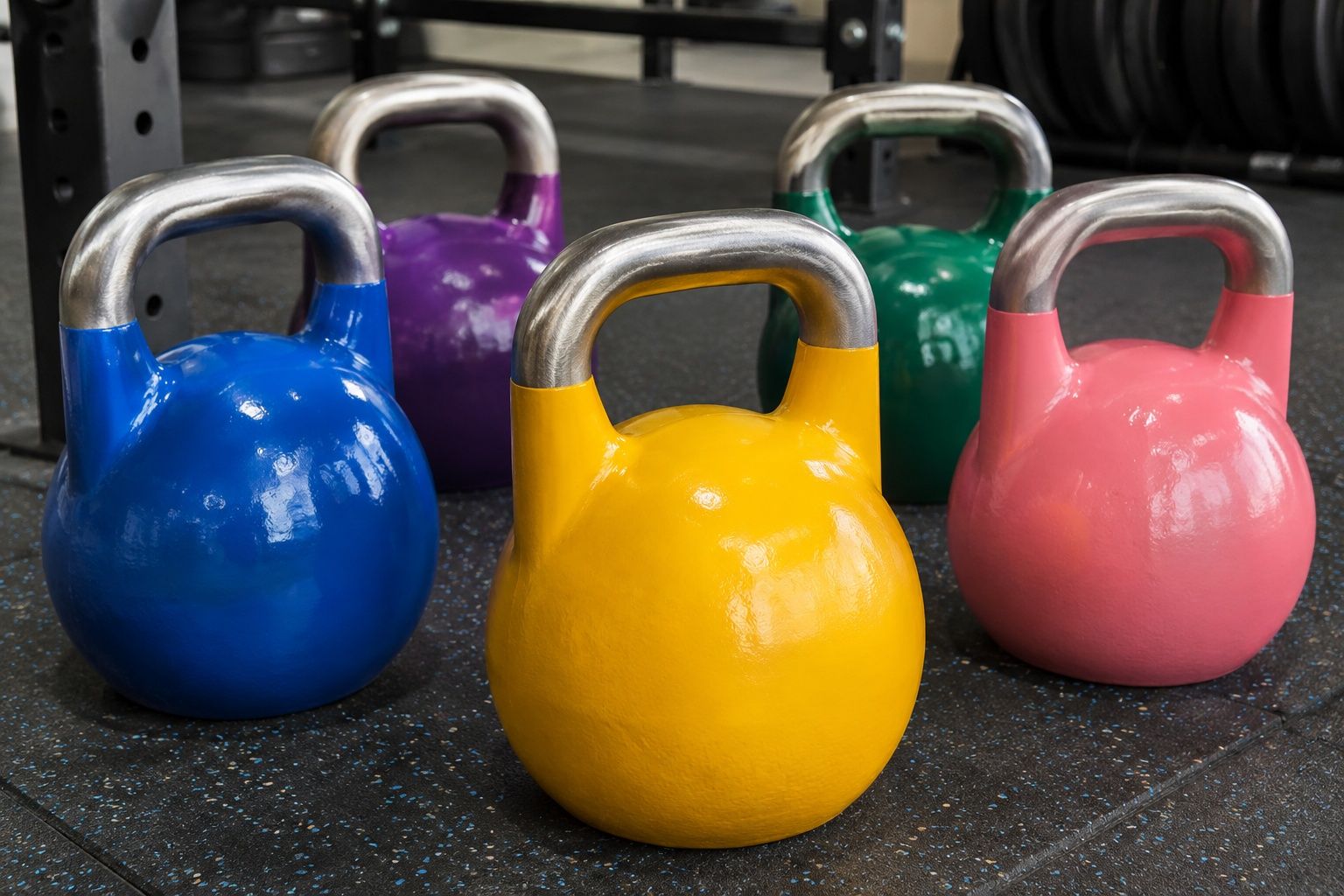
The first distinction to understand concerns the manufacturing philosophy of the two types. The traditional cast iron kettlebell is a tool characterized by a generally compact structure, in which the body and the handle are part of the same assembly. It is a widespread solution in strength training, functional circuits, and activities involving exercises with free loads. Competition models, on the other hand, are developed considering the needs of those who practice specific kettlebell disciplines, where the repeatability of the movement and familiarity with the tool take on particular importance.
This difference does not mean that one type is automatically superior to the other. The two products meet different priorities and can also be used in partially overlapping contexts. For a fitness center, the correct question should not be which kettlebell is the absolute best, but which solution allows the planned activities to be carried out with greater consistency regarding users' needs.
It is also important to avoid choosing exclusively based on appearance. The quality of a tool depends on the actual product features, workmanship, stability, finish, and available technical documentation. When comparing different commercial proposals, one must therefore verify the specifications declared by the manufacturer without attributing characteristics to an entire category that might vary from one model to another.
Characteristics of traditional cast iron kettlebells
Cast iron kettlebells are an established choice for training with free weights. Their configuration allows for ballistic movements, strength exercises, carries, and numerous unilateral variations. In a generalist programming, they can be used for swings, goblet squats, deadlifts, lunges, rows, and presses, offering a versatile solution for individual sessions and circuits. The availability of different loads also makes it possible to organize progressions suitable for people with different levels of experience.
The structure of these tools can vary depending on the manufacturer and the range. Body shape, handle size, finish, and material distribution are elements to check carefully, especially when equipment is purchased for frequent use. It is not correct to presume that all cast iron kettlebells have the same ergonomic characteristics or that their grip is necessarily more suited to every exercise.
Characteristics of competition kettlebells
Competition kettlebells are primarily associated with sports disciplines that use repeated technical movements and codified sequences. Their configuration is designed to offer greater geometric uniformity between different loads, a feature that can be important for athletes who want to maintain familiarity with the tool during progressions. This aspect becomes particularly relevant when the sports practice requires specific management of the grip and positioning of the kettlebell.
Here too, it is necessary to verify the specifications of the individual product. Not all models marketed under the competition name necessarily have the same characteristics or are accompanied by the documentation required for a given competition. For competitive use, the simple commercial description does not replace the verification of the requirements established by the reference sports organization.
When competition kettlebells are actually necessary
The competition kettlebell becomes a particularly sensible choice when training is oriented toward the specific practice of a sport discipline that uses this type of tool. In these contexts, familiarity with the kettlebell's configuration can contribute to the continuity of technical preparation. The athlete does not simply work with a generic overload, but develops motor skills that must be transferred to gestures performed according to defined methods and criteria.
The necessity therefore depends on the relationship between training and sports goals. If an athlete prepares for tests in which tools with defined characteristics are used, regularly training with a different configuration could make the transition to the intended equipment less immediate. In this case, having kettlebells consistent with the practiced discipline represents an organizational and technical choice to be considered carefully.
For a coach training competitive athletes, the choice must also be linked to annual programming. Technical preparation, conditioning work, and competition-oriented sessions may require different equipment. The presence of specific models allows for a more coherent path, avoiding confusing the needs of sports practice with those of general training.
Specific preparation for kettlebell disciplines
In disciplines where the kettlebell is the central tool of performance, the repetition of technical gestures plays a fundamental role. The athlete must learn to manage the grip, the path of the tool, the positioning during work phases, and the continuity of movement. Training with a familiar configuration allows one to focus more on the technical aspects of the discipline, without having to continually adapt the gesture to different characteristics of the tool.
This does not mean that every preparatory exercise must be performed exclusively with a competition model. Accessory work can include different tools, including dumbbells, traditional kettlebells, and other strength equipment. The important distinction concerns the moment when technical specificity takes priority over the simple availability of an overload.
Continuity between training and competition equipment
When an athlete is preparing for a competition, knowing the characteristics of the equipment they will have to use in advance can be an important element of planning. The coach should check the official event guidelines, including any specifications regarding permitted products, loads, and usage methods. One should not rely solely on commercial descriptions or generic information regarding the competition category.
A center hosting competitive athletes can therefore evaluate equipment dedicated to technical sessions, while simultaneously maintaining a selection of generalist kettlebells for other activities. This organization makes it possible to meet the needs of the discipline without turning every purchase into a forced choice. The presence of specific equipment must be proportional to the number of athletes involved and the frequency of specialized sessions.
Functional training and generalist use
In traditional functional training, the kettlebell is often used as a versatile tool within programs that combine strength, coordination, movement control, and physical conditioning. Sessions can include different exercises, timed circuits, individual work, and group activities. In this scenario, the need to use a competition model is not automatic, because the main goal does not necessarily coincide with preparation for a specific competitive discipline.
A personal trainer offering muscle-reconditioning programs, general training, or strength development may find cast iron kettlebells to be an adequate solution for the planned activities. The choice should be oriented toward the availability of loads usable by different clients, grip quality, ease of equipment management, and compatibility with programmed exercises. In many cases, the variety of available weights is more important than the presence of a specific geometry for competition.
The same reasoning applies to small studios and advanced home gyms. When space is limited and the number of users is small, each tool should concretely contribute to training variety. Buying a competition kettlebell just because it is perceived as more professional can translate into a poorly useful expense if there is no real technical need justifying that configuration.
Strength training and metabolic circuits
Kettlebell exercises can be included in numerous general strength programs. Goblet squats, swings, deadlifts, cleans, presses, and carries allow working with different movement patterns and adapting the load to individual capabilities. In metabolic circuits, on the other hand, the same tool can be used to organize sequences that alternate strength exercises and dynamic activities. The type of kettlebell should be chosen considering the characteristics of the movements actually proposed.
When the session involves different exercises and frequent movement changes, the practicality of the grip, ease of positioning, and the possibility of using appropriate loads become important. The coach should also evaluate whether the tool is used predominantly with one hand, with both hands, or in positions requiring specific contact with the body. These operational elements guide the choice much more than the simple commercial classification of the product.
Group activities and personal training
In a group class, the equipment must allow users to perform the same program with different loads. The presence of a balanced range of kettlebells allows the coach to propose variations and adaptations without continuously interrupting the session. For this reason, an investment focused exclusively on specialized models may not represent the most functional solution for a facility that primarily organizes generalist classes.
In personal training, however, the selection can be more targeted. The professional knows the client's technical level, the planned exercises, and the goals to be achieved. They can therefore choose a specific model when there is a concrete motivation, or use a traditional kettlebell when the program's characteristics do not require a competition configuration. Program quality remains the central factor: the equipment must support the work, not determine it without a technical reason.
The shape of the tool and the characteristics of the handle represent important elements in the choice between traditional and competition kettlebells. The relationship between the kettlebell body, the handle, and the load position influences how the user handles the tool during various exercises. However, there is no universally better configuration: comfort also depends on hand size, individual technique, movement type, and athlete preferences.
For a gym that needs to purchase equipment intended for numerous users, it is useful to evaluate these aspects through practical testing. A tool that is comfortable for an experienced athlete might not be equally intuitive for a beginner. The choice must therefore consider the prevailing type of users and the variety of exercises that will be performed daily.
Before comparing models, it is advisable to consult technical datasheets and verify information regarding the handle, finish, body shape, and overall construction. If data is not documented, it is preferable to request it from the supplier rather than deducing it from a photograph or commercial name. An accurate evaluation makes it possible to avoid purchases based on unconfirmed expectations.
The handle during different exercises
The handle is one of the elements that interacts most with the athletic gesture. During a swing, for example, the tool is handled through a dynamic movement requiring a stable grip and adequate control. In exercises such as cleans and presses, however, the way the kettlebell is positioned and the possibility of maintaining a comfortable configuration during movement also take on importance. The choice should therefore start from the exercises that make up the habitual programming.
The evaluation should not be limited to the perceived width of the handle. One must also consider the surface, finish, and the relationship between the grip and the body of the tool. These elements can affect the usage experience, especially during sessions with many repetitions or frequent exercise changes. Direct testing remains one of the most useful methods to verify if the product is consistent with users' needs.
Body shape and kettlebell position
The geometry of the body can influence the positioning of the kettlebell during certain exercises. In activities involving a rack position, for example, the relationship between the tool, forearm, and hand takes on particular importance. Management during dynamic exercises and transition movements can also be conditioned by the product's construction characteristics.
For those practicing generalist functional training, these differences must be evaluated in relation to the exercises actually used. If the program mainly involves swings, squats, deadlifts, and carries, priorities might differ compared to preparation centered on repeated technical movements. It is not necessary to attribute a general advantage to a particular shape: it is more useful to verify compatibility between the tool's configuration and the session's goal.
How to choose the correct weight and type
One of the most important decisions when purchasing kettlebells concerns load selection. For a fitness facility, the availability of weights consistent with users' levels is often a more relevant element than the choice between traditional and competition versions. Well-organized equipment must allow for gradual progressions, individual adaptations, and efficient management of group classes.
The load must be chosen considering the exercise, the number of repetitions, the required technical quality, and the athlete's level of experience. A weight suitable for a swing might not be appropriate for a press or an exercise requiring more precise movement control. For this reason, the coach should avoid identifying a single ideal load for all exercises or all users.
Choosing the type should follow the same logic. First, goals and exercises are defined, then it is verified which tool configuration best meets operational needs. This avoids purchasing specialized products without a real need or neglecting more specific equipment when sports preparation requires it.
Load progression and technical level
A well-structured training program provides progression compatible with the athlete's capabilities. For beginners, the priority often consists of learning movements and controlled load management. More experienced users can instead work with more articulated progressions, varying intensity, volume, and exercise complexity. The availability of different weights allows work to be adapted without continually modifying the session structure.
For fitness centers, it is useful to analyze which load ranges are used most frequently and by which categories of users. Balanced equipment avoids concentrating the budget on a few infrequently requested models and makes it possible to meet the needs of most clients. The presence of specialized equipment can be added when there is concrete demand tied to competitive preparation.
Checking specifications before purchase
Technical datasheets are an essential tool for comparing products belonging to the same category. In addition to the declared weight, it is advisable to verify available information on construction, finish, handle characteristics, and conditions of use provided by the manufacturer. The quality of information provided by the seller is also an element to consider, especially when the purchase involves equipment intended for professional use.
When evaluating a competition model for competitive preparation, it is also necessary to verify compatibility with the requirements of the specific discipline and event. One must not presume that every product defined as a competition model is automatically compliant with any regulation. For other uses, however, choice can focus more on manufacturing quality, practicality, and consistency with programmed exercises.
Dumbbells and kettlebells in functional programming
The choice between dumbbells and kettlebells represents a further element to consider when organizing equipment for functional training. The two tools allow for numerous exercises with overloads, but have different characteristics that can make them more or less suitable for certain activities. For a fitness center, it is not necessarily a matter of choosing one tool over the other, but rather of understanding how to integrate them into programming.
Dumbbells allow working with loads distributed along a central handle and are used in strength exercises, unilateral work, pushing, and pulling movements. Kettlebells, thanks to their configuration, also allow for dynamic and ballistic exercises that are part of many functional programs. The presence of both types broadens work possibilities and allows the coach to choose the tool based on the movement to be trained.
Equipment composition should therefore start from analyzing the programs actually proposed. If the center mainly organizes circuits with general strength exercises, having a selection of dumbbells and traditional kettlebells can be useful. If, on the other hand, a significant part of activities is dedicated to specific preparation with kettlebells, it may be appropriate to also include competition models. The choice must reflect the actual distribution of activities, not a market trend.
When to favor dumbbells
Dumbbells are particularly versatile in pushing, pulling, and unilateral work exercises. They can be used for chest presses, rows, shoulder presses, lunges, and numerous variations of exercises for the upper and lower limbs. In generalist programming, they represent an important tool because they allow load management independently between the two sides of the body and offer variations suitable for different levels.
For a gym, the availability of dumbbells in different weights makes it possible to build complete training paths without always having to rely on the same tools. It is therefore useful to evaluate overall equipment before investing in additional specialized kettlebells. A well-planned purchase should help expand the center's operational possibilities, avoiding poorly functional duplications.
When to integrate kettlebells
Kettlebells find space especially in programs including ballistic movements, carries, and motor patterns that exploit the tool's particular configuration. Swings, goblet squats, cleans, presses, and carries are examples of exercises that can be included in individual sessions or circuits. Their versatility makes them interesting for coaches who want to combine strength work and dynamic activities.
To choose the most suitable products, it is useful to consult a specialized range of kettlebell equipment, comparing features and availability of different models. An effective selection should include tools consistent with the average user level and planned exercises. The presence of competition models can complete the equipment when the center proposes specific activities, without becoming a requirement for every functional program.
Equipment for gyms, personal studios, and home gyms
Purchasing needs change significantly depending on the facility that will use the tools. A commercial gym must consider the number of members, frequency of use, and variety of activities proposed. A small personal studio generally works with a smaller number of users and can afford a more targeted selection. A home gym, on the other hand, must balance variety, available space, and overall investment.
These differences make it impractical to apply a single purchasing model to all situations. Equipment intended for a facility organizing functional training classes must meet different needs compared to a center specialized in preparing kettlebell sport athletes. In both cases, the central criterion remains the relationship between purchased equipment and activities actually performed.
Before proceeding with the order, it is advisable to inventory tools already present, identify any shortcomings, and define which exercises must be supported by the new equipment. This method avoids impulse purchases and concentrates the budget on equipment that will see concrete use. The choice between cast iron and competition should be just one part of this overall evaluation.
Organizing equipment for a box or gym
In a facility with multiple simultaneous users, load availability must be proportioned to class composition and program types. If classes involve different exercises and progressive difficulty levels, having multiple weights of the same type can be useful. The presence of an adequate range facilitates group management and reduces the need to continually modify programming based on available equipment.
For a box also offering competitive preparation, the solution may consist of generalist equipment flanked by a specialized selection. This way, users following ordinary programs can use versatile tools, while athletes preparing for a specific discipline have tools consistent with their needs. Separating the two usage areas also makes planning purchases over time simpler.
Choices for small studios and advanced home gyms
In a small personal studio, available space and the number of clients represent two decisive variables. A limited but well-studied selection can be more useful than a large quantity of tools used rarely. The professional should identify main exercises, evaluate necessary loads, and choose products allowing work with clients of different levels.
In advanced home gyms, however, choice also depends on the user's specialization. Those practicing functional training to stay in shape may find a selection of traditional kettlebells and dumbbells sufficient. Those preparing for competitions or dedicating an important part of their training to kettlebell sport might instead have concrete reasons to purchase competition models. In both cases, space availability and usage frequency should guide the investment.
Investment criteria and equipment selection
Purchasing kettlebells for a professional facility means evaluating not only the initial price, but also the overall quality of the equipment and its ability to meet operational needs over time. A tool used daily by numerous clients must be chosen considering construction, declared characteristics, management practicality, and support conditions eventually offered by the supplier. Economic comparison should therefore be accompanied by technical specification analysis.
Another important element concerns expected usage frequency. If competition kettlebells are used only during a few specialized sessions, purchasing a limited number of units might be sufficient. If, on the other hand, the center proposes dedicated classes with continuity, broader equipment can be justified. The same logic applies to traditional models, which can represent the basis of equipment when generalist functional training constitutes the main activity.
To make a rational decision, it is useful to distinguish necessary purchases from simply desirable ones. Specialized equipment can certainly enrich a gym's offering, but its value depends on the possibility of using it concretely. A well-planned investment considers the number of interested users, planned activities, available space, and consistency with the facility's commercial strategy.
Comparing equipment value over time
Purchase price is not the only parameter to consider. For a gym, construction quality, availability of technical information, ease of equipment organization, and the possibility of subsequently expanding the range also take on importance. A product suitable for planned activities can offer greater operational value than a more specialized model remaining unused for most of the week.
Comparison should also consider consistency among purchased products. Having tools with well-documented characteristics and loads suitable for users facilitates daily management and allows coaches to program work with greater precision. When purchasing multiple units, it is useful to maintain homogeneous selection criteria and verify that commercial information is sufficiently detailed.
A decision based on real goals
To choose between cast iron and competition kettlebells, the starting point should always be the intended use. If the facility proposes generalist functional training, metabolic circuits, and strength work, there is no automatic reason to favor competition models. If instead it hosts athletes practicing specific kettlebell disciplines, the availability of tools consistent with technical needs and event requirements can become an important part of preparation.
An effective approach consists of first defining main activities, identifying most frequent exercises, and verifying which tool characteristics are truly necessary. Subsequently, available products are compared, checking weight, handle, geometry, finish, and manufacturer documentation. This process allows for conscious choices without attributing universal advantages to a category that instead depend on the usage context.
For gym owners, personal trainers, and enthusiasts planning a home gym, the best choice is therefore one maintaining a balance between specialization and versatility. Competition kettlebells have a precise function when training requires familiarity with tools specific to a sports discipline. For many functional training activities, however, traditional cast iron models can adequately meet daily needs. Investing rationally means purchasing what is truly needed, letting training goals and documented product characteristics guide every decision.


 Budgets
 Dumbers
 Discs
 Benches
 Racks and Rigs
 Weights Holders
 Isotonic machines
 Calisthenics
 Cardio
 Kettlebells
 Flooring
 Gym Set
 Accessories
 Combat
 ARTI MARZIALI
 CONTAINER GYM
 Tug-Of-War
 Used Gym Equipment
 PILATES MACCHINARI
 GINNASTICA ARTISTICA
 CAMPI DA PADEL
 Prodotti in Pronta Consegna
 Informazioni
 IRONMAN
 Gift Card


Comments (0)