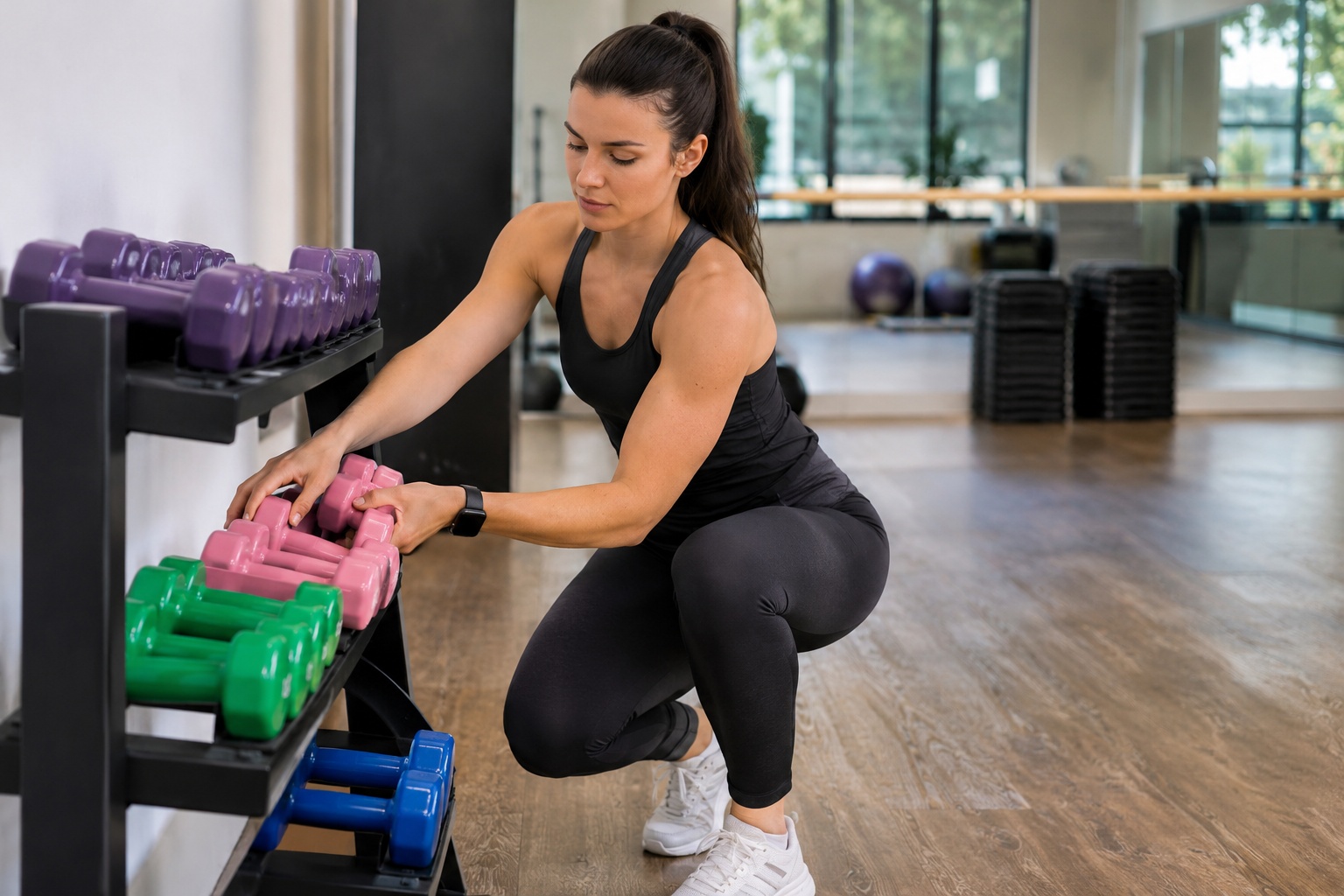
Managing dumbbells before and after a group fitness class is an organizational aspect that directly impacts gym operations. When multiple participants share the same space and use equipment during a collective session, weight distribution, collection at the end of the activity, and subsequent cleanup must follow a clear procedure. Without defined organization, even adequate equipment can become difficult to manage, especially when classes run back-to-back with short intervals.
For a fitness center manager and group fitness coordinator, the problem is not simply making a certain number of dumbbells available. It is necessary to establish which tools are needed, where to place them, how to assign them to participants, and who is responsible for their return. The procedure must also be consistent with the layout of the room, the type of class, and the characteristics of the inventory actually available.
In this guide, we analyze how to organize dumbbells before and after a group fitness class through a reproducible operational workflow. The goal is to help instructors and managers define a method for distribution, collection, and cleanup based on verifiable data, avoiding standard quantities unrelated to the facility's needs. We will see what information to collect, how to handle different operational situations, and what checks to perform to improve organizational continuity between one session and the next.
Table of contents
Analyze the available dumbbell inventory
The first step is to accurately know the equipment present in the facility. Before defining a distribution procedure, it is necessary to check how many dumbbells are available, what loads they represent, and what condition they are in. An updated inventory makes it possible to distinguish theoretical availability from actual availability, also considering equipment that is temporarily unusable or engaged in other activities. This check forms the basis for establishing whether the existing inventory is consistent with the group fitness schedule.
Knowing the total number of dumbbells is not enough. Two rooms could have the same amount of equipment but very different needs depending on the classes organized. A session with exercises requiring different loads may require more structured distribution than an activity where everyone uses the same type of equipment. For this reason, the inventory should also report available variants and their actual intended use.
It is useful to prepare an internal table showing quantities, types, loads, locations, and condition of the equipment. This information allows the instructor to know operational possibilities in advance and the purchasing manager to identify any shortages. The documentation must reflect the actual situation of the gym and not contain hypothetical quantities or availability not yet verified.
Inventory dumbbell quantities and variants
The census should distinguish dumbbells based on the characteristics actually present in the inventory. It is possible to organize the inventory by load, model, or other characteristics useful for quickly identifying each group of equipment. When different products are present, it is advisable to avoid considering them automatically equivalent: dimensions, grip, and storage methods can change and influence practical management during the class.
A simple register, updated after purchases and periodic checks, reduces the risk of scheduling a class based on equipment that is not actually available. The same documentation can be used to compare the requirements of different group activities and verify which variants are actually used.
Compare inventory and number of participants
The number of registered members or the theoretical capacity of the room do not necessarily represent the number of people using dumbbells during each session. Actual attendance, how the class is conducted, and any rotation in equipment use must be considered. The comparison between participants and inventory must therefore be made taking the concrete schedule of the course as a reference.
If a class requires all participants to use dumbbells simultaneously, the requirement will be different from an activity organized with rotations or stations. This distinction helps avoid both insufficient equipment and unjustified purchases. Requirements must be documented for each type of class, without turning the data from a single course into a rule valid for the entire gym.
Prepare the room before class
Once equipment availability has been verified, the next step is to prepare the room. Dumbbell placement must be consistent with the available space, the expected number of participants, and the exercise organization. The goal is to make the necessary equipment identifiable before the session begins, preventing instructors and participants from searching for them during the early stages of the class.
Preparation should follow a stable sequence. Staff checks the inventory, selects the variants required by the program, and places them in designated distribution areas. Placement must take into account access paths and the spaces actually used to perform exercises. There is no universal layout applicable to all rooms: the solution must be evaluated based on the floor plan, existing equipment, and planned activities.
It is also important to consider the available time between two consecutive classes. A preparation procedure that is too complex may be difficult to apply when the previous activity ends shortly before the next group arrives. Organizing operations in advance and assigning a recognizable location to the different dumbbells makes work more predictable and reduces improvised activities.
Identify distribution areas
The room can be organized with recognizable distribution points chosen based on the space layout. In some facilities, it may be practical to set up a central zone, while in others, it may be preferable to place equipment near workstations or along a dedicated area. The choice must consider the movement of people and the need to keep areas used during workouts accessible.
To avoid confusion, each area should have a precise and recognizable function. If multiple load variants are used, their placement must allow them to distinguish them without repeatedly checking each individual tool. Internal signage can also help make the identification of different categories more immediate, as long as it is consistent with the actual inventory.
Prepare dumbbells according to the class schedule
Preparation must start from the session sheet or instructor instructions. Before participants arrive, it is advisable to check which dumbbells will be used, if alternatives are planned, and if the activity requires load changes during the session. In this way, equipment selection stems from a concrete need rather than a standard arrangement that may not match the program.
When the class includes multiple exercises, it is useful to distinguish the equipment needed at the beginning from those that might be needed later. The decision depends on the structure of the session and available space. Orderly preparation allows the instructor to focus on conducting the class while still maintaining the ability to modify the layout when needs arise that differ from those initially planned.
Organize dumbbell distribution to participants
Distribution represents the moment when equipment availability turns into actual allocation. To manage this correctly, it is necessary to establish how participants receive dumbbells, who coordinates the operation, and what instructions are provided before class starts. The procedure can change based on group size, room layout, and the presence of dedicated staff.
A first alternative is to allow participants to independently retrieve equipment from designated areas. This model requires the layout to be intuitive and variants to be easily recognizable. Another possibility is to entrust distribution to the instructor or an assistant, especially when the program requires a specific selection of dumbbells. The choice must take into account available time and the facility's operating procedures.
The procedure should be communicated with simple and consistent instructions. Participants must know where to find the equipment, how to identify those planned for the session, and where to put them back when no longer in use. If substitutions are planned during class, it is also necessary to explain how to manage changes, preventing used dumbbells from being left in positions other than established ones.
Choose between independent and assisted distribution
Independent distribution may be suitable for groups and activities where participants can easily identify planned variants. In this case, organizational quality depends above all on the clarity of the layout and instructions. Pickup areas must be easily identifiable, and the procedure must make it clear where to find and return each category of equipment.
Assisted distribution may instead be more consistent with classes requiring specific distribution or where the instructor prefers to directly control selection. In this scenario, it is necessary to consider the time required to serve all participants and the availability of assistants. No single model can be declared the absolute best: the choice must be verified in relation to the number of people, the program, and staff organization.
Manage substitutions during class
Some classes may involve changes of equipment or load during the session. To manage these situations, it is useful to define in advance where to place dumbbells no longer needed and how to make those required for the next exercise available. The procedure must prevent substitutions from turning into a series of uncoordinated movements that are difficult to reconstruct at the end of the activity.
The instructor should clearly indicate when to make the change and where to place temporarily unused equipment. If the program does not include a substitution, there is no need to set up an additional step. The procedure must remain proportional to the real needs of the class and not introduce operations that increase complexity without providing a verifiable organizational advantage.
Define dumbbell collection after class
The end of class does not automatically coincide with the completion of equipment management. Dumbbells must be collected and returned to a condition that allows them to be used again. For this reason, collection should be considered an autonomous phase of the operational workflow, with a defined sequence and recognizable responsibilities.
The first element to establish is who coordinates the return. In some gyms, the instructor can directly handle instructions for participants, while in others, support from an assistant or floor staff may be provided. It is important that the task is explicitly assigned, avoiding everyone assuming someone else will take care of the equipment.
Collection must also provide a recognizable destination for the various variants. Dumbbells should not be left in random spots around the room waiting to be put away. A temporary collection zone can be useful when final cleanup is not immediately possible, but it must be distinct from walkways and workstations intended for the next class.
Define the return sequence
An effective procedure establishes how equipment is returned and what steps must be completed before the room is considered ready for the next session. The sequence can include collection by category, separation of different variants, and transfer to respective storage areas. The choice must be compatible with space and staff working methods.
If participants independently return dumbbells, precise instructions must be provided regarding final placement. If collection is handled by staff instead, it is advisable to define who performs the count and who checks that no equipment remains in various zones of the room. Repeatability of the sequence is more important than its complexity: a simple procedure applicable with continuity is more useful than an intricate system followed only occasionally.
Check equipment after use
Collection also represents an opportunity to observe the condition of the inventory. Staff can visually verify that dumbbells are intact and identify any anomalies encountered during the class. If a tool presents a problem, it is advisable to separate it from ordinarily available inventory and follow the internal procedure established for reporting and verification.
The check must not turn into an improvised technical inspection. Verifications must be consistent with manufacturer instructions and procedures adopted by the facility. Recording anomalies prevents a problem detected during a class from being forgotten before the next session and allows managers to evaluate any interventions.
Manage cleanup and storage
Once collected, dumbbells must be put away in an orderly manner consistent with the inventory layout. Cleanup is not just an aesthetic activity: it allows you to know what equipment is available, easily identify different variants, and prepare the room for subsequent uses. To achieve this result, it is necessary to establish a recognizable location and maintain it over time.
Storage solutions must be evaluated considering quantities, dumbbell characteristics, and available space. A facility with numerous variants may need more detailed subdivision compared to a room with limited inventory. Usage frequency is also an element to consider: equipment regularly used in classes may require a different placement than those intended for occasional activities.
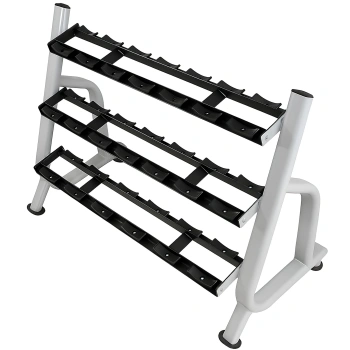
The choice of storage equipment must be compatible with products actually present. Racks, supports, and other solutions must not be considered interchangeable without verifying dimensions, capacity, and usage methods. Before introducing a new storage system, it is therefore advisable to consult product technical specifications and compare them with gym inventory.
Choose a stable layout
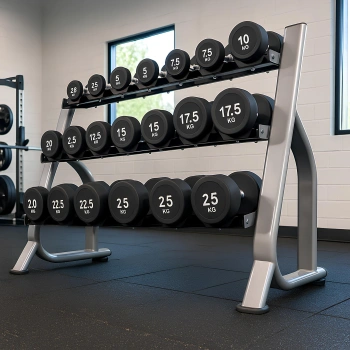
A stable layout allows instructors and assistants to quickly recognize the intended position for each dumbbell category. Subdivision can follow load, model, or an operational criterion chosen by management. The important aspect is that the criterion is understandable and applied uniformly by everyone involved in room management.
When inventory includes products of different sizes or shapes, it is advisable to verify that the support is compatible with each model. One should not assume every dumbbell can be placed on the same rack or that stated capacity applies to any configuration. Manufacturer information must be the reference for evaluating storage solution suitability.
Keep the operational storage area tidy
Storage should reflect the same logic used for inventory. If dumbbells are registered by category, their placement should make the correspondence between document and physical position immediate. This way, staff can more easily verify availability and identify any differences between recorded and real situations.
It is useful to schedule periodic checks, especially in facilities where dumbbells are moved between rooms or used for different activities. Management can compare inventory with present equipment and update information when tools are purchased, replaced, or retired. An orderly storage system thus becomes an integral part of fitness center resource management.
Assign responsibilities and handle unexpected issues
A distribution, collection, and cleanup workflow only works if involved personnel know their role. Even a well-designed layout can become ineffective when it is unclear who must prepare equipment, who must provide instructions to participants, and who must verify returns. The gym should therefore translate the procedure into concrete tasks consistent with staff organization.
Responsibilities can be distributed among group fitness coordinators, instructors, and assistants based on available resources. There is no need to create a complex organizational structure: it is sufficient to identify a point person for each phase and establish who to contact for problems. This clarity reduces overlaps and makes it easier to identify the process point requiring intervention.
The procedure must also consider unexpected events. Higher-than-expected attendance, an unavailable dumbbell, or a schedule change can alter initially planned distribution. To address these situations, it is useful to establish in advance which alternatives are actually available and who can authorize a modification to class configuration.
Define staff tasks
Room managers can handle overall inventory availability and updates. Instructors can communicate specific class needs and coordinate distribution during the session. An assistant, when present, can support preparation and cleanup. This is one possible division, to be adapted to the size and actual organization of the facility.
To avoid ambiguity, each activity should have a clearly identified point person. If one person is responsible for preparation but not final verification, this distinction must be known to those managing the class. Staff substitutions must also be considered: a written and accessible procedure ensures consistent organization when staff members change.
Provide operational alternatives
Alternatives must be based on truly available resources. If a specific dumbbell variant is missing, for example, the instructor should know what program modifications are permitted and what tools can be used as substitutes based on class characteristics and their own competence. Automatic substitutions should not be introduced simply because two products look similar.
If the number of participants changes compared to forecasts, distribution may require revision. Management must be able to quickly check remaining availability and decide whether to modify the layout, use a pre-arranged rotation method, or review session organization. Recording recurring unexpected events also helps understand whether the problem depends on planning, inventory, or the distribution procedure.
Verify and improve the operational workflow
A procedure should not be considered final just because it has been written and communicated to staff. It is necessary to verify whether it is actually applied and meets the needs of different classes. Evaluation can start by observing preparation, distribution, collection, and cleanup phases, noting steps requiring more interventions or generating recurring difficulties.
Verification must be based on observable elements. Missing equipment during preparation, requested substitutions during class, anomalies noted during collection, and inventory discrepancies can all be recorded. These data do not automatically prove whether a procedure is effective or ineffective, but they help identify where to deepen analysis and what modifications to subject to re-verification.
It is important to distinguish occasional problems from recurring ones. A single variation in participant numbers might only require a session adjustment, while frequent unavailability of the same dumbbell category might indicate planning or inventory issues. Management should document observations and evaluate modifications in relation to specific facility conditions.
Use an operational checklist
A checklist makes main steps verifiable without relying exclusively on staff memory. It can be organized into three moments: before class, during distribution, and at the end of the session. Each item must describe concrete verification, avoiding generic formulations that do not clarify whether an activity was actually completed.
Before the course, one can verify dumbbell availability, program correspondence, and preparation of distribution areas. During the session, one can check that substitutions follow instructor instructions. At the end, one verifies that equipment has been collected and put away, and that any anomalies have been reported. The checklist can be paper-based or digital, as long as it is easily accessible to those who need to use it.
Analyze recurring difficulties
When the same difficulty occurs multiple times, it is useful to trace its origin before modifying the procedure. If participants do not easily locate equipment, it may be necessary to revise signage or variant layout. If cleanup requires repeated interventions, one must check whether final placement is consistent with dumbbell number and characteristics.
Consultation with instructors and floor staff gathers observations from different operational phases. Indications must be compared with inventory and real facility conditions, distinguishing individual preferences from documentable problems. A modification should be introduced when a concrete motivation exists and subsequently verified to understand if it actually improved the process.
Evaluate inventory and plan the investment
Dumbbell management in group classes can highlight needs for purchases, replacements, or space reorganization. Before allocating a budget to new equipment, it is important to understand whether difficulties truly depend on insufficient inventory or inefficient distribution of what is already available. This distinction prevents automatically attributing every organizational problem to the need to purchase other products.
Economic evaluation should start from data collected during classes. Participant numbers, requested variants, usage frequency, and actual availability constitute useful information to justify a decision. If a specific shortage emerges, management can identify what characteristics new equipment must have and compare available solutions based on respective technical sheets.
To explore the characteristics of available equipment, you can consult the gym dumbbells category, using product information as a basis to verify compatibility with facility needs. Comparison should consider individual model characteristics, load variants, and planned management methods. One should not assume products belonging to the same category are automatically equivalent or compatible with any storage system.
Evaluate new purchases with verifiable data
A purchase request should indicate the problem it aims to solve and necessary characteristics to do so. If inventory shows a certain variant is frequently requested but unavailable in sufficient quantities for the class program, this information can become the starting point for evaluation. If the problem instead concerns difficulty locating equipment or their placement, intervening in room organization might be more appropriate.
Product comparison must include actually available technical information without deducing performance, durability, or compatibility from undocumented characteristics. It is also useful to check assistance conditions and availability of information regarding management and maintenance. The final decision should be motivated by concrete operational needs and not solely by the quantity of products included in an offer.
Consider ongoing management costs
Initial price represents only part of the evaluation. Space needed to store equipment, control activities, inventory management, and potential replacement interventions also impact overall organization. A seemingly affordable product might not be the most consistent choice if it does not meet gym operational needs or requires storage methods incompatible with existing spaces.
Planning should also consider the possibility that participant numbers or activity programs change over time. This does not mean proactively purchasing equipment for every conceivable scenario, but evaluating which developments are supported by facility data and which characteristics can keep inventory consistent with planned activities. A documented choice allows alternatives to be compared and clearly explains investment reasons.
For a gym manager, properly organizing dumbbells before and after a group fitness class means turning a series of daily operations into a controllable process. The most useful decision stems from integrating inventory, class schedules, participant numbers, space layout, and staff responsibilities. Defining these elements establishes a concrete procedure, verifies its application, and enables intervention when recurring difficulties arise. Before expanding inventory, it is therefore advisable to document real requirements, compare product characteristics, and verify storage solution compatibility, thereby allocating budgets to interventions motivated by the facility's actual needs.


 Budgets
 Dumbers
 Discs
 Benches
 Racks and Rigs
 Weights Holders
 Isotonic machines
 Calisthenics
 Cardio
 Kettlebells
 Flooring
 Gym Set
 Accessories
 Combat
 ARTI MARZIALI
 CONTAINER GYM
 Tug-Of-War
 Used Gym Equipment
 PILATES MACCHINARI
 GINNASTICA ARTISTICA
 CAMPI DA PADEL
 Prodotti in Pronta Consegna
 Informazioni
 IRONMAN
 Gift Card