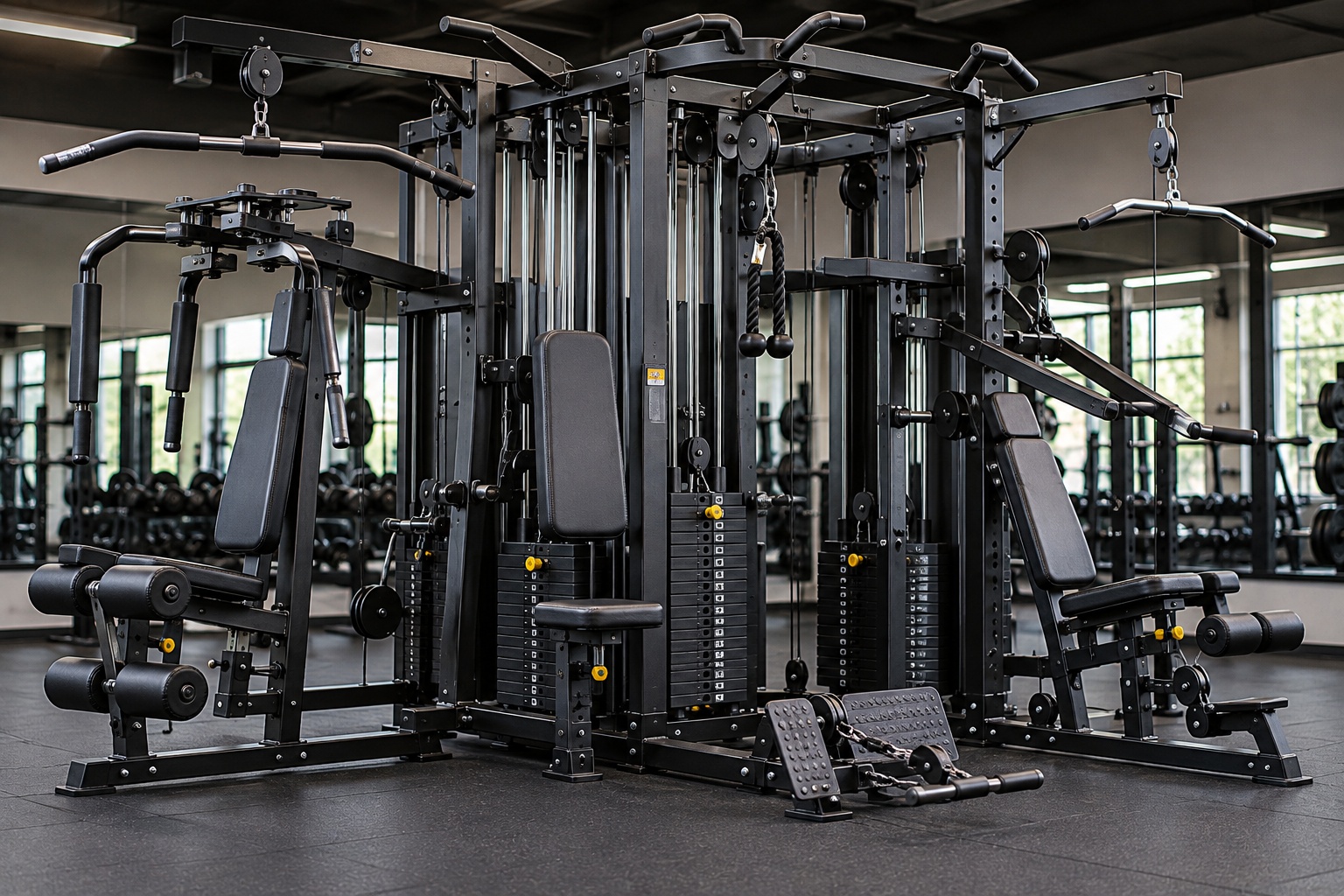
A jungle machine intended for a bodybuilding-oriented gym should offer a robust structure, multiple workstations, intuitive adjustment systems, and a configuration that allows continuous use during peak hours. The choice must be made by evaluating verifiable criteria such as the number of stations, build quality, modularity, maintenance, and compatibility with the weight room layout.
In bodybuilding, multi-station machines are often used to organize individual workouts, supersets, and circuits, reducing movement between different equipment and improving the management of user flows. For this reason, the design of the workstation is just as important as the features of the machine.
This guide analyzes the main requirements of a bodybuilding jungle machine, illustrating how to evaluate it before purchase and which aspects to consider during daily use.
What requirements must a bodybuilding jungle machine have?
A machine intended for intensive use should guarantee stability, ease of adjustment, and accessibility to the various workstations.
Aspects to check include frame quality, number of stations, ease of maintenance, availability of spare parts, and completeness of technical documentation.
A well-designed configuration also facilitates user management during peak hours.
Why is the frame important?
A rigid structure helps maintain consistent machine behavior during frequent and continuous use.
How much does modularity matter?
A modular configuration can make it easier to adapt the equipment to future organizational needs of the gym.
How to choose the most suitable configuration?
The configuration should be defined by considering the number of users, the exercises most frequently performed, and the available space.
Before purchasing, it is advisable to check the number of stations, the layout of the modules, the configuration of the weight stacks, and compatibility with the weight room project.
A consistent choice facilitates user distribution and helps improve the organization of the isatonic area.
How many workstations are needed?
The number depends on the actual flows of the gym, the number of people present simultaneously, and the type of training offered.
Is it advisable to plan for future expansion?
A modular machine can facilitate any future expansions without completely replacing the existing equipment.
How to use the jungle machine correctly?
Before training, it is appropriate to check adjustments, weight selectors, accessories, and the correct operation of the sliding systems.
Every user should follow the procedures outlined in the manufacturer's manual and modify adjustments only as provided for in the technical documentation.
A visual check before use helps identify any anomalies or components requiring maintenance.
How to manage simultaneous training?
A configuration designed for simultaneous training allows multiple users to use different workstations while maintaining orderly and easily accessible paths.
What checks to perform before use?
It is advisable to check cable integrity, structural stability, correct insertion of selectors, and the condition of accessories.
How much does the gym layout matter?
A jungle machine should be placed in an area that allows smooth movement and access to all workstations.
The project must consider the overall dimensions of the machine, the operating space required during exercises, and user passage routes.
The flooring should also be compatible with the installation instructions provided by the manufacturer.
Why organize paths correctly?
Well-defined paths reduce interference between users and facilitate the management of the different areas of the weight room.
Is it suitable for training circuits?
A jungle machine can be integrated into circuits when the layout allows orderly use of the various workstations.
What technical specifications to check?
Features to compare include dimensions, station configuration, construction materials, adjustment systems, component accessibility, and maintenance programs.
It is also useful to check the availability of spare parts and the completeness of the manuals provided by the manufacturer.
To learn more about the different types available, you can consult the isatonic machines category.
Why consult technical documentation?
Manuals and technical sheets report installation requirements, methods of use, scheduled checks, and maintenance procedures.
How much does the availability of spare parts matter?
The availability of replacement components can help reduce equipment downtime.
What errors to avoid?
One of the most frequent errors is choosing a machine based exclusively on price or the number of workstations.
It is important to also consider maintenance, layout, expandability, availability of spare parts, and the total cost of ownership.
Neglecting operating space or technical documentation can make gym organization more complex.
Why price is not the only criterion?
Installation, scheduled maintenance, and equipment management affect the total cost over the machine's life cycle.
Why check dimensions?
The dimensions reported in the technical sheet must be compared with the gym floor plan before purchase.
Comparative table of criteria
| Criterion |
What to check |
| Number of stations |
Compatibility with the number of users |
| Weight stacks |
Available configuration |
| Layout |
Operating space and paths |
| Modularity |
Possibility of expansion |
| Maintenance |
Component accessibility |
| Documentation |
Manuals and technical sheets |
This table allows you to compare different configurations using concrete and easily verifiable parameters.
Definitve characteristics must always be confirmed by consulting the manufacturer's official technical documentation.
What sources to consult?
Installation manuals, technical sheets, instructions for use, and official manufacturer documentation constitute the main reference for verifying requirements, configuration, and maintenance.
What aspects to compare before purchase?
Number of stations, modularity, build quality, ease of maintenance, availability of spare parts, dimensions, and completeness of technical documentation represent useful criteria for an objective evaluation.
How to choose the most suitable jungle machine for bodybuilding?
The choice of a jungle machine intended for a bodybuilding-oriented gym should stem from a complete analysis of available space, the expected number of users, and training organization. A preliminary evaluation allows you to compare different configurations using verifiable technical criteria rather than relying exclusively on commercial features.
Before investing, it is advisable to prepare a checklist including the number of stations, layout, weight stack configuration, maintenance, availability of spare parts, technical documentation, and future expansion possibilities. This method facilitates a choice consistent with the operational needs of the gym.
FAQ
Is a jungle machine suitable for a bodybuilding gym? It can be an appropriate solution when the configuration meets the organizational needs of the facility and the expected number of users.
How many stations are recommended? The number depends on gym flows, available surface area, and the modes of use of the isatonic area.
Which features are most important? Modularity, build quality, maintenance, number of stations, availability of spare parts, and technical documentation.
What is the most reliable source to verify features? Manuals, technical sheets, and official manufacturer documentation represent the main reference for installation, use, and maintenance of the machine.


 Budgets
 Dumbers
 Discs
 Benches
 Racks and Rigs
 Weights Holders
 Isotonic machines
 Calisthenics
 Cardio
 Kettlebells
 Flooring
 Gym Set
 Accessories
 Combat
 ARTI MARZIALI
 CONTAINER GYM
 Tug-Of-War
 Used Gym Equipment
 PILATES MACCHINARI
 GINNASTICA ARTISTICA
 CAMPI DA PADEL
 Prodotti in Pronta Consegna
 Informazioni
 IRONMAN
 Gift Card