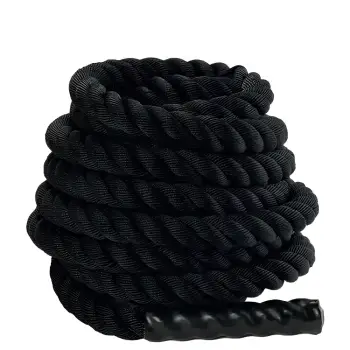
Proper battle rope maintenance consists of performing periodic checks, cleaning the rope when necessary, and storing it in a dry environment after use. These operations help limit wear caused by friction with the floor, keep the equipment efficient, and allow you to promptly identify any signs of deterioration.
The lifespan of a battle rope depends not only on its build quality, but also on the intensity of use, the surface it is used on, and storage methods. Regular maintenance helps preserve its performance both in home gyms and professional fitness facilities.
Before and after each workout, it is advisable to spend a few minutes checking the rope and the working area. This simple habit helps reduce wear and maintain a high level of safety during use.
How is battle rope maintenance performed?
Effective maintenance involves regular visual checks, cleaning the rope surfaces, checking the grips, and proper storage after each use. Intervening at the first signs of wear helps prevent progressive deterioration of the equipment.
The frequency of inspections should increase when the battle rope is used daily or by numerous users, as happens in functional areas of gyms.
Maintenance operations do not require complex tools but must be performed consistently to keep the rope in optimal condition.
Why maintenance is important
A rope kept in good condition retains its characteristics longer and reduces the risk of using damaged equipment.
What are the main objectives
Maintenance activities aim to limit wear, preserve the safety of the workstation, and extend the lifespan of the equipment.
What should be checked periodically?
Inspections should cover the entire length of the rope, the grips, the anchor point, and the area where it is used.
It is important to look for abrasions, fraying, deformations, or other evident signs of deterioration that could compromise normal use.
The fastening system should also be checked regularly to ensure it remains stable during workouts.
Check the rope
Pay attention to worn areas, damaged fibers, and points subject to greater friction during the wave technique.
Check the grips
The ends must be intact and securely fastened to ensure a secure grip during exercises.
How often should checks be performed?
Frequency depends on the intensity of use of the battle rope and the conditions of the training environment.
A visual check before use is a good practice in both home gyms and professional facilities.
More thorough checks can be integrated into the fitness area's routine maintenance schedule.
Before each workout
Quickly checking the rope, grips, and anchorage allows you to spot any immediately visible anomalies.
Scheduled checks
In gyms, it is useful to plan periodic inspections while documenting any maintenance work performed.
How to clean the battle rope?
Cleaning aims to remove dust, residue, and dirt that can increase abrasion during use.
After cleaning, it is advisable to let the rope dry completely before storing it, avoiding humid environments that could promote material deterioration.
It is preferable to use methods compatible with the instructions provided by the equipment manufacturer.
Routine cleaning
Regular removal of surface dirt helps keep the rope in optimal condition.
Dry storage
Storing the rope in a dry environment helps preserve its characteristics over time and reduces exposure to moisture.
Maintenance table
This table summarizes the main inspection and maintenance activities.
| Element |
What to check |
Objective |
| Rope |
Abrasions and fraying |
Identify wear |
| Grips |
Coating integrity |
Maintain a secure grip |
| Anchorage |
Fastening stability |
Ensure safety |
| Work area |
Cleanliness and absence of obstacles |
Reduce friction and interference |
| Storage |
Dry environment |
Limit deterioration |
The table serves as a useful operational reminder for both home use and the daily management of a gym.
How to use the table
Always following the same sequence of checks facilitates the early detection of any anomalies.
Log maintenance work
In professional facilities, it can be useful to record checks and replacements to monitor the condition of the equipment over time.
How to recognize signs of wear?
The most evident signs include localized abrasions, fraying, deterioration of the grips, and wear in the areas most in contact with the floor.
When these signs are evident, it is advisable to stop using the rope until its condition has been thoroughly checked.
Timely inspection prevents minor damage from turning into more extensive problems.
Surface abrasions
Abrasions generally indicate repeated contact with particularly abrasive surfaces or intensive use.
Worn grips
A deteriorated coating can compromise grip comfort during workouts.
How to prevent deterioration?
Prevention relies on proper management of the training area and constant maintenance of the equipment.
Using a suitable surface helps limit friction and preserve the rope during repeated workouts.
Avoiding unnecessary dragging and properly storing the battle rope after use also helps reduce wear.
Protect the work surface
An anti-shock gym flooring helps limit rope wear and protects the floor in areas dedicated to functional training.
Daily best practices
Avoiding forced bending, keeping the rope dry, and keeping the workstation clean are simple precautions that help extend its lifespan.
FAQ
Is it necessary to clean the battle rope after every workout?
Not always, but it is advisable to remove dirt and dust when present and keep the rope dry before storing it.
How to tell if the rope is worn?
Evident abrasions, fraying, and grip deterioration are signs that require a thorough check.
Where is the best place to store the battle rope?
In a dry and clean environment, avoiding prolonged exposure to moisture.
Does flooring affect lifespan?
Yes. A suitable surface helps reduce abrasion and deterioration caused by friction during exercises.
How to preserve your investment over time
Regular maintenance allows you to keep the battle rope efficient for longer and reduce extraordinary interventions due to premature wear. Periodic checks, cleaning, proper storage, and attention to the state of the flooring represent the main preventive actions that can be integrated into the ordinary management of the equipment.
For professional gyms, it is useful to adopt standardized procedures and document maintenance work, while in home gyms it is sufficient to follow a constant inspection routine before and after workouts.
A preventive approach helps maintain high equipment performance, improve workstation safety, and use the battle rope continuously over time without resorting to premature replacements.


 Budgets
 Dumbers
 Discs
 Benches
 Racks and Rigs
 Weights Holders
 Isotonic machines
 Calisthenics
 Cardio
 Kettlebells
 Flooring
 Gym Set
 Accessories
 Combat
 ARTI MARZIALI
 CONTAINER GYM
 Tug-Of-War
 Used Gym Equipment
 PILATES MACCHINARI
 GINNASTICA ARTISTICA
 CAMPI DA PADEL
 Prodotti in Pronta Consegna
 Informazioni
 IRONMAN
 Gift Card