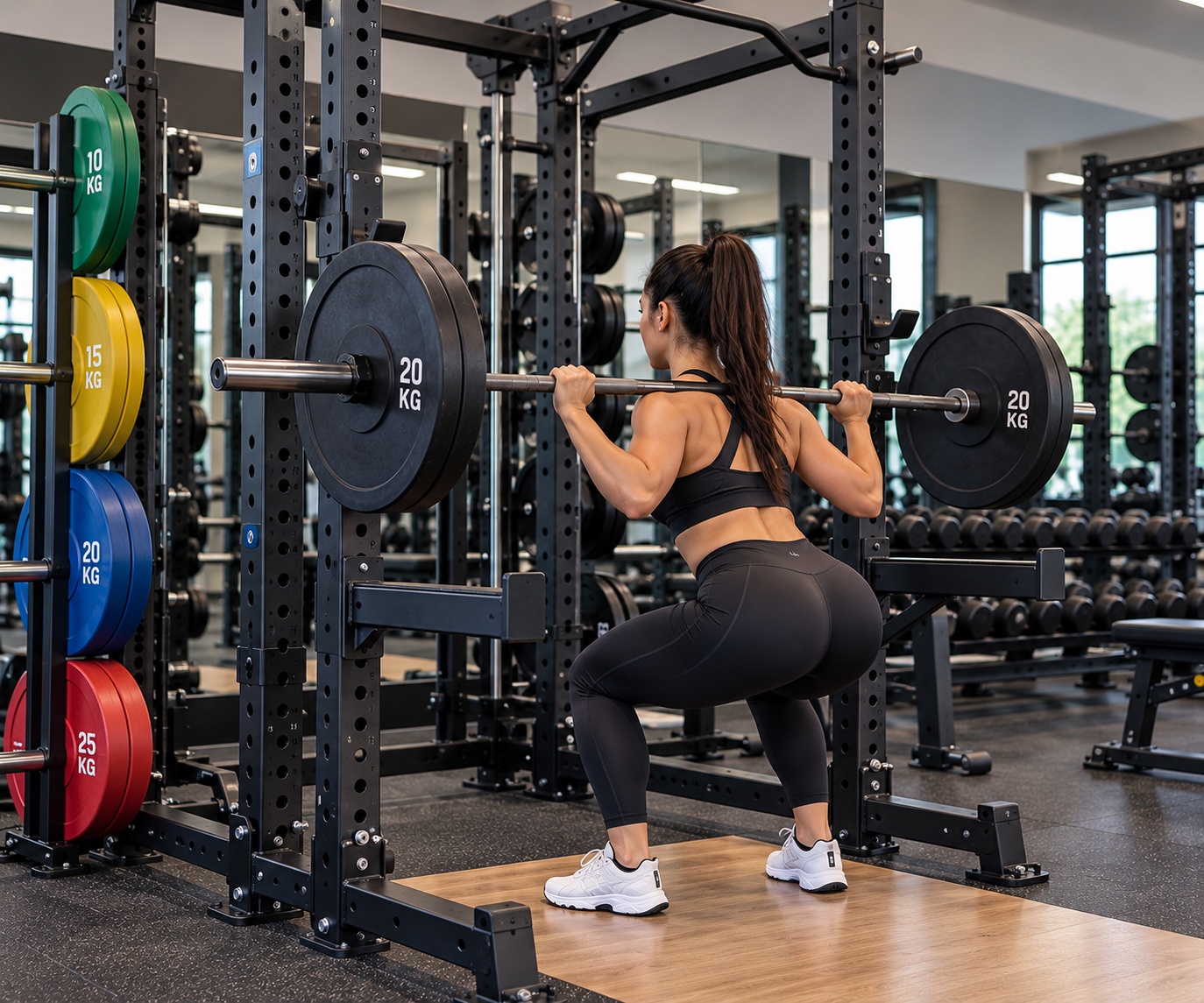
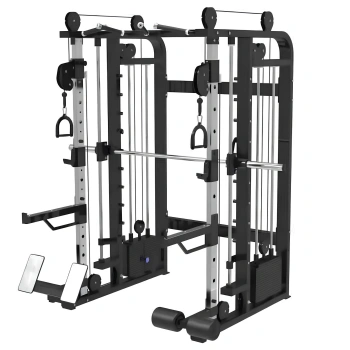
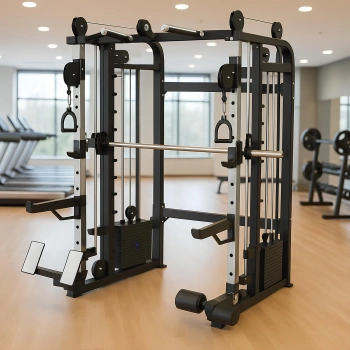
The space required for a power rack does not depend solely on the external dimensions of the structure, but also on the operating area required to use the barbell, install accessories, and move safely. Before purchasing, it is therefore necessary to evaluate the overall footprint, room height, walkways, and flooring characteristics, always referring to the manufacturer's technical specifications.
Whether it is a professional gym or a space dedicated to individual training, proper planning avoids limitations during exercises and allows the rack to be integrated with other equipment present in the room.
This guide illustrates the main criteria to consider when evaluating the space required for a power rack without referring to standard measurements not provided in the manufacturer's technical documentation.
What dimensions must be considered?
The first check concerns the dimensions declared by the manufacturer, including width, depth, and height of the structure.
These values represent the footprint of the machine but do not coincide with the space actually needed for training.
Before installation, it is advisable to compare the measurements reported in the technical sheet with the available floor plan.
Why check the height?
The height of the room must be compatible with that of the rack and with any exercises or accessories that require overhead movement.
Does the footprint coincide with the required space?
No. The footprint identifies the structure of the rack, while the operating area also includes the space needed to use the barbell and move freely.
Why is the operating area essential?
The space required must include all operations performed during training, including loading the barbell, adjusting safety arms, and using accessories.
The design should ensure smooth movements without interference with walls, columns, or other equipment.
Each configuration may require a different operating area, which should always be verified in the manufacturer's technical documentation.
Why consider the barbell?
Loading and unloading operations require additional space beyond just the dimensions of the structure.
Do exercises influence the space?
Yes. Activities like squats and bench press require an adequate free area to be performed according to the manufacturer's instructions.
How to organize the gym layout?
The power rack should be placed in a position that allows easy access, orderly pathways, and simultaneous use of other equipment.
It is advisable to avoid positioning it along main corridors or in areas where user movement could interfere with exercises.
Careful design improves the functionality of the weight room and facilitates training organization.
Why design pathways?
Well-organized pathways reduce interference and allow the rack to be used without obstructing other users.
How to integrate the rack with other equipment?
The layout should allow each machine to maintain its own operating area without overlaps.
Do accessories modify the required space?
Yes. Pull-up bars, weight plate storage systems, additional supports, and other accessories can increase the overall footprint and the area required for use.
Before purchasing, it is useful to verify the compatibility of accessories with the chosen model and the available space.
To learn about the various available configurations, you can consult the professional power racks category.
Why evaluate hole placement?
The configuration of the holes affects the adjustment of supports and compatibility with accessories provided by the manufacturer.
Is it worth planning space for future accessories?
If you plan to expand the rack with additional components, it is useful to consider the potential increase in occupied area right from the start.
What aspects to verify during installation?
Installation must comply with the manufacturer's instructions regarding assembly, possible anchoring, and support surface requirements.
The flooring should also be compatible with the weight of the structure and the planned installation methods.
Every intervention should be carried out following exclusively the official technical documentation.
Is anchoring always necessary?
It depends on the rack design and the manufacturer's instructions. It is advisable to follow exclusively the instructions provided for the installed model.
Why consult the manual?
Manuals and technical sheets report dimensional requirements, installation procedures, and checks provided by the manufacturer.
What errors to avoid?
One of the most frequent errors consists of considering only the external dimensions of the rack without evaluating the necessary operating area.
It is also advisable to avoid installations that limit access to accessories or make loading the barbell difficult.
Neglecting technical documentation can lead to a design that is inconsistent with the characteristics of the chosen model.
Why is measuring the rack not enough?
The measurements of the structure represent only part of the design. The operating area is equally important.
Why design before purchasing?
Preventive verification helps avoid subsequent changes to the gym layout and facilitates the integration of the rack with other equipment.
Compact verification table
| Element |
What to verify |
| Dimensions |
Width, depth, and height |
| Operating area |
Space for use and movement |
| Layout |
Pathways and accessibility |
| Accessories |
Compatibility and additional footprints |
| Flooring |
Requirements for installation |
| Documentation |
Manuals and technical sheets |
This table helps compare different configurations using practical and verifiable criteria.
Definitive characteristics must always be confirmed by consulting the manufacturer's official technical documentation.
What documents to consult?
Installation manuals, technical sheets, and manufacturer instructions constitute the primary sources to verify dimensions, assembly methods, and support surface requirements.
What aspects to compare before purchase?
Dimensions, operating area, accessory compatibility, installation methods, weight capacity, availability of spare parts, and completeness of technical documentation represent the main evaluation criteria.
How to properly plan the space for a power rack?
Space design should start from the analysis of the model's characteristics, the available environment, and the intended use methods. Considering footprints, operating area, accessories, and pathways simultaneously allows you to choose a configuration consistent with the needs of the gym or the room dedicated to training.
Before purchasing, it is advisable to prepare a checklist including dimensions, room height, operating area, flooring, compatible accessories, and technical documentation. This approach allows you to evaluate each solution using concrete and verifiable criteria.
FAQ
Is it enough to know the dimensions of the power rack? No. You also need to evaluate the operating area required to use the barbell and accessories.
Do accessories modify the footprint? Yes. Some accessories can increase the space required during use.
Is the room height important? Yes. It must be compatible with the rack and the planned exercises.
What is the most reliable source to verify space requirements? Installation manuals, technical sheets, and official manufacturer documentation represent the main reference for dimensions, installation, and configuration.


 Budgets
 Dumbers
 Discs
 Benches
 Racks and Rigs
 Weights Holders
 Isotonic machines
 Calisthenics
 Cardio
 Kettlebells
 Flooring
 Gym Set
 Accessories
 Combat
 ARTI MARZIALI
 CONTAINER GYM
 Tug-Of-War
 Used Gym Equipment
 PILATES MACCHINARI
 GINNASTICA ARTISTICA
 CAMPI DA PADEL
 Prodotti in Pronta Consegna
 Informazioni
 IRONMAN
 Gift Card