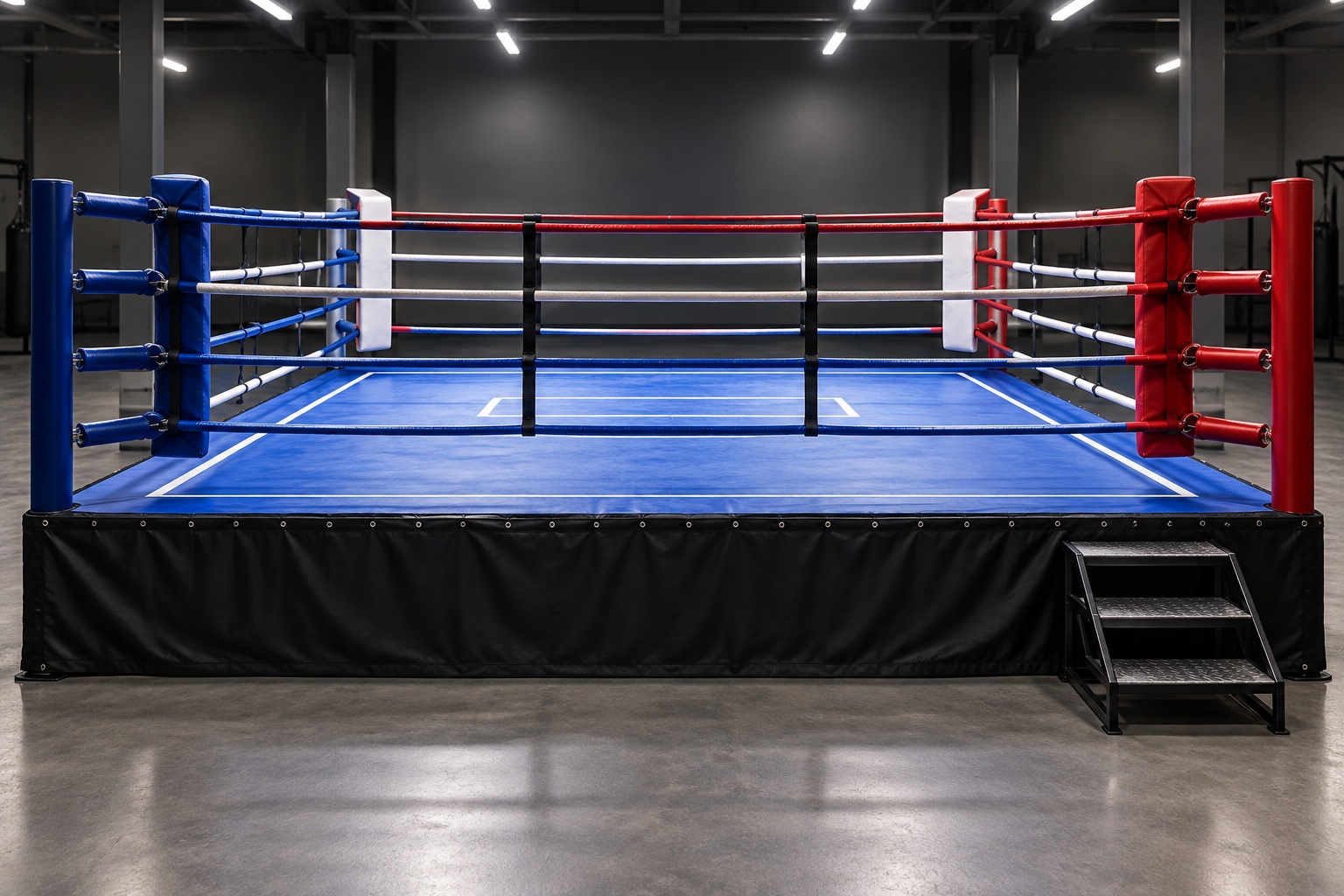
The choice between a boxing ring floor-standing model and an elevated one depends on the intended use of the gym, the available space, and how the ring will be used during training, classes, and athletic preparation. The two configurations address different needs and should be evaluated based on verifiable technical criteria rather than aesthetic preferences.
A floor-standing ring is installed at the same level as the gym surface, while an elevated ring uses a raised platform that affects accessibility, space organization, and installation methods. These features also impact maintenance, daily management, and the overall design of the area dedicated to combat sports.
Before purchasing, it is advisable to analyze the facility layout, access routes, number of practitioners, planned activities, and the manufacturer's technical documentation. A preliminary assessment makes it possible to choose the configuration most consistent with the operational needs of the gym.
Floor-standing or elevated boxing ring: which one to use?
The choice between a boxing ring floor-standing and an elevated one depends on available space, usage methods, gym configuration, and installation requirements. It is advisable to compare the room characteristics with the manufacturer's technical specifications before identifying the most suitable solution.
Both configurations can be appropriate if included in a project consistent with the intended use of the facility.
The manufacturer's instructions always represent the main reference for installation and use.
Define the objective
It is useful to determine whether the ring will be used primarily for technical training, sparring, athletic preparation, or other sports activities.
Analyze available space
Before purchasing, it is appropriate to check the room dimensions, access points, and characteristics of the flooring.
How do the two configurations work?
The floor-standing ring is installed directly on the gym surface without an elevated platform, whereas the elevated ring uses a structure with a platform height that changes accessibility and the organization of the surrounding space.
Both configurations require installation in compliance with the manufacturer's instructions and a periodic maintenance schedule.
To complete a gym dedicated to combat sports, you can consult the range of combat sports equipment.
Floor-standing ring
This configuration favors direct access to the training area and can seamlessly integrate into the room layout.
Elevated ring
The presence of the platform requires specific planning of access points, surrounding areas, and daily usage methods.
What criteria help in making the choice?
Available space represents one of the first elements to evaluate, along with the intended use and the gym configuration.
It is also necessary to consider installation methods, planned maintenance, number of users, and the possibility of modifying the layout in the future.
The manufacturer's technical documentation allows for comparing different solutions using objective criteria.
Gym layout
A room dedicated exclusively to boxing may require a different configuration compared to a multifunctional space.
Paths and accessibility
Access points, corridors, and passageways must be compatible with the assembly, use, and maintenance of the ring.
When to choose one solution or the other?
A floor-standing ring can be considered when you want to maintain continuity with the rest of the training area and facilitate access.
An elevated ring can be taken into consideration when the project includes an area specifically dedicated to boxing and the structure allows for the proper management of the platform.
The final decision should always be verified by comparing the project with the manufacturer's instructions.
When to prefer the floor-standing ring
It may be suitable in facilities that require flexible space organization and direct access to the operational area.
When to prefer the elevated ring
It may be indicated when the ring represents the central element of an area dedicated to boxing practice.
What errors to avoid during use?
One of the most frequent errors consists of choosing a configuration without evaluating the space necessary for access, maintenance, and daily use.
It is equally important to avoid structural modifications not foreseen by the manufacturer and to neglect the maintenance schedule.
Incorrect organization of the surrounding area can also reduce the gym's functionality.
Neglecting operational space
The design must include both the ring and the areas necessary for circulation, maintenance, and the work of instructors.
Postponing checks
Periodic checks on the structure, ropes, and components help keep the ring efficient over time.
Comparative table
| Criterion |
Floor-standing ring |
Elevated ring |
| Accessibility |
Direct |
With access to the platform |
| Configuration |
Integrated into the room |
Dedicated elevated area |
| Layout |
Greater continuity |
More defined zone |
| Installation |
According to the model |
According to the model and platform |
| Maintenance |
Follow the manufacturer's manual |
Follow the manufacturer's manual |
Compare layout
The arrangement of other equipment influences the choice of the most suitable configuration.
Compare operational needs
The solution should be consistent with the gym's activity schedule.
Manuals and technical documentation
Before installation, it is advisable to consult the manufacturer's manual to check assembly, use, and maintenance requirements.
It is useful to keep technical documentation, operating instructions, and a log of performed interventions.
When applicable, the manufacturer's instructions and current regulations regarding sports equipment must be respected.
Manufacturer's manual
Contains the official instructions for the installation, use, and maintenance of the ring.
Inspection log
Documenting checks and interventions facilitates the technical management of the facility.
FAQ
Is there an absolute best configuration?
No. The choice depends on available space, intended use, and the characteristics of the gym.
Does maintenance change between the two models?
Procedures can vary based on the installed model and must follow the manufacturer's instructions.
Why analyze the layout before purchasing?
To verify that the ring can be installed and used without limiting the functionality of the other gym spaces.
How to choose the most suitable configuration
The choice between a floor-standing and elevated boxing ring should be based on verifiable criteria such as available space, gym configuration, usage methods, planned maintenance, and the manufacturer's technical documentation. Analyzing these elements makes it possible to design a functional, easily manageable boxing area consistent with the operational goals of the sports facility.


 Budgets
 Dumbers
 Discs
 Benches
 Racks and Rigs
 Weights Holders
 Isotonic machines
 Calisthenics
 Cardio
 Kettlebells
 Flooring
 Gym Set
 Accessories
 Combat
 ARTI MARZIALI
 CONTAINER GYM
 Tug-Of-War
 Used Gym Equipment
 PILATES MACCHINARI
 GINNASTICA ARTISTICA
 CAMPI DA PADEL
 Prodotti in Pronta Consegna
 Informazioni
 IRONMAN
 Gift Card