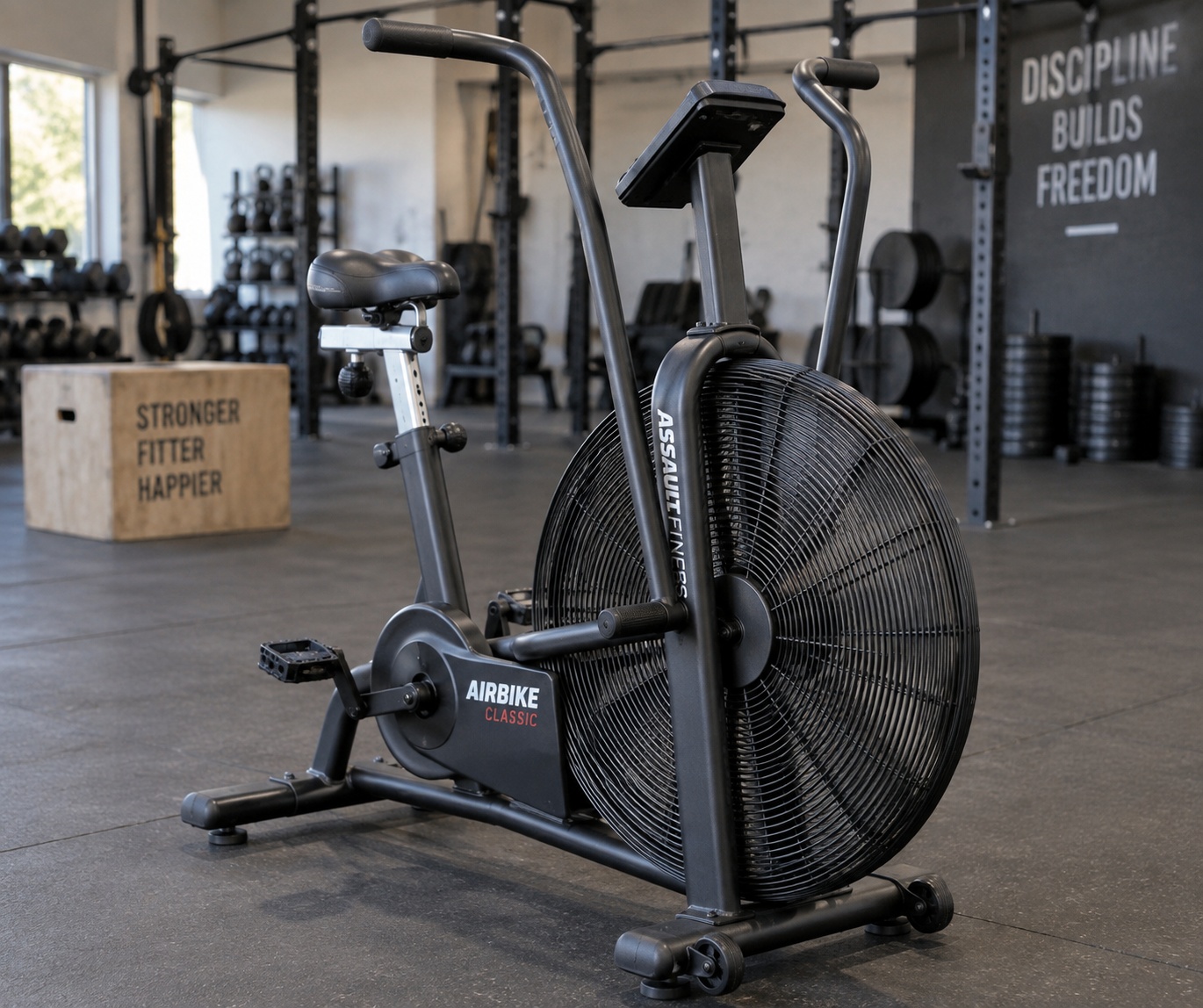
Air bike safety depends mainly on two factors: correct adjustment of the user's position and an installation that leaves free operating space around the machine, particularly in the fan area. Before each workout, it is essential to check the stability, adjustments, and general condition of the equipment following the manufacturer's instructions.
An incorrect setup can compromise comfort and movement efficiency, while an inadequate placement of the machine can hinder its use and make access, dismounting, and maintenance operations more difficult. For this reason, safety must be considered as early as the cardio area design phase.
Both in home gyms and professional gyms, it is good practice to arrange periodic checks of the equipment and keep the surrounding area free, avoiding the accumulation of accessories or other machines that are too close.
Why is correct setup important?
Correct positioning of the user allows the movement to be performed smoothly and in a controlled manner, reducing makeshift adjustments during the workout. The saddle and handlebars must be adapted to the physical characteristics of the user following the instructions provided by the manufacturer.
Whenever the machine is used by different people, it is advisable to check the adjustments again before starting the session.
Adjustments must be completely locked before use and checked visually to ensure they are inserted correctly.
Saddle adjustment
The saddle should be adjusted exclusively using the systems provided by the manufacturer, avoiding makeshift modifications or non-original components.
Handlebar adjustment
The handlebars must also be set according to the technical manual instructions, verifying the correct tightening of the adjustment devices.
Why leave space around the fan?
The fan represents the element that generates the resistance of the air bike and requires a free area that allows easy use of the machine and correct air circulation.
The operating space must not be evaluated exclusively based on the frame dimensions but also considering getting on and off, the movement of the grips, and the possibility of carrying out inspections and maintenance.
For minimum dimensions and installation spaces, it is always advisable to refer to the technical documentation of the specific machine's manufacturer.
Usage area
Keeping the surrounding area free facilitates access to the machine and reduces the risk of interference with other equipment.
Absence of obstacles
Plates, kettlebells, dumbbells, and other accessories should not be left near the operating zone of the air bike.
What checks to perform before use?
Before starting the workout, it is advisable to perform a quick visual check of the machine by checking stability, tighteners, adjustments, and general conditions.
Any unusual noises, loose components, or difficulties in adjustments require a technical check before proceeding with use.
It is also advisable to make sure that the floor is stable and that the machine rests correctly without oscillations.
Visual check
A simple inspection before use often allows easily recognizable anomalies to be identified.
Stability check
The machine should remain stable during all phases of the workout without abnormal movements of the frame.
How to properly adjust the air bike?
Adjustments must be made before getting on the machine following the procedure described by the manufacturer. After each modification, it is important to check that the locking systems are fully engaged.
When the air bike is used in a gym or functional box, instructors should show new users how to make adjustments correctly.
During the workout, it is advisable to avoid position modifications as long as the machine is moving.
Before the workout
All adjustments should be completed before starting the work session.
After adjustment
A final check of the locking systems helps reduce the risk of improper use.
How to install the machine safely?
Installation should comply with the instructions in the manufacturer's manual, verifying that the floor is suitable and that the usage area remains free.
A stable surface improves the dynamic behavior of the machine during more intense workouts. To learn more about dedicated solutions, you can consult the cardio machines category.
It is also advisable to organize the gym layout avoiding overlapping with passageways or areas dedicated to other exercises.
Space organization
An orderly arrangement makes the use of the machine easier and facilitates supervision by instructors.
Support surface
The flooring must be stable, uniform, and compatible with the intended type of use.
What checks to perform over time?
Preventive maintenance includes cleaning, checking tighteners, verifying adjustments, and inspecting moving parts as indicated by the manufacturer.
The frequency of interventions depends on the intensity of use and should be documented through a maintenance program.
Periodic checks help keep the machine efficient and ready for daily use.
Periodic cleaning
The removal of dust and residue keeps surfaces efficient and facilitates visual inspections.
Control log
Recording the interventions carried out makes it easier to plan subsequent maintenance.
What errors should be avoided?
Among the most frequent errors are the lack of initial adjustment of the machine, the positioning of the air bike in spaces that are too small, and the absence of periodic checks.
Also using the equipment when it has loose components or evident anomalies can compromise the correct functioning of the machine.
It is also advisable to avoid accumulating accessories around the fan or along the access area, thus limiting the available operating space.
Neglected adjustments
A hastily executed adjustment can make use less comfortable and increase the likelihood of operational errors.
Insufficient space
An arrangement that is too close to other equipment makes use, maintenance, and cleaning less convenient.
Why is safety a choice criterion?
Air bike safety depends on the quality of the installation, correct adjustments, and compliance with the maintenance schedule provided by the manufacturer. Evaluating these aspects as early as the purchase phase allows you to choose a machine that is easier to manage and suited to the intended context of use.
Before installation, it is advisable to consult the technical documentation to check dimensions, adjustments, assembly requirements, and maintenance program. For operating spaces, adjustment procedures, and periodic checks, it is appropriate to refer exclusively to the manuals of the specific air bike and the manufacturer's instructions, avoiding applying generic criteria to different models.


 Budgets
 Dumbers
 Discs
 Benches
 Racks and Rigs
 Weights Holders
 Isotonic machines
 Calisthenics
 Cardio
 Kettlebells
 Flooring
 Gym Set
 Accessories
 Combat
 ARTI MARZIALI
 CONTAINER GYM
 Tug-Of-War
 Used Gym Equipment
 PILATES MACCHINARI
 GINNASTICA ARTISTICA
 CAMPI DA PADEL
 Prodotti in Pronta Consegna
 Informazioni
 IRONMAN
 Gift Card