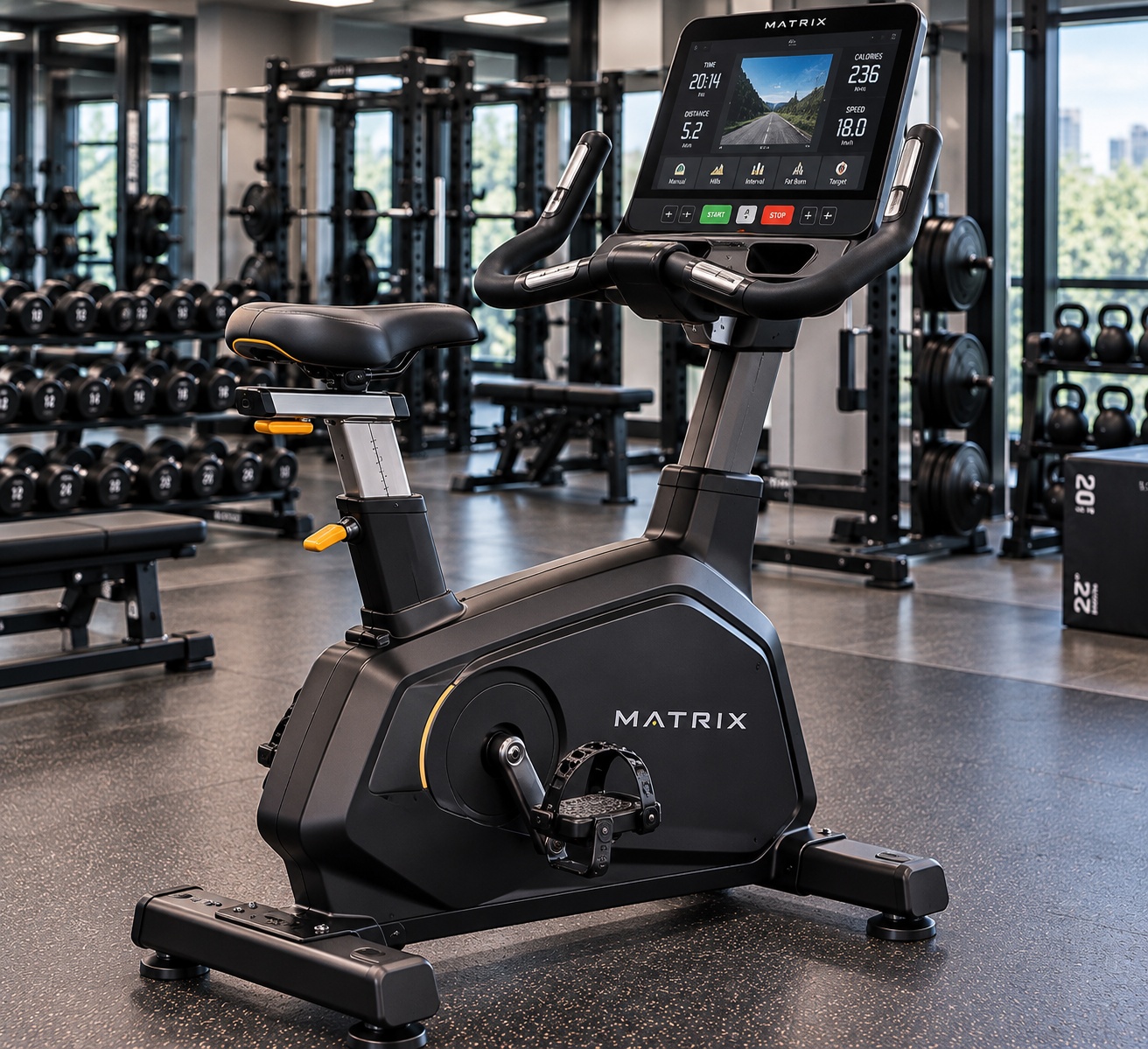
Safety is one of the most important aspects in managing a professional exercise bike. Even equipment designed for intensive use can provide an uncomfortable experience or prove unstable if installed incorrectly, improperly adjusted, or used without the checks provided by the manufacturer.
Most operational issues do not stem from machine defects, but rather from errors in adjusting the saddle or handlebars, floor positioning, or failing to perform scheduled maintenance. For this reason, it is important to adopt simple and repeatable verification procedures.
This guide outlines practical criteria for identifying the main causes of instability, performing pre-use checks, and managing the safety of professional exercise bikes during normal use in gyms, hotels, or fitness centers.
How to avoid incorrect adjustments and instability?
The safety of a professional exercise bike depends on proper installation, adjustments made according to the manufacturer's manual, and scheduled periodic maintenance. Before each use, it is advisable to check the stability of the machine, the correct locking of adjustments, and the absence of visible anomalies.
A stable and properly adjusted machine improves user comfort, reduces the risk of service interruptions, and helps preserve equipment performance over time.
Control procedures should be documented and included in the normal cardio room management plan.
What is the first check to perform?
Verify that the machine is positioned on a stable surface and does not show oscillations during a trial use.
Why follow the manual?
The manufacturer's instructions are the primary reference for adjustments, maintenance, and safety checks.
What are the main risks associated with incorrect adjustment?
Incorrect adjustment can compromise the quality of the training experience and increase the risk of improper use of the machine.
Among the most common situations are an inadequately adjusted saddle, a improperly secured handlebar, or components that are not completely locked after adjustment.
Even a machine installed on an uneven surface can transmit a feeling of instability that makes pedaling less comfortable.
Why is saddle adjustment important?
Appropriate adjustment allows the user to assume an ergonomic position and facilitates smooth pedaling.
What checks should be performed on the handlebar?
It is advisable to check that the adjustment system is properly tightened and that there are no abnormal movements during use.
What safety requirements must be verified?
Before commissioning, it is helpful to check that the machine is installed according to the manufacturer's instructions and that the surrounding area allows for easy use.
The load capacity declared by the manufacturer represents one of the fundamental parameters to respect, as well as all instructions reported in the technical documentation.
The quality of the flooring also affects the stability of the machine and should be evaluated during the design of the cardio room.
How much does installation matter?
Proper positioning reduces the risk of oscillations and facilitates subsequent maintenance operations.
Why leave space around the machine?
An adequate free area improves safety, accessibility, and ease of cleaning.
What checks should be performed before use?
A visual check takes only a few minutes and allows you to identify any anomalies before starting the workout.
It is advisable to check the stability of the machine, the correct locking of adjustments, the condition of the pedals, and the absence of loose or damaged elements.
In the case of evident anomalies, the machine should be temporarily removed from use until the checks required by the manufacturer are completed.
What visual checks are recommended?
General state of the structure, adjustment systems, pedals, fastening elements, and presence of any easily identifiable damage.
When to perform a functional test?
After installation, maintenance, or whenever abnormal behavior is reported during use.
Why does maintenance contribute to safety?
Scheduled maintenance keeps wear-prone components efficient and allows for the timely identification of any anomalies.
Operations should be performed following the schedule indicated by the manufacturer and recorded within the facility's maintenance plan.
To complete a room dedicated to cardiovascular training, you can also evaluate other professional cardio machines designed for continuous use.
Why check spare parts?
The availability of wear-prone parts facilitates scheduled interventions and reduces machine downtime.
How much does technical assistance matter?
An organized assistance service allows you to quickly address any extraordinary maintenance interventions.
Which errors most compromise safety?
One of the most frequent errors is using the machine without verifying the correct tightening of adjustments after a user change.
Another critical issue concerns the lack of scheduled maintenance or the use of the exercise bike despite the presence of evident anomalies.
It is also important to avoid modifications not foreseen by the manufacturer or interventions carried out without following the official technical documentation.
Why check every adjustment?
Adjustments are often changed between users and should always be properly locked before training.
Why check the floor?
An uneven surface can compromise perceived stability even when the machine is working perfectly.
Which checklist to use before use?
| Check |
Objective |
| Machine stability |
Verify the absence of oscillations |
| Adjustments |
Check the correct locking of saddle and handlebar |
| Pedals |
Verify correct fastening and general condition |
| Support surface |
Ascertain the stability of the flooring |
| Visible components |
Identify any anomalies or evident wear |
| Manual and maintenance |
Follow the manufacturer's instructions |
When to execute the checklist?
Before opening the room and whenever maintenance or significant adjustments are performed.
Why record checks?
Orderly documentation facilitates maintenance planning and monitoring of equipment status.
Why does safety also protect the investment?
Careful management of the professional exercise bike helps maintain high equipment reliability and reduce the risk of unplanned machine downtime.
The systematic application of the procedures indicated by the manufacturer, together with regular checks and scheduled maintenance, preserves performance and operational continuity over time.
Integrating safety into the daily management of the cardio room means protecting both the users and the value of the investment made by the facility.
What is the main cause of instability?
Causes can vary, but it is always advisable to check installation, adjustments, support surface, and general machine conditions following the manufacturer's manual.
Who should perform maintenance?
Maintenance should be carried out according to the manufacturer's instructions and in the manner provided by the technical documentation supplied with the equipment.


 Budgets
 Dumbers
 Discs
 Benches
 Racks and Rigs
 Weights Holders
 Isotonic machines
 Calisthenics
 Cardio
 Kettlebells
 Flooring
 Gym Set
 Accessories
 Combat
 ARTI MARZIALI
 CONTAINER GYM
 Tug-Of-War
 Used Gym Equipment
 PILATES MACCHINARI
 GINNASTICA ARTISTICA
 CAMPI DA PADEL
 Prodotti in Pronta Consegna
 Informazioni
 IRONMAN
 Gift Card