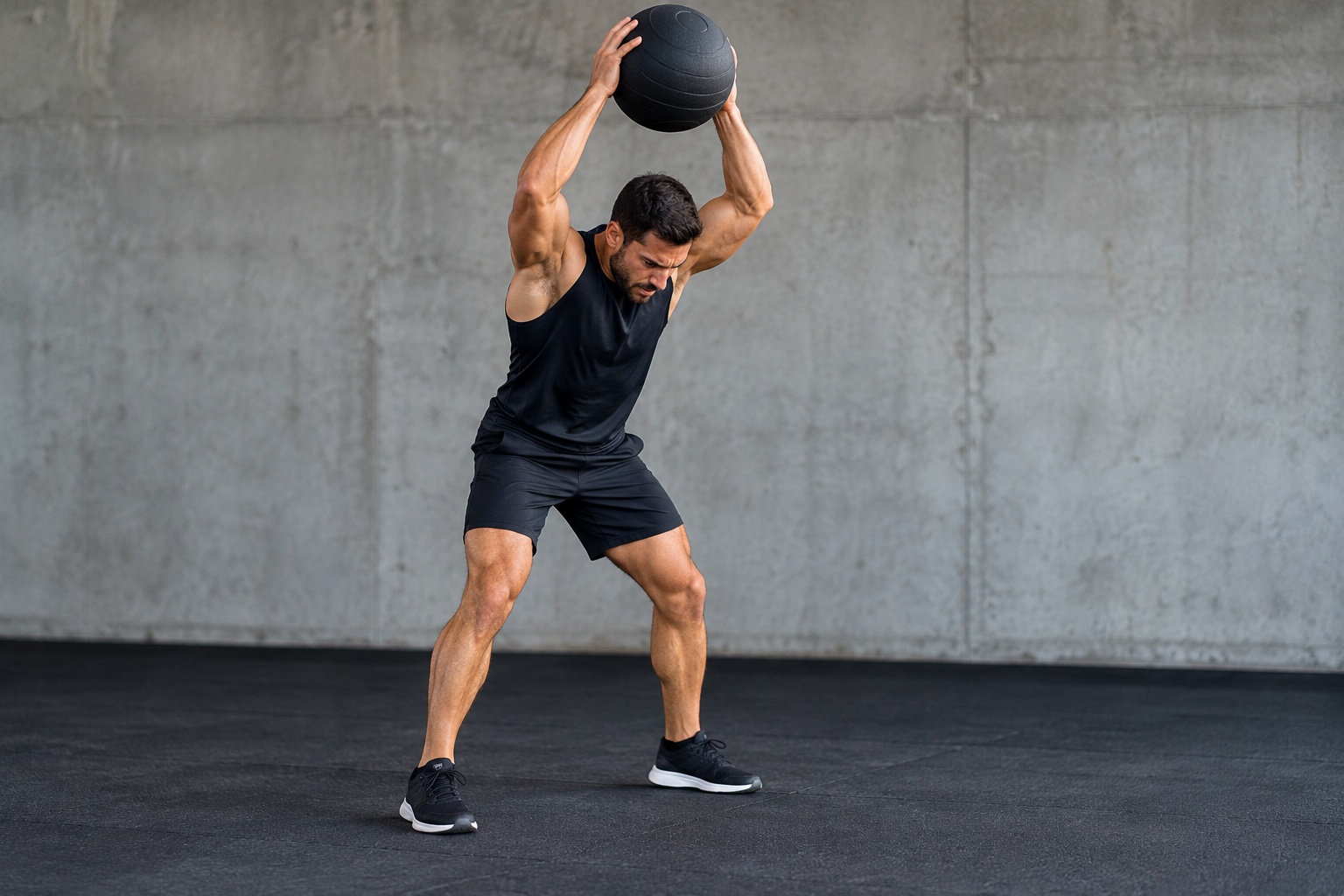
The slam ball is a weighted ball designed for dynamic exercises involving controlled throws against the floor, explosive movements, and high-intensity work. It is used in functional training, athletic preparation, and physical conditioning programs to develop strength, power, coordination, and muscular endurance.
Unlike other balls used in functional training, the slam ball is designed to absorb impacts during ground slams, allowing repeated exercises to be performed without the typical behavior of a bouncing ball. However, to achieve effective results, it is important to choose the correct weight, use a suitable surface, and adhere to a controlled execution technique.
This guide explains what a slam ball is, how to use it, what features to consider before purchasing, and what mistakes to avoid in order to train safely and effectively.
What is a slam ball and what is it used for?
The slam ball is a weighted ball used primarily for exercises involving ground slams, explosive movements, and functional workouts. It is used to develop strength, coordination, and endurance while maintaining control over the movement. The choice of weight and the training surface must be consistent with the training goals and the manufacturer's instructions.
For correct usage, it is advisable to check the planned type of exercise, the user's skill level, and the available space.
Technical specifications should always be consulted in the official product documentation.
Decision-making criteria
Weight, coating material, intended use, training surface, and execution quality are the main elements to evaluate.
Technical sources
For construction characteristics, methods of use, and maintenance, it is necessary to refer to the specifications and manuals provided by the manufacturer.
What is a slam ball?
The slam ball belongs to the category of weighted balls intended for functional training.
Its structure is designed to limit bouncing after impact with the floor, a characteristic that makes it suitable for explosive exercises performed with downward throws.
For this reason, it is frequently used in metabolic circuits, athletic preparation, and programs dedicated to the development of functional strength.
Ball structure
Construction features may vary among different manufacturers regarding coating, internal material, and surface finish.
Intended use
The slam ball is specifically designed for exercises with repeated impacts on the floor and should not be considered interchangeable with other types of balls used in functional training.
How to use it correctly?
Correct usage starts with choosing an adequate weight and learning the execution technique.
During exercises, it is important to maintain control of the ball throughout the entire movement, avoiding sacrificing technique quality to increase intensity.
Progression should be gradual, adapting the load to the user's capabilities.
Most common exercises
Ground slams, controlled throws, functional strength exercises, and some metabolic circuits represent the most frequent uses of the slam ball.
Training progression
Beginners should start with simple exercises and progressively increase intensity and complexity while always maintaining correct technique.
What features matter?
Before purchasing, it is useful to simultaneously evaluate weight, diameter, coating, and intended usage methods.
The choice should be made considering the training program and the level of the users who will use the equipment.
The quality of the support surface also affects the user experience and the durability of the ball.
Weight
The weight must allow the exercise to be completed while maintaining movement control and technical quality throughout all repetitions.
Diameter and grip
The diameter can vary depending on the model and manufacturer, influencing the grip and handling of the ball during exercises.
Practical usage criteria
A slam ball should be used exclusively in the exercises for which it was designed.
The training area must be free of obstacles and sufficiently wide to allow the complete execution of movements.
To create a functional station, you can integrate the slam ball with functional training accessories compatible with the work program.
Space organization
Each athlete should have a free area that allows them to retrieve the ball without interfering with other stations.
Training surface
An impact-absorbing flooring suitable for impacts helps protect both the equipment and the floor during repeated slams.
Mistakes to avoid and safety
One of the most common mistakes is using a slam ball with a weight not suited to one's preparation level.
It is also important to avoid performing exercises in shared spaces without adequate distance from other users or on surfaces not designed to absorb repeated impacts.
Before each workout, it is advisable to visually check the condition of the ball and the order of the work area.
Uncontrolled technique
Increasing speed or intensity while sacrificing the quality of movement can reduce workout effectiveness and increase the risk of execution errors.
Improper use
The slam ball should be used exclusively according to the methods indicated by the manufacturer, avoiding exercises for which it was not designed.
FAQ
Is the slam ball suitable for beginners?
Yes, provided that an adequate weight is chosen and exercises are introduced with a progression consistent with the user's level.
What is the difference compared to a wall ball?
The two pieces of equipment are designed for different usage methods and should not be considered interchangeable in all exercises.
Is specific flooring required?
A surface suitable for repeated impacts generally represents the most appropriate solution for ground slam exercises.
How to choose the correct weight?
The weight should allow control, technique, and continuity of movement to be maintained throughout the entire set, adapting to the athlete's level and the program's goals.
Evaluating the investment
Integrating a slam ball into a gym or an area dedicated to functional training means choosing versatile equipment suitable for numerous physical preparation programs. Evaluating weight, coating, construction quality, usage surface, and space organization allows for the creation of an efficient and safe station capable of meeting the needs of both beginners and the most experienced athletes.


 Budgets
 Dumbers
 Discs
 Benches
 Racks and Rigs
 Weights Holders
 Isotonic machines
 Calisthenics
 Cardio
 Kettlebells
 Flooring
 Gym Set
 Accessories
 Combat
 ARTI MARZIALI
 CONTAINER GYM
 Tug-Of-War
 Used Gym Equipment
 PILATES MACCHINARI
 GINNASTICA ARTISTICA
 CAMPI DA PADEL
 Prodotti in Pronta Consegna
 Informazioni
 IRONMAN
 Gift Card