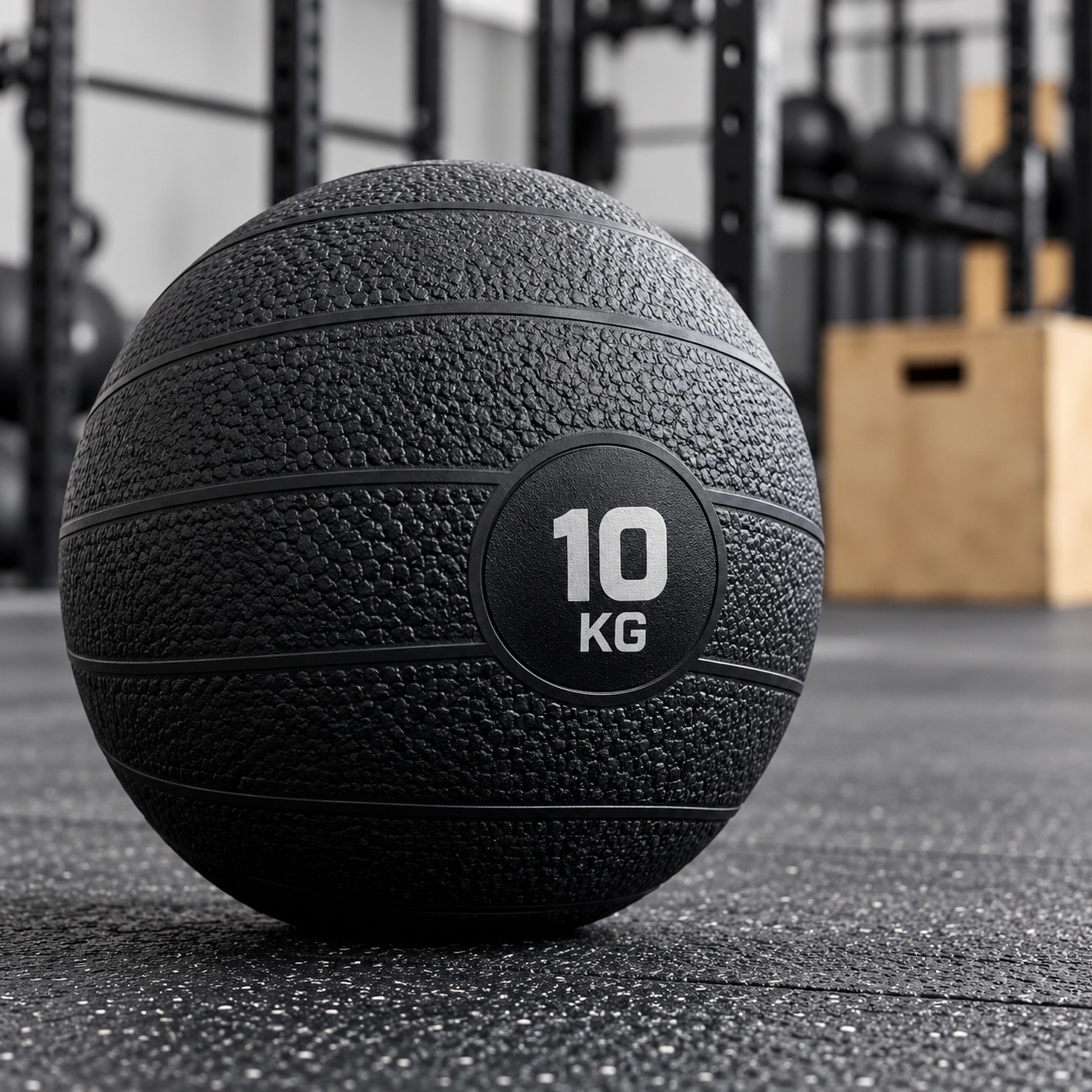
The slam ball represents one of the most used pieces of equipment in functional fitness thanks to its versatility and the possibility of performing explosive movements, metabolic exercises, and physical conditioning work. Its use allows for the development of strength, coordination, endurance, and motor control through exercises that involve the entire body.
To obtain an effective workout, it is not enough to choose a ball of the desired weight. It is necessary to verify that the equipment is suitable for the planned exercises, use a surface compatible with impacts, and correctly organize the workspace to ensure safety and continuity during sessions.
This guide delves into the requirements that a slam ball should meet for functional fitness, illustrating how to use it correctly, which aspects to evaluate before purchase, and which errors to avoid during training.
What requirements must a slam ball have for functional fitness?
A slam ball intended for functional fitness should be compatible with the planned exercises, offer a secure grip, be used on a surface suitable for impacts, and allow for correct technical execution. The choice must consider weight, coating, manufacturing quality, and methods of use indicated by the manufacturer.
Before training, it is useful to check the state of the equipment and the organization of the work area.
The technical characteristics must always be confirmed by consulting the manufacturer's documentation.
Decision criteria
Weight, coating, intended use, grip quality, available space, and flooring represent the main elements to evaluate.
Technical sources
For methods of use, maintenance, and construction characteristics, it is appropriate to refer to the manufacturer's manuals and technical sheets.
What role does the slam ball have in functional fitness?
In functional fitness, the slam ball is used to develop physical qualities through movements that involve multiple muscle groups simultaneously.
Exercises can be included in metabolic circuits, athletic preparation programs, or workouts aimed at improving coordination and the ability to produce force.
The possibility of integrating the slam ball with other equipment makes this tool particularly versatile within a gym.
Training objectives
Exercises with a slam ball can contribute to the development of functional strength, muscular endurance, coordination, and the ability to express explosive movements.
Inclusion in circuits
The slam ball can be used both as a main exercise and as an element within multi-station circuits.
How to use the slam ball correctly?
Correct execution starts with choosing a weight compatible with the user's level and training goals.
During exercises, it is important to maintain control of the movement and a stable technique, avoiding increasing the load at the expense of execution quality.
Progression should be gradual, adapting intensity and work volume to the athlete's capabilities.
Floor slams
Floor slams represent one of the most characteristic exercises of the discipline and require a surface compatible with repeated impacts.
Throws and dynamic movements
Controlled throws can be included in specific programs when they are compatible with the available space and the type of training planned.
What characteristics must the equipment have?
The choice of the slam ball should simultaneously consider weight, diameter, coating, and intended use.
Each element influences the quality of the training experience and compatibility with the planned exercises.
Before purchase, it is advisable to compare the technical specifications declared by the manufacturer.
Weight and progression
The weight must allow completing the movement while maintaining control and precision throughout the set.
Coating and grip
The coating contributes to the quality of the grip and the durability of the equipment during repeated uses.
Practical criteria of use
A station dedicated to functional fitness should be organized in a way that guarantees freedom of movement and safety.
The available space must allow the complete execution of exercises while avoiding interference with other activities present in the gym.
To complete the area, it is possible to integrate the slam ball with functional training accessories compatible with the training program.
Space organization
Each athlete should have sufficient area to perform explosive movements and retrieve the ball without obstacles.
Flooring
An anti-shock flooring designed for functional activities helps protect the subfloor and equipment during repeated impacts.
Errors to avoid and safety
One of the most frequent errors consists of using a slam ball with characteristics inconsistent with the training program.
Training in shared spaces without adequate organization or using surfaces not suited for slams can limit safety and exercise quality.
Before each session, it is good practice to visually verify the integrity of the ball and the order of the training area.
Inadequate weight
An excessive load can compromise technique while one that is too reduced might not be consistent with the program's objectives.
Unsuitable surface
Use on flooring not designed for repeated impacts can increase wear on the equipment and the floor.
FAQ
Is the slam ball suitable for functional fitness?
Yes. It is one of the most used tools in functional training programs thanks to the possibility of performing dynamic and multi-joint exercises.
Which weight to choose?
The weight should allow maintaining correct technique during all repetitions, adapting to the user's level and training goals.
Is specific flooring needed?
A surface compatible with repeated impacts generally represents the most indicated choice to preserve equipment and flooring.
Can the slam ball replace a wall ball?
No. The two pieces of equipment are designed for different modes of use and should not be considered equivalent for all exercises.
Evaluating the investment
Integrating a slam ball into an area dedicated to functional fitness means choosing versatile equipment that requires correct weight selection, rational space organization, and a surface compatible with impacts. Evaluating technical requirements, manufacturing quality, and methods of use allows creating an efficient, safe station suited for training programs aimed at both beginners and more experienced athletes.


 Budgets
 Dumbers
 Discs
 Benches
 Racks and Rigs
 Weights Holders
 Isotonic machines
 Calisthenics
 Cardio
 Kettlebells
 Flooring
 Gym Set
 Accessories
 Combat
 ARTI MARZIALI
 CONTAINER GYM
 Tug-Of-War
 Used Gym Equipment
 PILATES MACCHINARI
 GINNASTICA ARTISTICA
 CAMPI DA PADEL
 Prodotti in Pronta Consegna
 Informazioni
 IRONMAN
 Gift Card