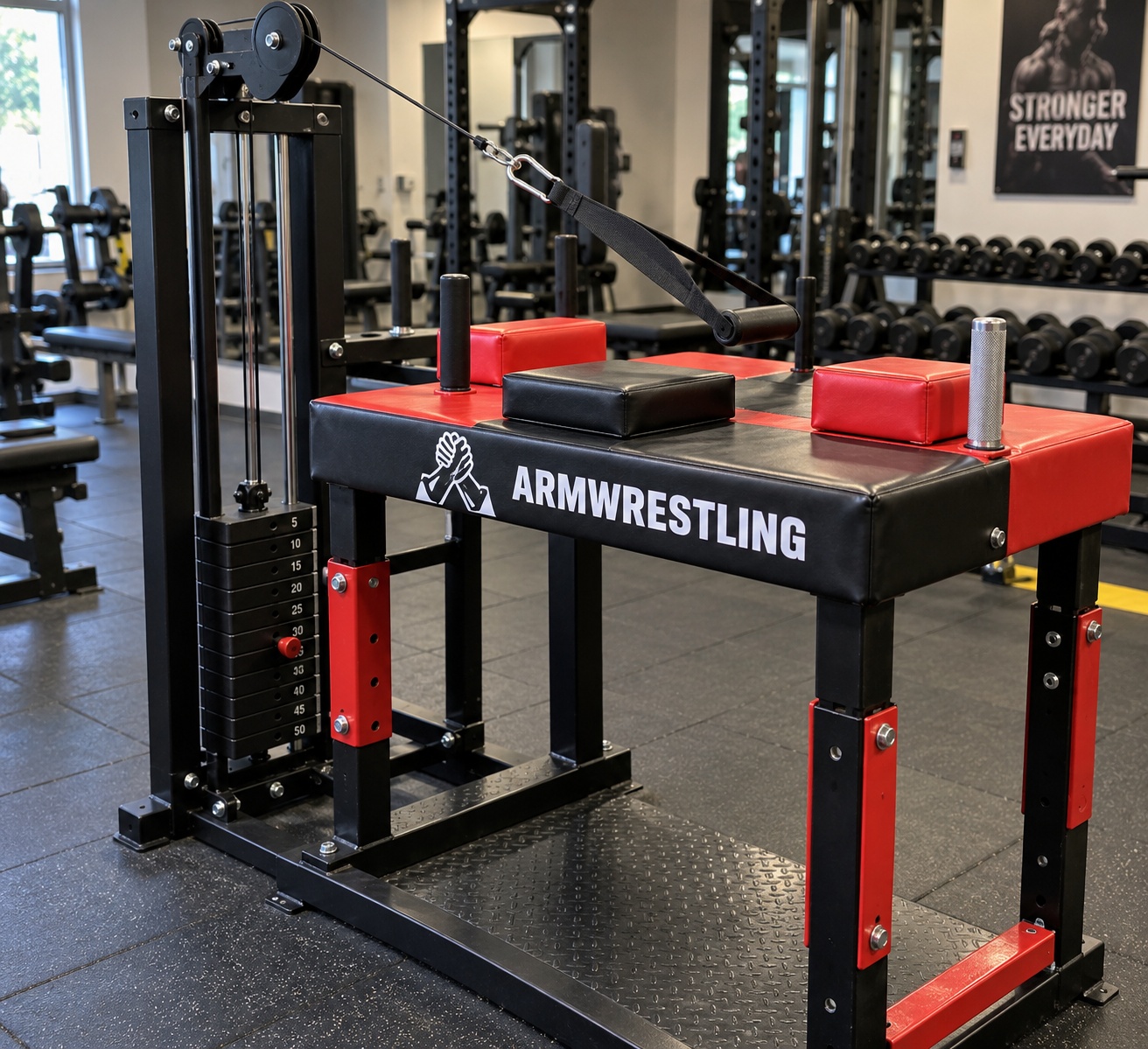
In armwrestling, the choice of the table influences training organization and the type of exercises that can be performed. A standard table is mainly designed for technical work between two athletes, whereas a pulley model integrates a system that also allows specific preparation exercises to be performed without having to use a separate station.
The choice depends not exclusively on the budget, but on the facility's goals, the number of practitioners, space availability, and the planned training program. Understanding the differences between the two configurations makes it possible to plan an investment consistent with real usage needs.
This guide compares standard and pulley armwrestling tables using verifiable technical criteria, offering practical guidance dedicated to gyms, sports associations, and athletes without replacing in-depth reviews of the construction features of individual models.
Is a standard table or a pulley table better?
The choice depends on the intended use. A standard table is generally oriented towards technical work between two athletes, while a pulley table allows you to also integrate specific exercises with a traction system. The decision should be based on the training program, available space, and the overall configuration of the area dedicated to armwrestling.
Before purchasing, it is advisable to check technical datasheets, compatible accessories, and installation methods indicated by the manufacturer.
For any competitions, it is appropriate to refer to the regulations of the relevant federation and the specifications required for competitive activity.
Goal of the choice
The selected model should support the type of training actually carried out in the facility without introducing unnecessary functions.
What aspects to evaluate?
Frequency of use, number of practitioners, available space, and the possibility of integrating other stations represent the main decision-making criteria.
What are the main differences?
The standard table is mainly dedicated to the technical training of the discipline, while the pulley version adds a system that allows preparation exercises to be performed directly on the same station.
The differences therefore concern above all the versatility of the configuration and the type of work that can be organized during the session.
Both solutions require adequate space and correct installation according to the manufacturer's instructions.
Characteristics of the standard table
It is suitable for technical training, match simulations, and work between two athletes according to the configuration provided by the model.
Characteristics of the pulley table
It integrates a traction system that expands training possibilities without requiring a separate station for certain specific drills.
Comparative table
The following table summarizes the main comparison elements.
| Criterion |
Standard table |
Pulley table |
| Main function |
Technical training |
Technical training and work with traction system |
| Versatility |
Oriented towards the practice of the discipline |
Greater integration of exercises |
| Configuration |
More essential |
Includes additional components |
| Required space |
To be evaluated based on the project |
To be verified considering the integrated system as well |
| Destination |
To be defined according to the training program |
To be evaluated based on operational needs |
How to read the comparison
The choice should be based on the activities actually performed and not exclusively on the number of available functions.
Why check the technical documentation?
Product datasheets and manufacturer manuals allow you to compare different configurations using objective criteria.
How to choose the most suitable model?
The decision-making process should start by defining the facility's goals and the planned training program.
Subsequently, it is appropriate to evaluate space availability, the organization of the technical area, and the possibility of integrating other equipment dedicated to athletic preparation.
For a complete configuration of the area, you can also consider a solution of armwrestling equipment compatible with the overall project.
Analyze the training program
The drills planned during the season directly influence the most suitable configuration.
Evaluate available space
The layout of the stations should allow easy movement and paths free from interference.
In which scenarios should you choose one solution or the other?
A facility oriented primarily towards technical training may prefer a standard table when it already has stations dedicated to physical preparation.
A center that wishes to concentrate different activities in the same area can instead evaluate a pulley table if the integrated configuration meets the goals of the training program.
The final choice should always be consistent with the overall layout of the facility and the expected number of users.
Standard table scenario
Suitable when the main focus is technical confrontation between athletes and complementary exercises are performed in dedicated areas.
Pulley table scenario
It can be useful when you want to integrate different modes of work into the same station, reducing movement during the session.
What mistakes should be avoided?
One of the most frequent mistakes consists of choosing the model exclusively based on price without considering the training program and space organization.
It is also advisable to avoid purchasing without a floor plan of the area or without having verified compatibility with other equipment present.
The design of the area should precede the final choice of the table to ensure a truly functional configuration.
Purchasing without a project
An unplanned configuration can limit the use of the station and make training management more complex.
Neglecting accessories
It is important to check from the beginning which components are compatible with the selected model.
Frequently asked questions
Can the pulley table be used in competition?
For official competitions, it is necessary to verify the provisions of the relevant federation and the characteristics required for the event.
Is more space needed for a pulley table?
The necessary space depends on the system configuration and the instructions provided by the manufacturer.
Is it possible to upgrade the configuration later?
The answer depends on the construction features of the model and the solutions provided by the manufacturer.
How to evaluate the investment?
The choice between a standard table and a pulley table should be approached by considering the lifecycle of the equipment, the availability of spare parts, the required maintenance, and the possibility of adapting the area to future facility needs.
To compare different solutions, it is advisable to prepare a technical specification document with the area floor plan, planned configuration, construction features, compatible accessories, and installation methods. In this way, it is possible to evaluate each proposal based on verifiable criteria consistent with the facility's goals.
A correctly planned investment allows you to create an area dedicated to armwrestling capable of supporting technical training, specific preparation, and future structural development while maintaining organization and operational continuity.


 Budgets
 Dumbers
 Discs
 Benches
 Racks and Rigs
 Weights Holders
 Isotonic machines
 Calisthenics
 Cardio
 Kettlebells
 Flooring
 Gym Set
 Accessories
 Combat
 ARTI MARZIALI
 CONTAINER GYM
 Tug-Of-War
 Used Gym Equipment
 PILATES MACCHINARI
 GINNASTICA ARTISTICA
 CAMPI DA PADEL
 Prodotti in Pronta Consegna
 Informazioni
 IRONMAN
 Gift Card