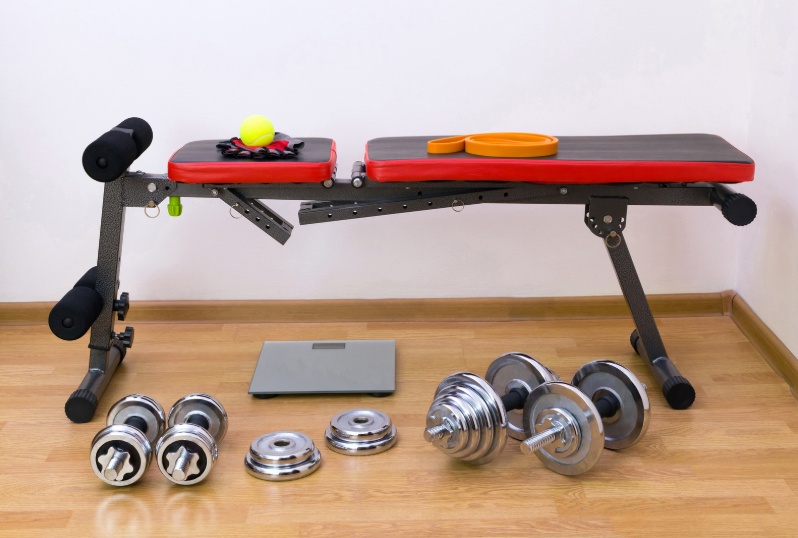
Setting up an effective home gym does not mean filling a room with equipment. The most common problem, especially when you start out with enthusiasm, is confusing the desire to train well with the idea that you need to buy everything right away. This leads to poorly considered spending, equipment that is hard to manage and a frustrating feeling: having a lot of gear around but little clarity about what really matters. A solid foundation, on the other hand, comes from a clear selection that fits the available space, your experience level and the type of training you will be able to maintain over time.
For those building a home gym in an apartment, and even more so in a condo, the real priority is not increasing the number of machines or weights, but creating an organized, sustainable and useful setup. An essential equipment checklist serves exactly this purpose: it helps you separate what allows you to train well from what can wait. When selection is done with judgment, you reduce wasted budget, unnecessary clutter and the risk of abandoning the project after a few months because the space has become confusing and uncomfortable to use.
What really makes a piece of equipment essential in a home gym
A piece of equipment is truly essential when it meets three simple criteria: you use it often, it allows more than one exercise and it concretely improves the quality of your workouts. This point is decisive because many purchases seem sensible only at the beginning, when everything feels motivating and promising. In reality, the difference between a home gym without clutter and a space full of low-value objects lies here: it is not about how much you can buy, but how much will actually fit into your weekly routine. A versatile product is worth far more than a very specific accessory you will use once in a while.
For this reason, when choosing, it is better to think in terms of training coverage rather than the appeal of a single product. If a piece of equipment lets you train several muscle groups, adjust the load over time and stay consistent with your goals, then it deserves a place in your minimum setup. If instead it takes up too much space, serves only a marginal variation or replaces something you can already do with simpler tools, it is probably not a priority. The logic of essentials brings relief because it reduces confusion and gives you back control.
In a home environment, there are also factors that are often underestimated at the time of purchase. The space it occupies, how easily it can be moved or stored, the noise it produces during use and the time needed to set it up all affect workout consistency more than you might think. An excellent piece of equipment on paper can become a practical burden if it gets in the way of movement, makes the room messy or requires a long setup and cleanup before and after each session.
This is especially true for those who live in an apartment. A home gym in a condo requires smart choices, not just technically valid ones. You need compact, manageable equipment that is compatible with real domestic use. The essentials, therefore, are not only what trains you well, but what can fit naturally into your home and your week. When a piece of equipment enters the space without taking it over, and enters your training without complicating it, it is truly doing its job.
The minimum foundation to start with without filling your home
The minimum foundation for a well-planned home gym is short, and that is precisely its strength. For many people, the initial core can consist of dumbbells, a bench if there is enough space, a mat and a set of resistance bands. These items, if chosen wisely, already allow you to cover a very wide range of exercises for upper body, lower body, core and mobility. They do not give the spectacular impression of a heavily equipped room, but they build a concrete, challenging and progressive base.
Dumbbells are among the most effective tools precisely because they remain useful for a long time. They can support both beginners and experienced trainees looking for a flexible solution at home. Resistance bands complete the setup well because they take up very little space, expand the range of possible exercises and help both in warm-ups and in complementary movements. The mat, which is often considered a minor detail, actually helps define a clear, comfortable and organized training area. The bench, when there is enough space to use it properly and store it easily, becomes a multiplier of variety without requiring a complex setup.
Many accessories, on the other hand, can wait without compromising your initial results. The point is not that they are useless in absolute terms, but that they are not necessary in the first phase. Buying specialized products or add-ons too early, which do not address a real need, risks turning a rational choice into an endless list of purchases. When the focus shifts from training to collecting objects, the space loses its clarity and the budget is dispersed.
Starting with a minimum foundation also means leaving yourself room to understand what you truly lack. Only real use reveals whether you need more load, better organization or additional support. Anticipating every possible need is almost always a mistake. In a well-built home gym checklist, the goal is not to complete everything at once, but to set up an essential system that works from day one.
Clear priorities by purchase category
When you reason by category, the selection becomes much simpler. The first priority tier includes equipment that provides direct and frequent training: dumbbells, resistance bands, a mat and, in many cases, a bench. These are the elements that make the difference between an improvised corner and a truly usable base. They have the advantage of covering different needs without forcing you to dedicate too much space to a single function. This is why they represent the core of the essentials-based choice.
The second tier concerns everything that improves order, accessibility and continuity of use. This includes, for example, systems for storing weights properly or defining the training area. A small weight rack or storage solution makes sense when the equipment is already enough to create disorder or when leaving items on the floor makes training less convenient. It is therefore not a purchase to rule out entirely, but not one to place automatically among the first items. It should be introduced when it becomes a real organizational support.
Distinguishing between priorities and accessories helps you avoid confusing two different levels. What makes you train comes before what visually completes the space. This difference may seem obvious, but it is what prevents the most common trap: spending money to make the room look like a gym before you even have equipment that allows you to train well. A tidy environment is important, but order should come from proportionate choices, not from an oversized setup.
In practice, the most useful rule is this: first build training capacity, then improve comfort and organization. This order protects both your budget and your space. It also creates a natural progression, because each later purchase builds on a use that is already established. In this way, your home gym grows in response to real needs rather than as an accumulation driven by the enthusiasm of the moment.
Minimum setups based on level and available space
For an entry-level user who wants to train at home without complicating life, the minimum setup should remain very essential. A pair of dumbbells, a set of resistance bands and a mat are often enough to start wisely. This combination allows you to work on general strength, body control, mobility and light conditioning without taking up much space and without introducing unnecessary variables. It is a solution suited to those who want to build a habit, understand their consistency and set up a clean base.
At this stage, the best choice is the one that eliminates friction. The less time you spend preparing the space, the more likely you are to train regularly. A simple setup also helps you read your needs more clearly: if after a few weeks or months you feel the limit of your loads, you will have a clear signal to make a considered next purchase. If, instead, the equipment you already have still covers your sessions well, you know you have no need to add anything.
For a more advanced profile, such as a condo user who wants a more complete yet still manageable base, it makes sense to include a bench and consider a better organization of the space. Here the goal is not so much to start, but to make an existing training routine more fluid. In this case, a well-designed minimum setup can include dumbbells better suited to progression, resistance bands for variations and assistance, a mat and a bench that allows more exercise angles without becoming a constant obstacle.
Even for more experienced users, however, the criterion does not change: every piece of equipment must justify its presence. In a condo especially, it is best to favor an orderly and quiet structure, with few elements that are truly used. The underlying idea stays the same for all levels: you do not need to expand your equipment to feel more serious, you need to choose well what makes your training more complete, frequent and sustainable within the real context of your home.
How to avoid wasting budget and FOMO-driven purchases
Applying FOMO to fitness easily leads to a specific mistake: buying equipment out of fear of falling behind, not out of a real need. You see complete setups, full rooms and constantly new accessories, and you end up thinking that training well means replicating that model. In reality, the greatest risk is not having too little, but having too much without a logic. When the space fills up with products used rarely, the sense of confusion grows and the quality of future decisions declines.
There are very clear signs of a premature purchase. The first is when you cannot say precisely which part of your routine that piece of equipment will fit into. The second is when you hope the purchase will motivate you on its own, instead of reinforcing a habit that already exists. The third is when the product only marginally replaces what you can already do with the tools you own. In all these cases, it is wise to stop and bring the decision back to a simple question: does this equipment solve a real limitation, or is it just chasing an idea of completeness?
A useful logic for adding equipment without turning the room into a pile of clutter is to proceed based on observed gaps, not theoretical possibilities. First use what you have well, then identify the bottleneck: insufficient load, limited variety, poor organization, difficulty in execution or the need for more comfort. Only then choose the product that addresses exactly that problem. It is a slower method, but much smarter, because it keeps your equipment aligned with your actual use.
In the end, an effective essential equipment checklist for a home gym is not only about deciding what to buy. Above all, it protects the project over time. When the space stays readable, the budget is under control and every piece of equipment has a clear function, training becomes simpler and more consistent. This is exactly the difference between a room full of stuff and a well-designed home gym: in the first, you accumulate; in the second, you build.


 Budgets
 Dumbers
 Discs
 Benches
 Racks and Rigs
 Weights Holders
 Isotonic machines
 Calisthenics
 Cardio
 Kettlebells
 Flooring
 Gym Set
 Accessories
 Combat
 ARTI MARZIALI
 CONTAINER GYM
 Tug-Of-War
 Used Gym Equipment
 PILATES MACCHINARI
 GINNASTICA ARTISTICA
 CAMPI DA PADEL
 Prodotti in Pronta Consegna
 Informazioni
 IRONMAN
 Gift Card