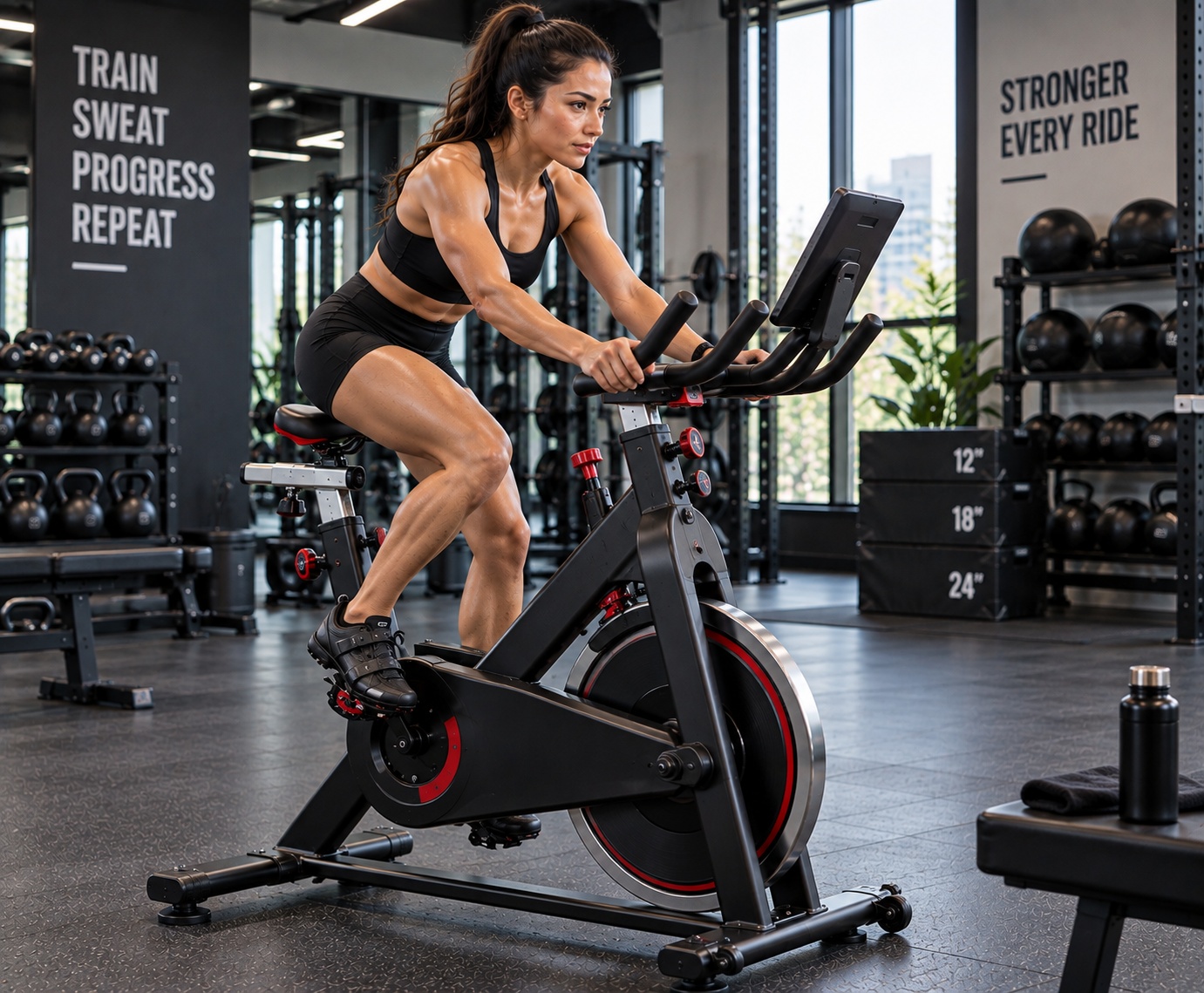
Choosing a professional exercise bike means evaluating much more than just the purchase price. A machine intended for a gym, a fitness center, a hotel, or a sports facility must guarantee reliability, operational continuity, and ease of management even after many years of intensive use.
An informed decision requires the analysis of verifiable technical characteristics such as build quality, weight capacity, adjustments, resistance system, ergonomics, maintenance, and spare parts availability. Considering all these aspects makes it possible to reduce management costs and improve the user experience.
This guide brings together the main decision-making criteria for choosing a professional exercise bike without focusing exclusively on the catalog or commercial features, but instead favoring the elements that truly impact the value of the investment.
How to choose a professional exercise bike?
The choice of a professional exercise bike should start with an analysis of the intended use, the type of users, and the characteristics of the facility. Next, it is necessary to check documented technical data, availability of support, spare parts, maintenance, and build quality.
The most effective criterion is to compare the total cost of ownership instead of just the initial price. A machine designed for intensive use can offer greater operational continuity and reduce unexpected expenses during its lifecycle.
Before purchasing, it is advisable to request technical datasheets, user manuals, warranty conditions, and documentation related to the maintenance programs provided by the manufacturer.
What is the first element to evaluate?
The destination environment represents the starting point because it determines the intensity of use, number of users, and characteristics required of the machine.
What documents should be requested?
Datasheets, manuals, any applicable certifications, and warranty conditions allow for a comparison based on verifiable data.
Which technical specifications really matter?
The truly important features are those that influence the durability, safety, comfort, and simplicity of managing the machine over time.
The weight capacity declared by the manufacturer represents one of the first parameters to check because it indicates the intended range of use. It is equally important to evaluate the sturdiness of the frame, the quality of the adjustments, and the resistance system.
Stability during pedaling, smoothness of movement, and simplicity of saddle and handlebar adjustments also significantly impact the user experience.
Why is weight capacity important?
It allows you to verify that the machine is designed to accommodate the type of users expected by the facility.
How much does ergonomics matter?
An easily adjustable position improves comfort, adaptability, and speed of use for people with different physical characteristics.
What criteria should be used to compare multiple models?
Comparing different professional exercise bikes requires a uniform methodology that takes technical characteristics, economic aspects, and operational management into consideration.
Among the main criteria are build quality, adjustments, availability of spare parts, technical support, maintenance simplicity, and the expected lifespan of wear-and-tear components.
A structured evaluation makes it possible to identify the most consistent solution for the goals of the gym or accommodation facility without being exclusively influenced by the price.
Which resistance system should you choose?
It is advisable to verify that the adopted system is designed to guarantee continuity of operation and a smooth pedaling motion during professional use.
Which adjustments should be checked?
The saddle and handlebars should offer sufficiently wide adjustments to adapt to users of different heights.
How to check compatibility with the facility?
The machine must be compatible with the available space, the cardio room layout, and the expected number of users during peak hours.
It is advisable to evaluate operational dimensions and provide adequate space for use, cleaning, and maintenance interventions.
To design a complete cardio zone, it is possible to integrate the exercise bike with other professional cardio machines by selecting complementary equipment according to the facility's goals.
Why is the layout important?
A rational distribution improves user circulation and facilitates the daily activities of the staff.
What role does flooring play?
A stable and adequate surface contributes to the correct positioning of the machine and protects the floor from wear.
Why are support and maintenance decisive?
A professional exercise bike represents an investment destined to last for many years. For this reason, it is essential to check the availability of technical support and spare parts.
Scheduled maintenance helps keep performance high and reduces the risk of service interruptions.
Before purchasing, it is useful to inquire about the average availability times for wear-and-tear components and the procedures for handling technical interventions.
How to evaluate spare parts?
It is advisable to check the availability of components most subject to replacement and the methods by which they are provided by the manufacturer.
What maintenance should be scheduled?
Interventions should follow the instructions provided in the machine's technical manual and fall within the facility's maintenance plan.
What mistakes are best avoided?
The first mistake is comparing only the initial price while neglecting the total management cost during the machine's lifecycle.
It is also advisable to avoid models with limited adjustments, poorly structured support, or difficult-to-find spare parts.
Another critical issue concerns the failure to analyze the available space and the real needs of the users who will use the equipment daily.
Why isn't the price enough?
The value of the investment also depends on durability, reliability, maintenance, and operational continuity.
Why analyze the type of use?
A machine correctly proportioned to the operational context generally offers more efficient management over time.
What aspects should be compared between different models?
| Criterion |
Why it matters |
| Weight capacity |
Verifies suitability for the intended users |
| Adjustments |
Improve adaptability and ergonomics |
| Resistance system |
Affects pedaling continuity |
| Support |
Reduces machine downtime |
| Spare parts |
Facilitate maintenance over time |
| Dimensions |
Promote efficient room design |
| Accessories |
Contribute to usage comfort |
Is it useful to create a checklist?
A checklist allows you to compare multiple models using the same parameters and makes the decision-making process more objective.
Why compare documentation?
Analyzing technical datasheets and manuals allows you to verify the characteristics declared by the manufacturer before purchasing.
How to make a long-term oriented choice?
The choice of the professional exercise bike should consider reliability, maintenance simplicity, support availability, and design quality in addition to technical characteristics.
An informed investment stems from the analysis of the entire lifecycle of the machine and the verification of the information provided by the manufacturer through technical documentation and official manuals.
Evaluating each element with objective criteria makes it possible to identify a solution consistent with the operational needs of the facility and to reduce the risk of unexpected costs in subsequent years.
How to choose between similar models?
When the main characteristics are comparable, it is useful to compare support, spare parts availability, warranty conditions, and the simplicity of scheduled maintenance.
What is the most reliable method?
Basing the decision on documented technical data, manufacturer manuals, and measurable criteria represents the most effective approach for making an informed choice.


 Budgets
 Dumbers
 Discs
 Benches
 Racks and Rigs
 Weights Holders
 Isotonic machines
 Calisthenics
 Cardio
 Kettlebells
 Flooring
 Gym Set
 Accessories
 Combat
 ARTI MARZIALI
 CONTAINER GYM
 Tug-Of-War
 Used Gym Equipment
 PILATES MACCHINARI
 GINNASTICA ARTISTICA
 CAMPI DA PADEL
 Prodotti in Pronta Consegna
 Informazioni
 IRONMAN
 Gift Card