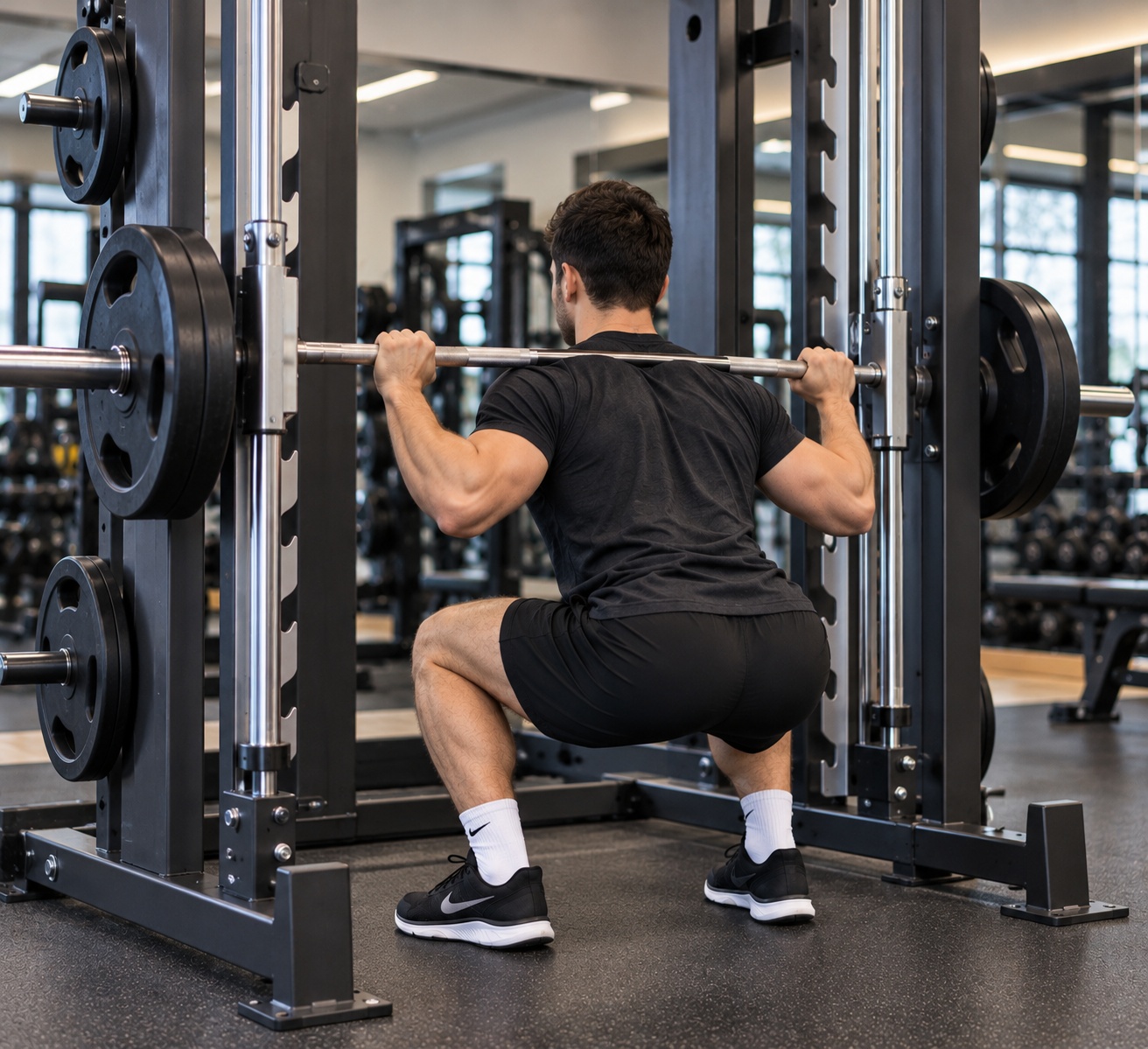
The smith machine is an isotonico machine equipped with a barbell that slides along fixed guides. Its operation is based on a guided trajectory that allows the barbell to move in a controlled manner along the path provided by the manufacturer, generally integrating locking systems and adjustable safety devices.
From an operational standpoint, correct use consists of pre-adjusting the safety stops, checking the sliding of the barbell, and adapting body position to the trajectory of the guides. The goal is not to automatically replicate free barbell movement but to use the machine in compliance with the construction characteristics provided by the manufacturer.
This guide explores the operation of the smith machine through practical and verifiable criteria, illustrating the main checks to perform before training, the most frequent errors, and the aspects to consider for proper use in a gym or home gym.
How does a smith machine work?
The smith machine uses a barbell fixed to a system of vertical or slightly inclined guides that control its trajectory during movement.
The barbell is hooked and unhooked by means of a hook rotation system while adjustable stops allow limiting the travel to increase safety during exercises.
To use the machine correctly, it is necessary to check the correct sliding of the guides, adjust the safety devices, and set the starting position according to the exercise to be performed.
What is the operating principle?
The barbell does not move freely in space but follows the path imposed by the guides, ensuring a constant trajectory throughout the execution.
What are the main components?
The machine includes the frame, guides, guided barbell, locking systems, safety stops, and supports intended for the correct operation of the equipment.
What is a smith machine?
The smith machine belongs to the category of isotonic machines designed to perform exercises with a guided barbell.
Unlike a free barbell, the path of movement is determined by the machine's structure and not exclusively by the user.
This characteristic makes it necessary to adapt the execution technique to the trajectory provided by the guide system.
The role of the guides
The guides ensure controlled sliding of the barbell and contribute to the regularity of movement throughout the travel.
Safety devices
Adjustable stops make it possible to limit the barbell's path and must be set before the start of training.
How does it work during exercises?
During the execution of exercises, the barbell moves exclusively along the trajectory provided by the machine.
To start the movement, the user positions the barbell at the desired height, unhooks it by rotating it according to the intended system, and proceeds with the exercise while maintaining load control.
At the end of the set, the barbell is rotated again until it engages on the designated points or is stopped by the safety stops if necessary.
Guided movement
The trajectory remains constant throughout the execution and depends exclusively on the machine's configuration.
Locking system
The locking mechanism must be checked before each workout to ascertain its correct operation.
How to use the smith machine correctly?
Before starting, it is necessary to adjust the safety stops according to the exercise, check the position of the bench if applicable, and verify that the barbell slides without friction.
During execution, the body must be positioned consistently with the trajectory of the guides, avoiding unnecessary compensations.
Each exercise requires specific adjustment of the equipment and correct load selection.
Before the first set
Check the operation of the hooks, the condition of the guides, the stability of the structure, and the adjustment of the safety devices.
During movement
Maintain control of the barbell throughout the travel, avoiding jerky movements or sudden changes in direction.
What checks should be performed before training?
A preliminary check allows identifying any anomalies before use.
It is necessary to check the condition of the guides, the correct tightening of structural elements, the adjustment of the stops, and the cleanliness of the workout area.
The flooring must also be stable and compatible with the weight of the machine and the loads used.
Operational checklist
1. Check the guides. 2. Check the stops. 3. Check the locking system. 4. Check the tightening of the structure. 5. Test the movement without load.
Environmental control
The surrounding space must allow easy use of the machine without obstacles or interference with other equipment.
What errors should be avoided?
The most frequent error consists of using the smith machine as if it were a completely free barbell.
The guided trajectory actually requires correct initial positioning and appropriate adjustment of the safety devices.
It is also advisable to avoid using the machine if the barbell exhibits anomalous friction, unusual noises, or difficulty sliding.
Starting position
Posture must be adapted to the machine's trajectory and verified before the start of the set.
Safety checks
The stops must be adjusted correctly before use and their operation must be verified with an unloaded test.
What aspects should be evaluated before choosing a smith machine?
For a professional gym, it is important to consider construction quality, fluidity of the guides, availability of spare parts, ease of maintenance, and technical documentation provided by the manufacturer.
A machine designed for intensive use facilitates daily management and contributes to the operational continuity of the facility. To explore the category of isotonic machines, it is useful to compare the technical characteristics of the various configurations available.
The presence of the user manual, maintenance instructions, and information on weight capacity represents an important element in overall evaluation.
Indicators to compare
Frame rigidity, guide quality, simplicity of adjustments, and availability of technical assistance constitute practical criteria for comparison.
Technical documentation
The instructions provided by the manufacturer represent the main reference for installation, use, maintenance, and safety of the machine.
FAQ
Is the smith machine suitable only for beginners?
No. It can be used by users with different levels of experience provided it is used correctly and according to the manufacturer's instructions.
Is it possible to use the smith machine for squats and bench press?
Yes. Both exercises can be performed by correctly adjusting stops, starting position, and the height of the accessories used.
Why does the barbell always follow the same trajectory?
Because it is constrained to the machine's guides, which determine the path of movement throughout the entire execution.
What sources should be consulted to understand how the machine works?
The main sources are the manufacturer's manual, official technical documentation, and any references to applicable standards declared by the manufacturer. The structure of this guide follows an answer-first approach with verifiable criteria, consistent with the brief provided.


 Budgets
 Dumbers
 Discs
 Benches
 Racks and Rigs
 Weights Holders
 Isotonic machines
 Calisthenics
 Cardio
 Kettlebells
 Flooring
 Gym Set
 Accessories
 Combat
 ARTI MARZIALI
 CONTAINER GYM
 Tug-Of-War
 Used Gym Equipment
 PILATES MACCHINARI
 GINNASTICA ARTISTICA
 CAMPI DA PADEL
 Prodotti in Pronta Consegna
 Informazioni
 IRONMAN
 Gift Card