
Trolley
You have no items in your shopping cart

 Budgets
 Dumbers
 Discs
Discs
 Benches
 Racks and Rigs
 Weights Holders
 Isotonic machines
 Calisthenics
 Cardio
 Kettlebells
 Flooring
 Gym Set
 Accessories
 Combat
 ARTI MARZIALI
 CONTAINER GYM
 Tug-Of-War
 Used Gym Equipment
 PILATES MACCHINARI
 GINNASTICA ARTISTICA
 CAMPI DA PADEL
 Prodotti in Pronta Consegna
 Informazioni
 IRONMAN
 Gift Card
- Donatif
- Sports products
- 0 I like it
- 3497 Views
- 0 comments
READING TIME: 5 MINUTES ➤➤
Comparison of the Best Gym Flooring Materials: Which One Should You Really Choose?
Flooring is one of the most underestimated yet fundamental elements in the design and management of a gym. Whether it’s an urban fitness center, a professional weight room, or a multifunctional space, choosing the right flooring material directly impacts safety, performance, and long-term durability. In this article, we will analyze in detail the main materials used – rubber, PVC, resin, and linoleum – comparing their advantages and limitations to help you make informed and long-lasting decisions.
- Why choosing the right flooring is critical in a gym
- Key features of a good flooring material
- Rubber gym flooring
- PVC gym flooring
- Resin gym flooring
- Linoleum gym flooring
- Direct comparison: pros and cons at a glance
- How to choose the right material for your gym
Why choosing the right flooring is critical in a gym
Gym flooring is not just a walking surface: it is an essential component for user safety, equipment protection, and the overall quality of the training experience. A poor choice can lead to structural damage, increased risk of injury, or premature wear of training equipment.
Each type of workout requires specific features in terms of shock absorption, grip, elasticity, and ease of maintenance. For this reason, evaluating materials carefully and in relation to their intended use is a strategic decision that cannot be based solely on aesthetics or initial cost.
Key features of a good flooring material
Before diving into the comparison of specific materials, it is useful to define the criteria for evaluating a gym floor. A quality material must ensure mechanical resistance, meaning the ability to withstand heavy loads and continuous stress without deforming or breaking. It must also provide a non-slip surface, even in the presence of sweat or humidity.
Another key feature is acoustic and vibration insulation, especially in shared or residential environments. Ease of cleaning and compatibility with underfloor heating systems are additional factors to consider during the selection process. Finally, installation and maintenance impact overall costs, so these aspects should also be evaluated.
Rubber gym flooring
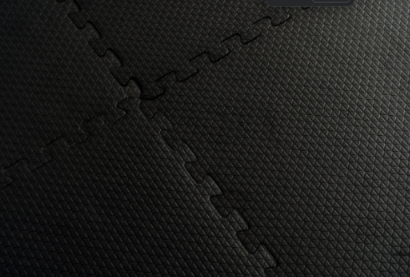
Rubber is one of the most widely used and appreciated solutions in the fitness industry. Commonly used in high-impact areas such as weight rooms or functional training spaces, it offers excellent shock absorption and high resistance to traction and compression.
Rubber flooring is easy to install, available in tiles or rolls, and can be removed or replaced with ease. It is also non-slip and sound-absorbing, making it ideal for environments where noise control is important. On the downside, it may be less visually appealing than other options and may require proper ventilation to avoid persistent odors in the first weeks after installation.
PVC gym flooring
PVC is an increasingly popular choice due to its versatility and ease of maintenance. It offers good wear resistance and can be used in multipurpose areas, from group class rooms to cardio zones. Its main advantage is the availability of numerous designs, including wood or stone effects, making it both functional and visually appealing.
From a technical perspective, PVC floors are elastic, waterproof, and antistatic, with good acoustic insulation. However, in very high-impact environments (e.g., heavy weightlifting), they may not be sufficiently durable and should be combined with more robust materials in specific areas.
Resin gym flooring
Resin flooring is a highly professional solution, often used in newly built gyms or high-end renovations. This material provides a seamless surface with no joints, extremely resistant both mechanically and chemically.
One of its main advantages is the possibility of aesthetic and functional customization: surfaces can be made antibacterial, non-slip, and easy to sanitize. However, resin installation requires specialized labor and can involve higher initial costs. Additionally, its structural rigidity makes it less suitable for high-impact areas unless combined with shock-absorbing sublayers.
Linoleum gym flooring
Linoleum is often considered a “traditional” material, but in recent years it has gained renewed attention thanks to more advanced and sustainable solutions. It is a natural material made from linseed oil, wood flour, and cork, making it inherently eco-friendly and antibacterial.
It offers good wear resistance, is easy to clean, and provides a certain level of elasticity. However, compared to other materials, it may be less suitable for high-load or high-impact areas. It is particularly recommended for fitness classes, yoga, pilates, and educational or rehabilitation environments.
Direct comparison: pros and cons at a glance
In summary, each material presents advantages and trade-offs that must be evaluated based on the specific needs of the gym. Rubber excels in shock absorption but may be less aesthetically pleasing. PVC offers a good balance between design, versatility, and cost. Resin delivers a professional finish but requires a higher initial investment. Linoleum is eco-friendly and practical but has limitations in more demanding environments.
The key is to analyze not only the material itself but also the context of use, frequency, type of training, and available budget. A well-chosen floor not only improves service quality but also reduces maintenance and replacement costs over time.
How to choose the right material for your gym
The optimal choice comes from a thorough analysis of your facility’s actual needs. If you manage a weight room with intensive use and heavy loads, rubber is almost always the first option. For multipurpose and visually appealing spaces, PVC offers an excellent balance between aesthetics and functionality. If you are looking for a long-lasting solution with high hygiene requirements, resin may be the most suitable choice.
Finally, if your target includes low-impact disciplines such as yoga or holistic classes, linoleum combines comfort, sustainability, and solid performance. In any case, evaluating flooring from a design perspective means considering installation, durability, and lifecycle costs. Only then can you ensure your gym has a solid, functional foundation aligned with your brand identity.
Comments (0)