The bulk purchase of used strength machines can represent an interesting opportunity for gym owners, fitness centers, and personal training studios wishing to expand their equipment without necessarily incurring the cost of new equipment. However, purchasing multiple machines simultaneously introduces an often underestimated difficulty: determining whether the conditions observed on a few specimens are truly representative of the entire lot.
When a seller offers ten, fifteen, or twenty strength machines from the same facility, it may seem reasonable to test only a few. If the selected specimens function correctly, one might assume that the others are in similar conditions as well. This conclusion, however, fails to consider the differences in use, maintenance, wear, and repairs that can characterize each piece of equipment.
For a professional buyer, the issue is not only about the immediate operation of the machines, but also the possibility of documenting their conditions, identifying any critical issues, and estimating the necessary interventions before installation. A used strength machines inspection organized by individual unit allows for gathering more reliable information and comparing the actual value of the lot with the requested price.
In this guide, we analyze why sampling cannot automatically replace individual verification, what checks can be carried out without invasive interventions, how to interpret the results, and when to request the support of a qualified technician. The objective is to build an evaluation method applicable to real situations, avoiding both superficial checks and improvised verifications on potentially dangerous components.
Why testing only a sample of the lot is not enough
Sampling consists of selecting some representative equipment and using their results to form an overall judgment on the entire group. This approach can be useful for an initial commercial survey, but it presents important limitations when applied to used strength machines. Unlike new products manufactured according to uniform specifications, second-hand equipment can have very different operational histories even when they belong to the same brand and come from the same gym.
A leg training machine might have been used daily by numerous members, while a machine intended for a less requested muscle group might have accumulated a lower number of work cycles. Frequency of adjustments, cleaning methods, and maintenance interventions also affect actual conditions. For this reason, the good conservation of one specimen does not constitute sufficient proof of the state of the others.
The individual verification of the machines allows instead to distinguish the common characteristics of the lot from the specific conditions of each unit. This does not necessarily mean performing complex tests on every piece of equipment, but adopting a consistent procedure that includes identification, observation, document collection, and evaluation of allowed functional checks.
Differences in wear between seemingly identical machines
Two machines of the same model can present very different conditions. One might have recently replaced padding, still precise adjustments, and well-preserved external components. The other might show abnormal play, deteriorated upholstery, or signs of previous interventions. Even when both appear aesthetically acceptable, these differences can influence the costs required to bring them back to the required operating conditions.
It is therefore useful to record the findings for each unit separately, without automatically attributing the characteristics of the best-preserved specimen to the entire lot. The evaluation must be based on observable evidence and not just on general impression.
When sampling can still be useful
A preliminary sample check can help understand the general quality of the proposal, identify families of machines, and decide whether to pursue the negotiation further. It can also be used to identify recurring criticalities that suggest the need for more extensive specialized verifications.
However, its role must remain preliminary. If the lot includes twelve machines, the positive outcome of three checks does not prove that the other nine are free of defects. The final decision should therefore include a documented evaluation of all units and an explicit management of those that cannot be verified.
How to prepare checks before purchase
An effective evaluation begins before the site inspection. The first step consists of requesting a detailed inventory of the available equipment from the seller, preferably including manufacturer, model, identification number, year of purchase when documentable, and declared conditions. This information allows understanding the composition of the lot and preparing a specific sheet for each machine.
Preparation should also include a request for updated photographs, available manuals, maintenance records, and information on any replaced components. If the seller does not have certain documents, this absence must be recorded without automatically interpreting it as proof of poor maintenance. It still represents an informational limit to consider in the evaluation.
Before the inspection, it is advisable to establish which checks can be performed safely and which require qualified personnel. The availability of a machine does not imply that it is safe to use. If there is obvious damage, missing components, or uncertain operating conditions, the test must be postponed until evaluated by a competent professional.
Creating an inventory with univocal identification
Each piece of equipment should receive a temporary internal code, for example LOT01, LOT02, and LOT03. This code must appear on the control sheet, in photographs, and in any technical observations. The system helps avoid confusion when the lot contains multiple similar specimens.
It is important to distinguish the code attributed by the buyer from the manufacturer's serial number. The latter, when present and legible, can be useful for reconstructing model characteristics, verifying relevant documentation, and requesting specific technical information.
Organizing the site inspection effectively
During the visit, it is preferable to follow a pre-established order rather than concentrating on the most accessible or visually interesting machines. The procedure can start with the identification of the unit, continue with the observation of external conditions, and end with the recording of any authorized functional checks.
A well-organized site inspection also makes it possible to distinguish immediately evaluable machines from those that are disconnected, partially disassembled, stored, or inaccessible. In these cases, it is necessary to clearly indicate that the verification is incomplete, avoiding classifying the equipment as functioning solely on the basis of received declarations.
Visual inspection and structural conditions of the machines
Visual inspection represents the first level of evaluation and allows identifying numerous anomalies without moving the equipment. The used gym machine check should start with observing the frame, metal surfaces, visible connection points, and general preservation conditions. The goal is not to certify the safety of the structure, but to recognize elements that require further investigation.
Signs of corrosion, deformations, apparently altered welds, missing fasteners, or non-original components can constitute indicators of possible problems. Their importance depends on the model, position, and construction characteristics. It is therefore incorrect to formulate a definitive structural diagnosis through simple observation.
Aesthetic state must also be interpreted with care. Recent painting and new padding can improve commercial presentation, but they do not prove that mechanical components have been overhauled. Similarly, minor surface scratches do not necessarily indicate a functional problem. The evaluation must separate cosmetic aspects from those potentially relevant for use.
Frame, corrosion, and visible connections
During external observation, it is useful to check for obvious deformations, missing parts, signs of significant impacts, and differences from the configuration documented by the manufacturer. Hard-to-reach areas must not be explored through makeshift disassembly, especially when components under tension may be present.
Any suspicious anomaly should be photographed and associated with the machine's sheet. If it concerns structural elements or essential connections, the equipment must be considered unverified from a safety perspective until the intervention of a qualified technician.
Upholstery, coverings, and contact surfaces
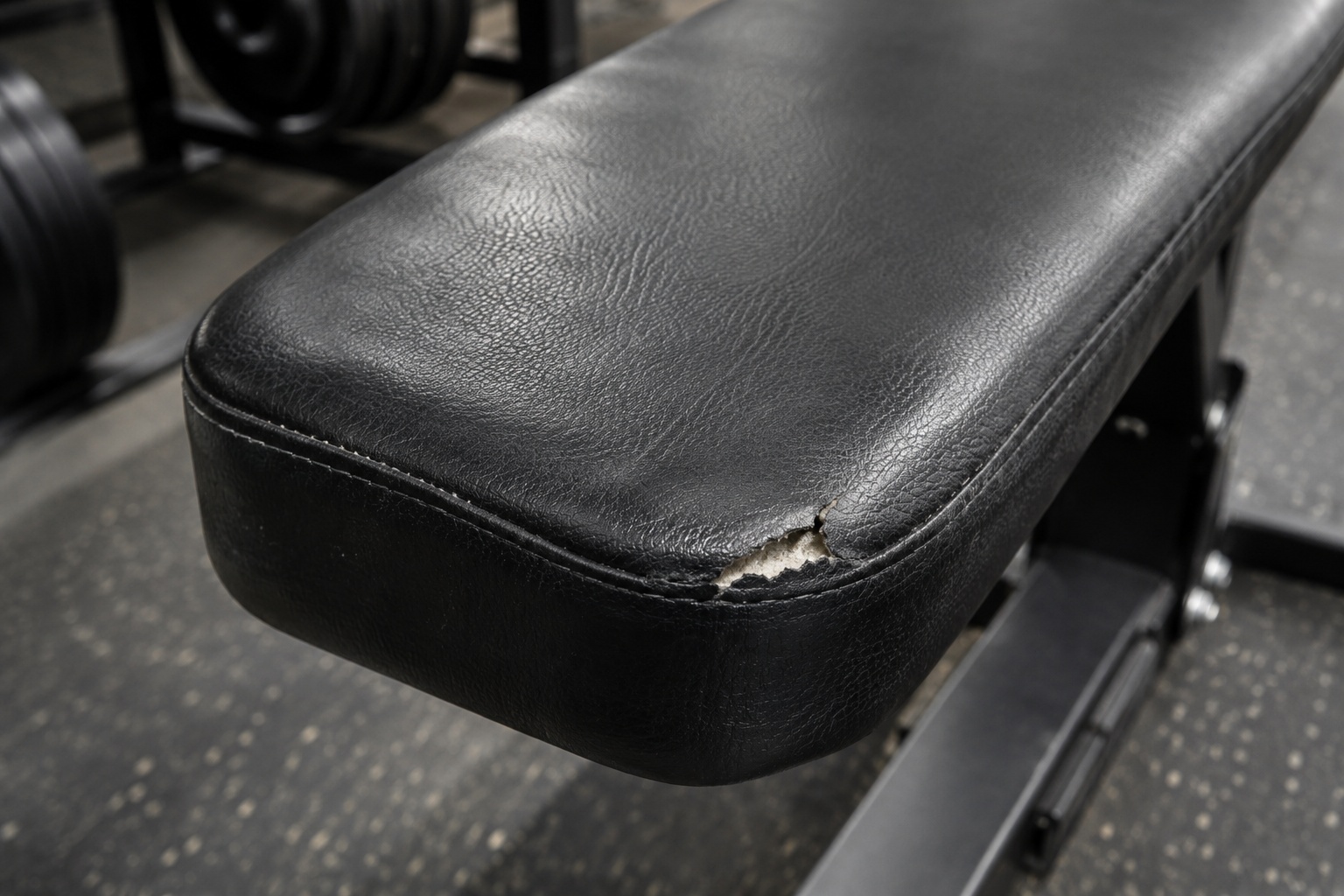
Upholstery affects comfort, hygiene, and the perception of quality by members. Torn coverings, deformed foams, and unstable supports may require replacement before putting back into service. It is useful to check if spare parts are identifiable and available for the specific model.
Replacing aesthetic parts can represent a relatively simple intervention in some cases, but the total cost depends on the number of components involved and the availability of compatible materials. For this reason, even seemingly minor anomalies should be recorded in the restoration estimate.
Functional check of components and adjustments
The gym equipment functional test allows gathering information on the operational behavior of a machine, but must be performed only when preliminary conditions and manufacturer instructions allow it. It is not appropriate to use equipment that shows suspicious damage, missing protections, deteriorated cables, or unstable components. In these situations, the priority is to request a qualified inspection.
When a machine has been preliminarily judged suitable for verification by competent personnel, observation can focus on the regularity of movements, the correct response of adjustments, and the possible presence of noise or abnormal behavior. The results must be referred to the specific conditions of the test, without turning them into a general guarantee of future reliability.
Strength machines include different configurations, including weight stack systems, plate loaded machines, and equipment with articulated kinematics. A uniform procedure must therefore provide common registration criteria, but technical checks adapted to the model and manufacturer's instructions.
Cables, pulleys, and sliding systems
In models equipped with weight stacks, cables and pulleys are particularly important components. During external inspection, it is possible to detect visible signs of deterioration, damaged coverings, or configurations seemingly inconsistent with documentation. However, components under tension should not be manipulated or interventions made on connections to independently verify their resistance.
Any irregular movement may depend on different causes, including wear, misalignment, or insufficient maintenance. Identifying the cause and defining the necessary interventions must be entrusted to qualified personnel, especially when the problem affects elements that support or transmit the load.
Seats, backs, and adjustment systems
Adjustments make it possible to adapt the machine to the anthropometric characteristics of users. For a professional gym, it is important that the systems provided by the manufacturer are present, intact, and usable according to documented methods. Anomalies may concern missing knobs, deteriorated selectors, or mechanisms that do not maintain position correctly.
A seemingly functioning adjustment must not be automatically considered safe under load. When doubts arise about the locking or stability of a component, testing must be suspended and a specialist check requested before authorizing use by members.
Documentation, maintenance, and traceability
The physical conditions of a machine represent only a part of the information necessary to evaluate its purchase. Manuals, identifiers, maintenance records, and sales documents help reconstruct the history of the equipment and understand what checks have been carried out over time. Complete documentation does not eliminate the risk of defects, but allows for more informed evaluations.
It is important to request information on the main interventions carried out, distinguishing routine maintenance from extraordinary repairs. Replacing padding has a different meaning compared to an intervention on a load transmission system. Both can be legitimate, but must be considered in relation to the quality of the intervention and available documentation.
For a professional buyer, it is also useful to verify that the seller can provide clear information on the origin of the equipment and the contractual conditions of the transfer. Any declarations relating to overhaul, refurbishment, or warranty should be defined in writing, specifying which units they refer to and what services they include.
Manufacturer manuals and model identification
The manual relevant to the model constitutes a fundamental reference for knowing the configuration, intended use, maintenance, and safety instructions. When not available, it may be appropriate to request it from the manufacturer or an authorized contact, using the identification data present on the machine.
One must not assume that the instructions of a similar model are automatically applicable. Differences between versions, production years, and installed components may make specific checks necessary before planning checks or interventions.
Intervention history and seller declarations
A useful maintenance history should make it possible to identify the machine concerned, the date of the intervention, the nature of the activity carried out, and, when relevant, the responsible subject. Generic statements that all machines have been overhauled do not offer the same level of information as records referring to individual units.
If the seller does not have a complete history, the buyer can request an independent technical evaluation and consider the uncertainty in the economic negotiation. The absence of documentation does not necessarily prove a defect, but limits the possibility of reconstructing past conditions.
How to compare individual machines in the lot
Once information is collected, the main problem becomes comparing different units without losing important details. A standardized sheet allows distinguishing observations, available documents, checks performed, and criticalities still to be investigated. Comparison should be built on explicit criteria, avoiding evaluations based solely on aesthetic impressions or unmotivated synthetic judgments.
For each machine, it is possible to record the state of identification, external conditions, presence of documentation, outcome of authorized verifications, and interventions possibly suggested by a technician. It is particularly important to distinguish a passed verification from an unperformed verification. The absence of observed anomalies is not equivalent to the absence of hidden problems.
Comparison can also be used to evaluate the commercial utility of the equipment. A machine in good condition but poorly consistent with the gym's services might have a lower operational value compared to a more requested model that requires documented and sustainable interventions. The decision must therefore integrate technical conditions and facility objectives.
Classifying findings without creating false certainties
A practical classification can distinguish machines with completed checks and no detected anomalies, those requiring further investigation, and those not evaluable in present conditions. This subdivision describes the state of the evaluation, and does not automatically certify safety or suitability for professional use.
Anomalies involving critical components must be reported separately from aesthetic imperfections. Worn upholstery and a possible structural problem cannot be treated as equivalent defects simply because both appear on the checklist.
Operational example: a lot of twelve machines
Imagine that a fitness center is evaluating twelve strength machines from a gym undergoing renovation. During an initial visit, four pieces of equipment are observed, all seemingly well preserved. The seller proposes to conclude the purchase claiming that the entire lot presents similar conditions.
Subsequent individual verification might highlight, for example, seven machines with no external anomalies detected, three with a need for further investigation on adjustments, and two lacking sufficient documentation to complete the evaluation. This is an illustrative scenario, not an expected statistical distribution. Its value consists in showing how different results can emerge within the same lot and modify negotiation.
Limits of autonomous checks and technical intervention
A visual and documentary checklist can improve the quality of commercial evaluation, but does not replace qualified technical verification. Some defects are not recognizable from the outside, while others require specific skills, tools, and procedures. It is therefore necessary to distinguish what the gym owner can observe from what must be ascertained by a professional.
This distinction is particularly important when the equipment has load-bearing components, transmission systems, structural elements, or adjustment mechanisms. An improvised test can expose people to unnecessary risks and produce unreliable results. The buyer's objective must not be to independently demonstrate that every machine is safe, but to gather sufficient information to decide which specialized verifications to request.
Technical support can also be useful for estimating the cost of interventions and evaluating the availability of spare parts. A seemingly limited problem can become economically significant if it requires hard-to-find components or specialized work. Conversely, some aesthetic imperfections can be managed with scheduled interventions, as long as they do not compromise the intended use.
When to suspend a verification
The presence of visibly damaged cables, suspicious deformations, missing fasteners, unstable components, or absent protections must lead to interrupting any operational test not yet authorized. Even abnormal noises or unexpected behaviors observed during checks conducted by competent personnel require further investigation.
It is not advisable to attempt corrective adjustments, disassembly, or repairs to quickly complete the negotiation. Operations must be planned according to applicable instructions and entrusted to subjects with adequate skills.
The value of an independent technical inspection
A qualified technician can help define the extent of necessary checks, interpret anomalies, and prepare an estimate of interventions. Their evaluation should specify which machines were examined, which procedures were applied, and what limitations remain.
For the buyer, a report referring to individual units is generally more useful than a generic judgment on the entire lot. In fact, it allows connecting any costs, acceptance conditions, and contractual requests to the equipment actually concerned.
Operational checklist for lot evaluation
A repeatable procedure helps reduce omissions during complex site inspections. The checklist should be sufficiently detailed to document findings, but also simple to use when numerous pieces of equipment are present. It is preferable to fill out a sheet for each machine rather than using a single form with generic evaluations.
The first group of information concerns identification and origin. It is necessary to note internal code, manufacturer, model, available identification number, machine position, and documents received. The second group concerns observable conditions, including surfaces, coverings, visible components, and any anomalies. The third includes the outcome of authorized technical checks and issues still open.
Each significant observation should be accompanied by a photograph or documentary reference. Sheets must also report the date of the visit and the subject who performed the check. This makes it possible to distinguish information collected directly from seller declarations and evaluations formulated subsequently.
Essential fields of the individual sheet
An effective sheet can include identification, available documentation, aesthetic conditions, visible anomalies, checks performed, unperformed checks, need for technical deepening, and cost estimation when supported by a quote. It is also useful to provide a space dedicated to the seller's declarations, keeping them separate from verified findings.
The distinction between positive outcome, anomaly, and unperformed check avoids one of the most common errors in used evaluations: interpreting an empty box as the absence of problems. Missing information must remain clearly identifiable until the analysis is completed.
How to use the checklist in negotiation
Once sheets are completed, the buyer can prepare a summary of acceptable units according to established criteria, those requiring interventions, and those for which essential information is missing. The summary allows discussing the price based on specific elements rather than general impressions.
The checklist can also become an attachment to purchase documentation, when agreed between parties. In this way, detected conditions and any commitments by the seller are more easily identifiable even after the transfer of equipment.
How to turn checks into an investment decision
The economic value of a lot does not necessarily coincide with the sum of prices requested for individual machines. To evaluate the convenience of the operation, one must also consider transport, handling, installation, any technical checks, spare parts, and interventions necessary before use. An initially interesting proposal can lose part of its advantage if it includes numerous unverifiable equipment or those in need of costly restorations.
A useful method consists in calculating the total expected cost for each machine, separately allocating the purchase price and documentable additional expenses. Uncertain amounts should be treated as variables to be investigated, not as automatically zero costs. This setup allows comparing the bulk purchase with different alternatives, including selecting a smaller number of machines in better documented conditions.
When the goal is to renovate a weight room, it can be useful to compare the proposed lot with opportunities available in the sector of used and refurbished gym equipment. Comparison should concern actually available models, declared conditions, any documented interventions, and included services, without presuming that all offers present the same characteristics or guarantees.
Evaluating total acquisition cost
Suppose a lot of ten machines is offered at 8,000 euros. If transport and installation require 1,200 euros, budgeted interventions amount to 1,500 euros, and specialist checks cost 500 euros, the total estimated cost reaches 11,200 euros. These are purely illustrative amounts, useful for showing why the initial price is not the only decision-making parameter.
If some machines are unusable or require further interventions, the average cost of actually available equipment may increase. For this reason, it is advisable to compare different scenarios, including the possibility of excluding certain units from negotiation.
Defining verifiable purchase conditions
Before formalizing the operation, it is useful to agree on which equipment is included in the lot, which documents will be delivered, which interventions are eventually borne by the seller, and how machines failing agreed checks will be managed. Conditions should be described with sufficient precision to avoid different interpretations after payment.
For a gym owner, the most sustainable choice is not necessarily the one with the lowest unit price, but the one offering an adequate ratio between total cost, documented conditions, machine utility, and residual risks. Investing in gathering evidence before purchase allows negotiating with greater awareness, scheduling necessary interventions, and allocating budget to equipment truly consistent with facility needs.


 Budgets
 Dumbers
 Discs
 Benches
 Racks and Rigs
 Weights Holders
 Isotonic machines
 Calisthenics
 Cardio
 Kettlebells
 Flooring
 Gym Set
 Accessories
 Combat
 ARTI MARZIALI
 CONTAINER GYM
 Tug-Of-War
 Used Gym Equipment
 PILATES MACCHINARI
 GINNASTICA ARTISTICA
 CAMPI DA PADEL
 Prodotti in Pronta Consegna
 Informazioni
 IRONMAN
 Gift Card